Honey Nut Cake (plakous)
from The Classical Cookbook by Andrew Dalby and Sally Grainger
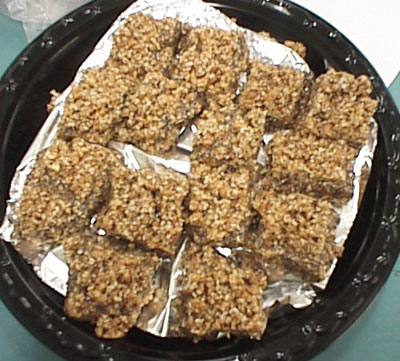
This recipe by Chrysippus of Tyana (4th century BC), is an example of a cake eaten in ancient Greece. The ancient Greeks called cake πλακοῦς (plakous), which was derived from the word for "flat", πλακόεις (plakoeis). Though Chrysippus says this recipe is from Crete, where they called it "gastris." Such sweet cakes would have been used as offerings in temples, as well as at ordinary meals.
Even today they make a very similar sweet in Greece called "pasteli."
"In Crete they make a little cake which they call gastris. This is how it is done: sweet almonds, hazelnuts, bitter almonds, poppy seeds: roast them, watching them carefully, and pound well in a clean mortar. After mixing the nuts knead with boiled honey, adding plenty of pepper. It turns black because of the poppy. Flatten out into a square. Now pound some white sesame, work with boiled honey, and stretch two lagana*, one below and the other above, so that the black is in the middle, and divide into shapes." -- Chrysippus of Tyana, quoted by ATHENAEUS 647f
"in Crete they make a kind of cheesecake which they call gastris. And it is made thus:—Take some Thasian and Pontic nuts and some almonds, and also a poppy. Roast this last with great care, and then take the seed and pound it in a clean mortar; then, adding the fruits which I have mentioned above, beat them up with boiled honey, putting in plenty of pepper, and make the whole into a soft mass, (but it will be of a black colour because of the [Pg 1036] poppy;) flatten it and make it into a square shape; then, having pounded some white sesame, soften that too with boiled honey, and draw it out into two cakes, placing one beneath and the other above, so as to have the black surface in the middle, and make it into a neat shape." These are the recipes of that clever writer on confectionary, Chrysippus. -- Chrysippus of Tyana, quoted by ATHENAEUS 647f
*Aristophanes, a poet of the 5th century BC, mentioned the phrase “laganas stéte”, meaning “laganas are made” in his work “l’eccliaste”, while the roman hero Horatius referred to this bread as “the sweetness of the poor”. Linguistically, the word lagana comes from the Greco-Roman words “lagana”, “laganum” or “laganon” (in ancient Greek: λάγανον), also known as “tracta” or “tractum” (in ancient Greek τρακτὸς, τρακτόν). This term used to refer to a sheet of dough or a thin pancake in the ancient Greek and Roman times. There is a modern Greek leavened flatbread called lagana, but it is not clear when the name was first applied to a leavened bread.
This recipe uses sesame seeds to make a top and bottom layer for this sweet, then fills it with a nut and pepper honey mixture.
1 cup (4 oz) blanched almonds
1 cup (4 oz) blanched hazlenuts
1 tbl. bitter almonds or peach pits
2 tbl. poppy seeds
1 tsp. freshly ground pepper
4 tbl. clear honey
1 1/2 cups (6 oz) toasted sesame seeds
3 tbl. clear honey
Olive oil
Heat the oven to 350°. Mix the nuts and poppy seeds together and roast them until they start to color.
Grind the sesame seeds to a fine powder. Put 3 tablespoons of the honey in a small pan and bring to the boil. Lower heat and simmer gently for 7 minutes (keep your eye on it!). Remove from the heat and add the ground sesame seeds and mix well. Allow it to cool enough to handle and pour out onto an oiled table or marble slab. Grease your hands and knead until it's firm but still warm. Divide it into two equal portions and set one aside to keep warm. Roll out the the other piece with an oiled rolling pin to line the bottom of a greased, shallow square baking tray or pan.
Put all of the roasted nuts into a food processor with the pepper and process to a fine texture. Bring the remaining 4 tablespoons of honey to the boil and simmer for 7 minutes, as above. Add the nut mixture and stir well. While it's still hot, spread this evenly over the sesame layer. Roll out the second piece of sesame/honey paste and place over the nuts.
Leave to set for an hour, then cut into lozenge shapes (diamonds, such as Baklava is cut). Be sure not to leave it longer than an hour, or it will become too hard to cut. Serve with fruit.
Makes about 15
Note: Bitter almonds are obtainable from Chinese supermarkets. In small amounts they add an unusual tang to the recipe. You can find Greek mountain thyme honey in health-food stores and sometimes in supermarkets. Known as thymeli, it has a wonderful flavour and (though fairly expensive) adds a special touch to the sweet.
Another recipe that leaves the sesame seed whole:
Same ingredients.
Preheat the oven at 350 F. Mix all the nuts except the sesame seeds and bake them for a few minutes in the oven. Do the same for the sesame seeds and then let them cool down. In a small pot let 3 tablespoons of honey simmer for about 7 minutes, add the sesame seeds, mix well. Let it cool enough so that you can handle it, pour it on an oily surface and knead into a ball. Separate it into 2 pieces, roll 1 piece out with a rolling pin into a thin sheet that will fit in a shallow pan. Place the sheet on the bottom of the pan. Put all the nuts with the pepper in a blender or mixer and mix well for about 1 to 2 minutes. Boil the rest of the honey for 7 minutes and then add all the nuts and mix well. While it is still hot pour the nut and honey mixture in the pan on top of the sesame layer. Spread evenly. Roll the other piece of sesame seed dough into a sheet and cover the nut mixture. Let it cool off for 1 hour and then cut it small pieces.
