Mesopotamian Menus
by John Lawton
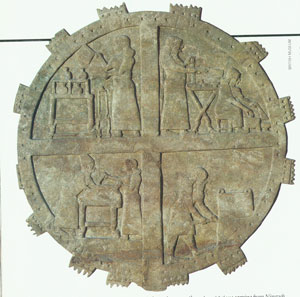
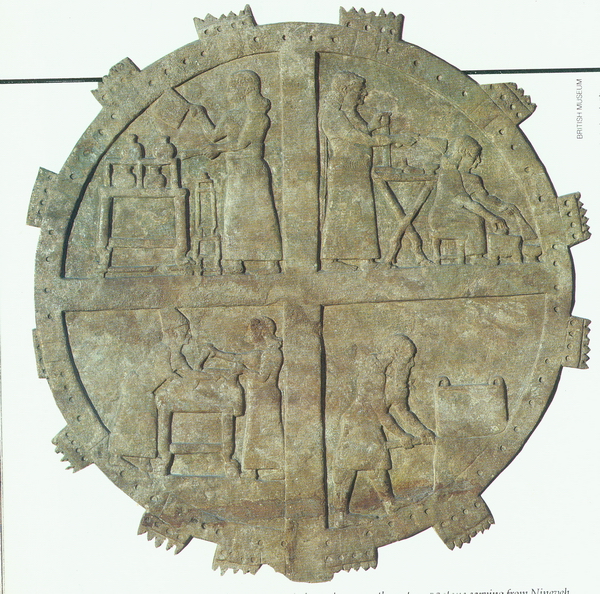
Cooks at work in the royal kitchens. Relief from
Ashurbanipal's palace at Nineveh 7th century BC.
Cooks at work in the royal kitchens. Relief from
Ashurbanipal's palace at Nineveh 7th century BC.
"Carefully lay out the fowls on a platter; spread over them the chopped pieces of gizzard and pluck, as well as the small sêpêtu breads which have been baked in the oven; sprinkle the whole with sauce, cover with the prepared crust and send to the table."
Pie à la Paris, 2011? No! Baking à la Babylon, 1700 BC.
This 3,700-year-old recipe is for a meat pie baked in an unleavened crust. Stirred into the dough were various condiments and aromatic ingredients that enhanced the taste. The pie's filling was composed of small fowls - we don't know whether they were wild or domestic fowl, land-, water-or seabirds - cooked in a spicy sauce with their own gizzards and pluck, or livers, hearts and lungs. The result must have been a little like giblet gravy. And when the dish was served, it was garnished with small flat bread loaves that were also specially flavored - not too different from the bread stuffing we eat with fowl.
A dish like that, though not necessarily to everyone's taste today, was certainly no mere mess of pottage. Indeed, according to ancient art and texts, the Mesopotamians had a large and gastronomically advanced menu. The land between the Tigris and Euphrates Rivers was apparently the birthplace of haute cuisine as well as a cradle of civilization.
One text that has come down to us is a Sumerian-Akkadian bilingual dictionary, recorded in cuneiform script on 24 stone tablets about 1900 BC. It lists terms in the two ancient Mesopotamian languages for over 800 different items of food and drink. Included are 20 different kinds of cheese, over 100 varieties of soup and 300 types of bread - each with different ingredients, filling, shape or size.
Other archaeological evidence suggests that a complete shopping list of available Mesopotamian foodstuffs would be at least twice as long: A stone bas-relief discovered at Nineveh, for example, shows servants carrying choice delicacies - among them grasshoppers en brochette - to the royal table, while a satirical text about meat-filled intestine casings indicates that the Mesopotamians made, and presumably ate, the world's first known sausage.
Records of deliveries to the royal kitchens at Ur include suckling pigs, wood-pigeons, ducks, lambs and geese. Other texts list many kinds of fresh- and saltwater fish, the preferred kinds being those raised in the reservoirs which were part of Mesopotamia's intricate irrigation system.
Mesopotamia was much more fertile in ancient times than it is today. Chickpeas and lentils - still important crops in today's Syria, Iraq and Jordan - head on Sumerian listing of foods that grew there. But the cornerstone of the Mesopotamian diet appears to have been the onion by far - including leeks, shallots and garlic. Sumerians also ate lettuce and cucumber and apples, pears, grapes, figs, pistachios and pomegranates were widely grown.
The Sumerians also used a wide range of spices and herbs, including coriander cumin and watercress, says Belgian scholar Henri Limet. That indicates, he says that at least the upper classes enjoyed cuisine that was not only varied in its ingredients but also refined in its preparation.
Nonetheless, the actual dishes the Mesopotamian peoples ate, and how they cooked them, remained a mystery until recently. Although Sumerian lexicographical lists and economic records indicate that a wide range of foodstuffs was consumed, not a single recipe existed from this early Mesopotamia period. Indeed, the earliest cookbook we knew about - and it is more of a menu reference list than a step-by-step guide - is De Re Coquinaria, a Roman work probably compiled in the fourth century, a good 20 centuries after the Mesopotamian kingdoms flourished. Lacking information, scholars had depicted the peoples of ancient Mesopotamia as consumers of nothing more interesting than sorry mushes.
The Tablets
That was the case until eminent French Assyriologist Jean Bottéro, himself an accomplished chef, succeeded in deciphering three cracked, caramel-colored clay tablets written in Akkadian around 1700 BC. Though his predecessors had thought they contained pharmaceutical formulas, the tablets in fact recorded the world's oldest extant recipes, revealing a varied Mesopotamian cuisine of striking richness, sophistication and artistry.
The hand-size tablets include recipes for spicy meat and vegetable stews of gazelle, kid, pigeon, partridge and turnip, as well as for pies and garnishes that suggest, says Bottéro, "so much refinement in dealing with matters of the palate" that we must now accept that the Mesopotamians had a "scientifically-based, learned cuisine."
Tablet Containing Stews
The best preserved of the tablets measures a little more than 12 by 16 centimeters (4 ¾ by 6 ½ in.), and features 21 meat-based and four vegetable-based stews, identified very much as dishes are today by their main ingredient ("stew of stag"), their appearance ("glistening" or "crumbly") or their place of origin: An "Assyrian stew" comes from the northern part of the country, while an "Elamite stew" is borrowed from neighbors in what is now the southwestern corner of Iran.
Telegraphic and concise, these recipes are not for the culinary amateur. Often just a few lines long, they summarize essential steps and ingredients, laconically ignoring quantities and cooking times, which their users were apparently expected to know from experience. A far cry from the cookbooks of today, they were not meant to guide the housewife, Bottéro believes, but mainly to standardize and even ritualize cooking procedures. In 1700 BC, after all, writing - and therefore also reading - was a professional rather than a general skill.
Other Two Tablets
The two other tablets, however, are much more detailed and scrupulous in describing the various cooking operations. Unfortunately, they are full of breaks and illegible portions; few of the recipes are complete. They include mainly bird dishes, but also deal in detail with various cereal and vegetable side dishes.
Preparation of these meals was complex, calling in different recipes for operations like mixing, sprinkling, slicing, squeezing, pounding, steeping, shredding, crumbling, straining and marinating. Along with the number of steps involved, this complexity implies the availability of a wide selection of kitchen implements and ample culinary installations - both features more likely to be found in a temple or palace than in a private household.
Heat for cooking was provided primarily by an oven - although grilled and roasted meat were also common. Bread and pastry were baked in the oven and pots were placed over the oven's opening to bring liquids to the boil. Two vessels were invented, or refined, by the Mesopotamians to allow cooking in a liquid medium: the metal cauldron, for quick, pre-cooking steps such as browning, and a closed clay pot for simmering.
"All these details," says Bottéro, writing in a recent issue of The Journal of the American Oriental Society, "show how far the Babylonians had developed the art of cooking, clearly to satisfy refined and gastronomical concerns." The Mesopotamians, for example, prepared a fermented sauce, which they called siqqu, from fish, shellfish and grasshoppers for both kitchen and table use. They also had knowledge of the lactic fermentation needed to make cream cheese. In their cooking, spices abound. No recipe contains fewer than three condiments, some contain as many as 10 - all added with care and combined into a blend of often complementary flavors.
Bottéro spent several years studying the three recipe tablets, which are part of Yale University's 40,000-piece Babylonian Collection, the largest assemblage of Mesopotamian antiquities in the United States. Acquired by Yale in 1933, baked in a kiln to preserve them in 1942, and copied by hand onto paper in 1952, the tablets had not received much attention until recently. Now they are among the collection's most talked-about pieces; just looking at them reported the New Haven Register imaginatively, "you almost can smell a 4,000-year old leg of lamb bubbling in a sauce thick with mysterious Mesopotamian herbs."
An Assyriologist-chef, Bottéro believes that the Mesopotamians' concept of good food was not only worlds away from ours in time, but also in taste. They liked their food soaked in fats and oils, seemed obsessed with every member of the onion family and may have used much less salt than we do today.
Bottéro says that truly recreating the Mesopotamian dishes is practically impossible because of the difficulty in matching the original ingredients precisely, and because of the tantalizing shorthand in which the recipes were written. But Bottéro is convinced that the Mesopotamians - and not only Mesopotamia royalty - enjoyed them. "It is my opinion," he wrote in the The Journal of the American Oriental Society, "that in any given culture, imagination and refinement, whether culinary or otherwise, are by themselves easily contagious. We might imagine, therefore, that even small households must have introduced some experimentation into their everyday eating, within the limits of their economic' capabilities. "In other words, I do not believe that the cuisine of even the most modest of [Mesopotamian] households is necessarily reflected in the sorry mushes and doleful mastications to which we Asyriologists have consigned them so sadistically."
Ancient Mesopotamian Cooking
Five thousand years ago record keepers in the early civilization of Mesopotamia invented cuneiform writing on clay tablets. In the hands of modern scholars, half a million of these tablets have revealed the lives, customs, literature, arts, technology, folklore, military history, political life, mythology, and religion for thousands of years of this civilization.
Among the half-million tablets, many record foodstuffs, but only three so far seem to have recorded actual recipes. Cuneiform expert Jean Bottero in The Oldest Cuisine in the World: Cooking in Mesopotamia (Chicago, 2004) shares his wealth of knowledge from decoding the recipes on the three tablets, from interpreting many other cuneiform tablets, and from archeology digs. Along with details from the recipe tablets, he describes the dining habits, feasts, and cooking apparatus of ancient Babylonia.
Bottero says that no one will ever reconstruct "from such a distance in time and space, the authentic flavor and quality of the scores of ingredients that were used in these culinary creations. We can never recover the taste ... of this rich and appetizing cuisine, whose refinement and brilliance we can only imagine." (p. 125)
And yet... he gives us a vivid picture of banquets, kitchens, and the content of the clay stew pots from nearly 4000 years ago.
So what did an ancient Mesopotamian eat for dinner? The three recipe tablets concentrate on cooking of meat and vegetable stews. Some describe how to serve meat in pastry: "you take the platter prepared with a lining of crust, and you place the cooked birds on it carefully ... You cover the serving dish with its pastry 'cover' and bring it to the table." (p. 72)
Most recipes start with a combination of fat and water, used to begin braising venison, kid, gazelle, lamb, mutton, or small birds. Some recipes specify particular organs (such as gizzard, spleen, or intestines). Some say to cut the meat in small pieces. Some also call for kisimmu -- a type of cheese. Cooks used prepared cakes of pounded seeds or crumbs of baked bread or cake to thicken the sauces.
Many herbs and vegetables in these stews are startlingly familiar -- garlic, leeks, onions, cumin, and coriander. An onion-like plant called samidu, an herb called dodder (now considered a weed), and some unidentifiable herbs also appear in the recipes. Crushed or mashed vegetables appear to have flavored and thickened the stew -- not at all strange to a modern cook. Cooking might be a multi-stage process, starting with boiling the meat, then cleaning it (I guess an analog to washing the scum off of the veal bones in a modern stock), then cooking with more ingredients, and finally "before the broth cools ... you rub the meat with garlic, add greens and vinegar. The broth may be eaten at a later time." (p. 72). To accompany the stews, diners at feasts or official meals ate green salads with vinegar and various sorts of leavened and unleavened bread or cakes.
Cooking took place on an all-purpose hearth over an open fire or on grills, skewers, or racks. This reminds me of my Webber grill, but the author warns me not to think this way. Bread and other food might be cooked directly in the ashes: poets praised the smoky taste. Some recipes also mention an indirect type of cooking stove. (p. 46-47) More fascinating are descriptions of banquets for thousands of inhabitants of a city, where large numbers of whole animals were slaughtered and needed preparation. A modern home cook can't begin to imagine the techniques for such an event.
"Let us not forget that our recipes belong to a refined cuisine, for guests of a certain social caliber, and that we know nothing about the routine of ordinary meals without fanfare among simple folk," writes Bottero (p. 73). His description of these ancient foods, kitchens, and events are indeed fascinating.
