Ancient Mesopotamia Timeline
from https://www.ducksters.com/
Ancient Mesopotamia is called the cradle of civilization. The first cities and empires formed here. As you will see from the timeline, power changed hands many times throughout the ancient history of this area. It went from the Sumerians to the Akkadians to the Babylonians to the Assyrians back to the Babylonians back to the Assyrians and finally to the Persians.
Natufians
Natufian culture, Mesolithic culture of Palestine and southern Syria dating from about 9000 BC. They practiced semi-sedentism and proto-agriculture. They foraged wild cereals and hunted gazelles but did not cultivate crops or domesticate animals.
Mainly hunters, the Natufians (who lived approximately 15,000–11,500 years ago) supplemented their diet by gathering wild grain; they likely did not cultivate it. They had sickles of flint blades set in straight bone handles for harvesting grain and stone mortars and pestles for grinding it. Their sickle blades suggest intensive harvesting of wild plants. While not full-fledged farmers, their lifestyle set the stage for the Neolithic Revolution (~10,000 BCE) and the transition to agriculture. Some groups lived in caves, others occupied incipient villages. Unlike earlier groups, they built permanent stone dwellings and stored surplus grain, showing early steps toward farming.
The Natufians were a mainly African population that had migrated into and settled in Southwest Anatolia, Syria, Lebanon, Jordan, Israel, Palestine, and the Upper Euphrates (northern Iraq). Specifically, The Natufians were primarily an African-descended population, carrying East African and North African paternal and maternal lineages, alongside contributions from local Levantine hunter-gatherers. They were neither European nor Asian, as these geographic constructs did not exist at the time—in fact, the idea of “Europe” and “Asia” as separate entities only emerged with the Ionian Greeks in the 6th century BCE.
The Natufians appear to be an "out-of-Africa" population. They are an early biblical population in that their area included parts of Western Egypt (Fayoum Oasis), Mount Carmel, Jericho and Bethlehem, Jordan, Syria, and Lebanon between 15,000 and 7,500 years ago.
At Ain Mallaha (in Northern Israel), a separate team found parthenocarpic figs from Africa to the southeastern corner of the Fertile Crescent, c. 10,000 BC [6], and shellfish from the Nile valley implying either long distance exchange or long distance trade; while Anatolian obsidian and malachite of unknown origin was also found. Malachite, a copper carbonate mineral used since antiquity, was sourced across Afro-Eurasia. In Africa, major deposits were found in the Democratic Republic of Congo, Sinai Peninsula, and Nubia. The Timna Valley in southern Israel also supplied malachite to ancient Egyptians. In Europe, notable sources included Cyprus (especially for Roman use), Serbia, and the Ural Mountains in Russia. In Asia, Iran’s Anarak region and parts of Central Asia provided malachite, often linked to early metallurgy and decorative use. The Sinai peninsula and Nubia are the closest land-route sources of supplying malachite to epipaleolithic Israel.
[Most probably they became the people who created the Neolithic cultures in the Levant, and specifically the Yarmukian culture.]
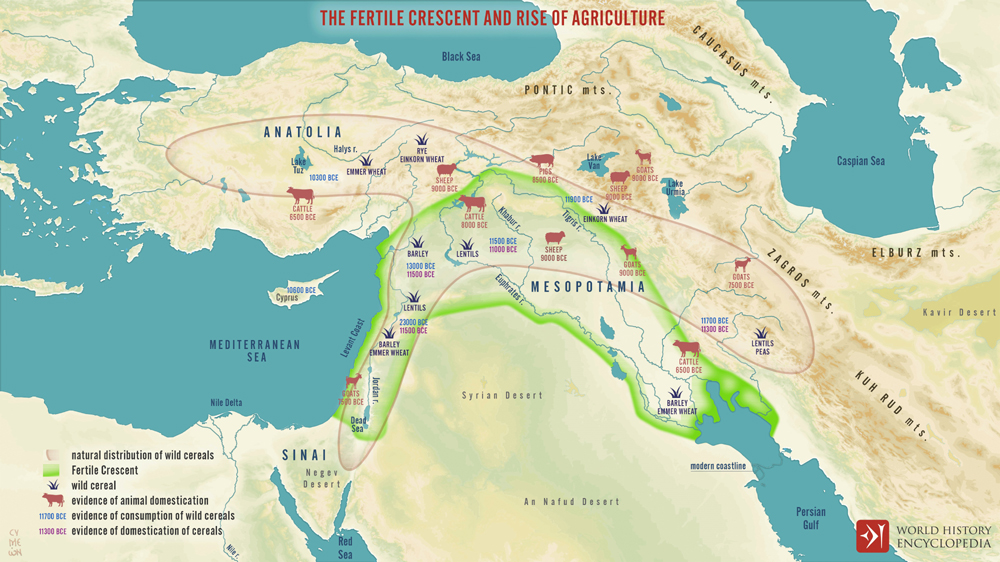
Archaeologically, the Fertile Crescent has a very deep history. Agriculture first appeared here around 11,000 years ago, and the people responsible have all been part of a network of shared traditions in an era we we refer to as the Pre-Pottery Neolithic (PPN). Even before the domestication of plants and animals, many of these cultures were already quite complex as hunter-foragers, a lifestyle that can support a population surplus and artisans if the landscape is managed correctly. Their predecessors, the Natufians, had managed to do just that. Pre-Pottery Neolithic A (PPNA) peoples built Göbekli Tepe, the famous megalithic complex with fascinating carvings and alignments. Its hypothesized use has ranged from strictly a temple complex, to the structures being inhabited yet spiritually important, and a few other archaeological interpretations
Ubaid Period
The archeological period previous to Sumer in lower Mesopotamia is the Ubaid Period (6,000–4,000 BC), which was preceded by the Samarra archeological culture, and both originated in northern Mesopotamia and gradually spread downstream as land became more arable due to the implementation of irrigation systems. Whether or not the Sumerians were a part of this archeological culture is unclear (if they weren’t, they certainly inherited its material culture). The development of complex urban centers during the Ubaid period is generally seen as the confluence of multiple cultures into the area, and unfortunately determining their precise makeup is fraught with difficulty.
Prior to roughly 5500 BC, much of southern Mesopotamia was covered in salt marshes and low-lying alluvial plains (which were frequently inundated), which made long-term intensive agriculture difficult. Only when the climate began to aridify and techniques for draining marshland were developed did the region begin to see rapid growth. The Ubaid Period encapsulates much of these early developments and was the pivotal era of transition toward the development of major urban centers (which we see reach their pinnacle during and after the Uruk Period).
At the dawn of agriculture, the PPN-B (Pre-Pottery Neolithic B) period saw the rise of increasingly large settlements. In 9600 BC, PPNB peoples founded Jericho, which is now the oldest continuously inhabited city in the world, although it may not have been considered a “city” until the Bronze Age. Speaking of cities, the other famous Neolithic Turkish site is Çatalhöyük. By 7,000 BC, it reached a population of 10,000; at the time, the largest gathering of humans in one place anywhere in the world.
Sumeria
Cylinder Seals & Envelopes (7600-6000 BCE)
Prior to the development of writing, people used small seals to authenticate agreements, created with a personal design signifying their identity and occupation, known as cylinder seals and stamp seals. The cylinder seal originated either in Sumer or the region now known as Syria, circa 7600-6000 BCE. They were made from semiprecious stone (such as amethyst, lapis lazuli, marble, and obsidian, among others) and worn around one's neck, wrist, or attached to one's clothing.
The cylinder seal was pressed into damp clay, leaving an impression that served as one's signature in legal proceedings or business agreements. After writing was invented, the cylinder seal or stamp seal was used to sign correspondence and legitimize contracts. Once long-distance correspondence became more commonplace, clay envelopes were invented to contain a message. The envelope would be stamped on the outside with one's cylinder seal, which was only to be cracked open by the intended recipient. Cylinder seals became so closely associated with their owners that their loss was comparable to identity theft in the present day, as anyone who found a seal could use it as they pleased.
5000 BC - The Sumerians form the first towns and cities. They use irrigation to farm large areas of land.
Cities first began to appear in the region during the Uruk period, with Uruk as the first walled urban center rising in 4500 BCE (giving the period its name). During the earlier Ubaid period (circa 6500-4000 BCE), the people had already moved from the hunter-gatherer phase to permanent agrarian settlements and built homes and other buildings from sun-dried, handmade brick. During the Uruk period, these villages became more densely populated, expanded, and became the world's first cities.
The rise of the cities created different definitions of the populace, as city-dwellers identified themselves with their city, whereas formerly they had associated themselves with a tribe. Those who lived outside of cities still maintained their tribal identities, further classifying people as urban or rural citizens. Since scribes usually lived in cities, they favored city-dwellers over those beyond the walls in their works, and so city life came to be associated with culture and civilization, while farmers or shepherds were considered lower class and uncultivated.
4000 BC - The Sumerians establish powerful city-states building large ziggurats at the center of their cities as temples to their gods.
The ziggurat was a temple to the main god of the city. Each city in Mesopotamia had a primary god. For example, Murdock was the god of Babylon, Enki was the god of Eridu, and Ishtar was the goddess of Nineveh. The ziggurat showed that the city was dedicated to that god. At the top of the ziggurat was a shrine to the god. The priests would perform sacrifices and other rituals here. They built them high because they wanted the shrine to be as close to the heavens as possible.
3500 BC - Much of lower Mesopotamia is inhabited by numerous Sumer city-states such as Ur, Uruk, Eridu, Kish, Lagash, and Nippur.
The wheel was invented circa 3500 BCE for the production of ceramics – the first potter's wheel – and only later came to be used for transportation. Although the oldest wheel found thus far – the Ljubljana Marshes Wheel – comes from Central Europe, the concept of the wheel is believed to have originated in Mesopotamia earlier.
The potter's wheel allowed for mass-produced ceramics, which provided the lower classes with affordable items such as jars and bowls. Previously, these items were handmade, and although anyone could – and did – fashion usable bowls and jugs from clay which was then sun-dried, they were inferior to those made by actual craftspeople. Mass-produced ceramics also supplied the military and labor force with containers for rations that could be easily carried and, if broken, quickly replaced. Craftspeople were usually attached to temples or palaces, which provided them with the raw materials for their art. Although produced en masse, these ceramics were often ornamented and decorated with painted figures, shapes, or designs.
Sumerian artisans learned how to make glass about 3500 BC.
3300 BC - The Sumerians invent the first writing. They use pictures for words and inscribe them on clay tablets. Also see Cuneiform, an introduction
The Sumerians developed the first form of writing. As Sumerian towns grew into cities, the people needed a way to keep track of business transactions, ownership rights, and government records. Around 3300 BC the Sumerians began to use picture symbols marked into clay tablets to keep their records. Scribes would take a stylus (a stick made from a reed) and press the lines and symbols into soft, moist clay. Once they were done, they would let the clay harden and they had a permanent record.
The initial writing of the Sumerians utilized simple pictures or pictograms. For example, a drawing of a person's head, meant the word "head". Over time, however, the writing of the Sumerians further developed to include sounds and meanings. Scribes would use the stylus to make wedge shaped marks in the clay. This type of writing is called cuneiform writing, which means "wedge-shaped".
Translating Mesopotamian writing is difficult for archeologists today. This is because there were over 700 different symbols and the symbols' meaning and shapes could change between different cities and regions. The symbols often changed over time as well. However, many Sumerian tablets have been deciphered. This is how we know so much about Mesopotamian culture, government, and history.
While most of the tablets discovered have been government and financial records, some of the writings are literature. This literature includes mythology of the Mesopotamian gods, tales of their heroes, poetry, and songs. Some of the writings include sayings of wisdom. The most famous and epic of all the Mesopotamian literature is the story Gilgamesh. People signed items with personal seals made of stone, metal, or wood.
As far as archeologists can tell, the Sumerian language is not related to any other language on Earth.
3200 BC - The Sumerians begin to use the wheel on vehicles.
It is likely the Sumer first used the wheel in making pottery in 3500BC and then used it for their chariots in around 3200 BC. The wheels of these vehicles were made of two half-discs of solid wood nailed together and covered with tires of leather. By circa 3200 BCE, the first chariots were made for the nobility and wealthy as forms of personal transportation, and these were later developed by the Akkadians and Assyrians for the military.
3100 BC - Mass-Produced Bricks
Mass-produced bricks were developed during the Uruk period, circa 3100 BCE. Prior to this time, each brick was made by hand and then either fired in a kiln or sun-dried. Making bricks, especially for monumental structures such as ziggurats (another Mesopotamian invention), was extremely labor-intensive, and this encouraged the development of brick molds into which a single worker could pack clay to make ten bricks, or more, at a time instead of only one. The clay was tempered with sand, straw, or chaff for durability and then either sun-dried or fired. This process allowed for building projects to proceed much more quickly and so encouraged the further development and expansion of cities.
3000 BC - The Sumerians start to implement mathematics using a number system with the base 60.
By circa 3000 BCE, the Sumerians were using two-wheeled and four-wheeled carts and wagons to transport people and goods.
Humans couldn't have mastered complex and abstract math without figuring out how to count first, and evidence suggests our species was counting tens of thousands of years ago. From 3000 BC the Mesopotamian states of Sumer, Akkad and Assyria, followed closely by Ancient Egypt and the Levantine state of Ebla began using arithmetic, algebra and geometry for taxation, commerce, trade, and in astronomy, to record time and formulate calendars. The earliest mathematical texts available are from Mesopotamia and Egypt – Plimpton 322 (Babylonian c. 2000 – 1900 BC), the Rhind Mathematical Papyrus (Egyptian c. 1800 BC) and the Moscow Mathematical Papyrus (Egyptian c. 1890 BC). All these texts mention the so-called Pythagorean triples, so, by inference, the Pythagorean theorem seems to be the most ancient and widespread mathematical development, after basic arithmetic and geometry.
An understanding of mathematical principles and applications was a requirement for scribal training in the early Uruk period, and, by the Early Dynastic period, geometry was used regularly in measuring out and dividing tracts of land as well as the creation of irrigation canals. Scholar Gwendolyn Leick explains, "this was done by measuring the sides of areas rather than angles, and fields with an irregular outline, for instance, were divided up into simple rectilinear parts, which were then added up". Trigonometry never developed, as Leick notes, but the so-called Pythagorean Theorem was in use millennia before Pythagoras lived.
At some point, after the invention of mathematics, and usually dated to circa 3000 BCE, the Sumerians also created the concept of time. Using the sexagesimal system, they divided a day into 12 hours of light and 12 of darkness and then further divided these into 60-minute hours and 60-second minutes. Prior to this, it would appear, people worked from the time the day dawned until the sun set, but afterward, a limit of time could be placed on a workday, and one's day and night could be organized according to a system independent of sunrise or sunset. People could tell the time using sundials and water clocks, giving them greater control over their lives and a better means of organizing work, leisure, and religious observances.
2700 BC - The famous Sumerian King Gilgamesh rules the city-state of Ur.
2400 BC - The Sumerian language is replaced by the Akkadian language as the primary spoken language in Mesopotamia.
Akkadia - First Empire
2330 BC - Sargon I of the Akkadians conquers most of the Sumerian city states and creates the world's first empire, the Akkadian Empire.
2250 BC - King Naram-Sin of the Akkadians expands the empire to its largest state. He will rule for 50 years.
2100 BC - After the Akkadian Empire crumbles, the Sumerians once again gain power. The city of Ur is rebuilt.
2000 BC - The Elamites capture Ur.
Babylonia
1900 BC - The Assyrians rise to power in northern Mesopotamia.
1792 BC - Hammurabi becomes king of Babylon. He establishes the Code of Hammurabi and Babylon soon takes over much of Mesopotamia.
1781 BC - King Shamshi-Adad of the Assyrians dies. The First Assyrian Empire is soon taken over by the Babylonians.
1750 BC - Hammurabi dies and the First Babylonian Empire begins to fall apart.
1595 BC - The Kassites take the city of Babylon.
Assyria
1360 BC - The Assyrians once again rise in power.
1250 BC - The Assyrians begin to use iron weapons and chariots.
1225 BC - The Assyrians capture Babylon.
1115 BC - The Second Assyrian Empire reaches its peak under the rule of King Tiglath-Piliser I.
1077 BC - Tiglath-Piliser dies and the Assyrian Empire becomes weaker for a time.
744 BC - The Assyrian Empire becomes strong once again under the rule of Tiglath-Piliser III.
721 BC - King Sargon II takes control of Assyria. The empire grows stronger.
709 BC - Sargon II takes control of the city of Babylon.
705 BC - Sargon II dies and Sennacherib becomes king. He moves the capital to Nineveh.
668 BC - Ashurbanipal becomes the last great King of Assyria. He establishes a great library in the city of Nineveh.
626 BC - Ashurbanipal dies and Assyria begins to crumble.
Neo-Babylonia
616 BC - Nabopolassar takes control of Babylon back from the Assyrians and crowns himself king. The neo-Babylonian empire begins.
604 BC - Nabopolassar dies and Nebuchadnezzar II becomes King of Babylon. He will rule for 43 years and bring the Babylonian Empire to its peak.
Persia
550 BC - Cyrus the Great rises to power and the Persian Empire begins.
539 BC - Cyrus the Great takes the city of Babylon and lets the Jewish people return to Israel.
522 BC - Darius I becomes King of Persia. He expands the empire and divides it up into states each ruled by a governor called a satrap.
518 BC - Darius I establishes the capital of the Persian Empire at Persepolis.
490 BC - Darius I attacks the Greeks. He is defeated at the Battle of Marathon.
480 BC - Xerxes I tries to conquer the Greeks with a huge army. He is eventually turned back in defeat.
Alexander the Great - Ancient Greek kingdom of Macedon
333 BC - Alexander the Great invades the land and conquers the Persian Empire.
