Artifacts from Ur
Known today as Tell el-Muqayyar, the city of Ur was occupied from around 5,000 BC to 300 BC and was once the capital of an empire stretching across southern Mesopotamia. In all probability, Ur is the “Ur of the Chaldees” mentioned in the Bible as the birthplace of the patriarch Abraham (Gen. 12: 4-5). Much of what we know of the people and cultures of early Mesopotamia comes from the material uncovered in the Royal Cemetery at Ur. Inhabited from about 5500 BCE, Ur was finally abandoned around 400 BCE because of difficulties with its water supply. In between, Ur was a politically and economically powerful center on the Euphrates, particularly during the 3rd millennium BCE, with easy access to the Persian Gulf and long-distance sea trade. Woolley dug on a scale unimaginable today, initially focusing on Ur’s public buildings, such as the iconic stepped temple tower, or ziggurat. In the late 1920s, he turned his attention to the Royal Cemetery, which contained 2,000 simple burials dating from 2600 to 2100 BCE and 16 royal tombs more closely dated to about 2500 BCE. The latter yielded the most spectacular finds of gold, silver, and semi-precious stones, as well as the remains of court attendants who were interred at the same time as the kings and queens. This “human sacrifice” shocked audiences worldwide.
The Standard of Ur
Housed at the British Museum
From Ur, southern Iraq, about 2600-2400 BC
This object was found in one of the largest graves in the Royal Cemetery at Ur, lying in the corner of a chamber above the right shoulder of a man. Its original function is not yet understood. Leonard Woolley, the excavator at Ur, imagined that it was carried on a pole as a standard, hence its common name. Another theory suggests that it formed the soundbox of a musical instrument. The “Standard of Ur” is a small trapezoidal box (8.5 Inches high by 19.5 Inches long) whose two sides and end panels are covered with figurative and geometric mosaics made of pieces of shell, lapis lazuli, and red limestone set into bitumen.
When found, the original wooden frame for the mosaic of shell, red limestone and lapis lazuli had decayed, and the two main panels had been crushed together by the weight of the soil. The bitumen acting as glue had disintegrated and the end panels were broken. As a result, the present restoration is only a best guess as to how it originally appeared.
The mosaics on the Standard depict life in early Mesopotamia. The two sides, dubbed the "War Side" and the "Peace Side," tell a story read from bottom to top. The top register on each side depicts a king, who is larger in scale than the other figures. The Standard shows the two most important roles of an early Mesopotamian ruler: the warrior who protected the people and secured access to water and natural resources and the leader who served as an intermediary between the people and the gods.
The Standard of Ur in War
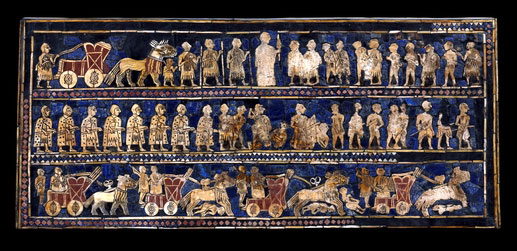
'War' shows one of the earliest representations of a Sumerian army. Chariots, each pulled by four donkeys, trample enemies; infantry with cloaks carry spears; enemy soldiers are killed with axes, others are paraded naked and presented to the king who holds a spear.
The Standard's War side shows the defeat of some unknown enemy. At the bottom, war carts, drawn by onagers (donkeys), race with increasing speed from left to right, trampling naked enemy soldiers. The second register shows a phalanx of armed soldiers to the left, while on the right soldiers in a variety of poses dispatch some captives and lead others away. The top register shows the ruler, his height exceeding the border of the field, facing right. Behind him, his cart is drawn by four onagers alongside his attendants. In front of him, soldiers parade nude and bound prisoners.
Detail of the Standard of Ur in WarBy the 3rd millennium BCE, southern Mesopotamia was organized into 20-30 city-states, consisting of urban centers, towns, villages, and hamlets. Each city-state had its principle guardian deity. Ur's patron was Nanna, the moon god. Officially, the city-state was the deity's property. These deities chose and nurtured the city-state's ruler, whose title varied from place to place. Lugal, literally, "big man," was one title. For their part, city-state rulers acted on the deity's behalf, even on the battlefield. Though sources provide evidence of peaceful cooperation among city-states, they equally record conflicts, both local disputes and more wide-ranging conquests. A long simmering dispute over the border between Lagash and Umma and involving access to water is the best documented interstate conflict. The Standard of Ur and other royal monuments provide graphic illustrations of these battles and their aftermaths.
The Standard of Ur in Peace
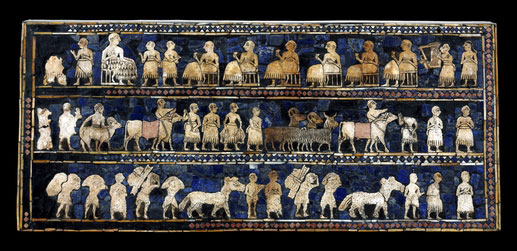
The 'Peace' panel depicts animals, fish and other goods brought in procession to a banquet. Seated figures, wearing woollen fleeces or fringed skirts, drink to the accompaniment of a musician playing a lyre. Banquet scenes such as this are common on cylinder seals of the period, such as on the seal of the 'Queen' Pu-abi, also in the British Museum.
The Standard's Peace side has a completely different theme from the War side. Its two lower registers illustrate the bounty of the land. The bottom one depicts men carrying produce in bags on their shoulders and in backpacks supported by headbands, as well as men leading onagers by ropes. The second register shows men leading bulls and caprids (sheep and goats) and carrying fish, presumably the produce of the pastures, rivers, and swamps. The upper register depicts a royal banquet. The ruler, wearing a kilt composed of tufts of wool, is shown larger in scale than the others—the center of attention. The other banqueters, who wear plain-fringed kilts, face him and raise their cups together while attendants provide food and drink. Banqueting in early Mesopotamia usually involved music. A lyre player and a singer, distinguished by their long black hair, stand to the right of the scene.
Detail of the Standard of Ur in PeaceIn addition to being a warrior, the city-state's ruler was an intermediary between the gods and the people. One of his major responsibilities was to build and maintain the temples of the city's gods and goddesses, a responsibility that included provisioning their cults. In doing so he guaranteed the fertility of the land, which the Standard's Peace side so vividly illustrates.
The Royal Game of Ur
From Ur, southern Iraq, about 2600-2400 BC
One of the most popular games of the ancient world
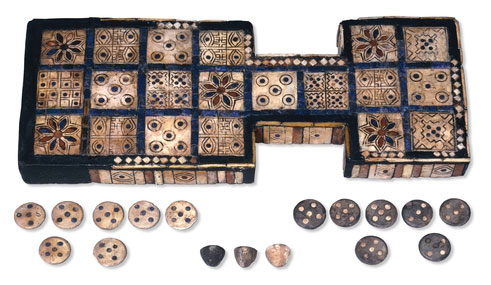
This game board is one of several with a similar layout found by Leonard Woolley in the Royal Cemetery at Ur. The wood had decayed but the inlay of shell, red limestone and lapis lazuli survived in position so that the original shape could be restored. The board has twenty squares made of shell: Five squares each have flower rosettes, 'eyes', and circled dots. The remaining five squares have various designs of five dots. According to references in ancient documents, two players competed to race their pieces from one end of the board to another. Pieces were allowed on to the board at the beginning only with specific throws of the dice. We also know that rosette spaces were lucky.
The gaming pieces for this particular board do not survive. However, some sets of gaming pieces of inlaid shale and shell were excavated at Ur with their boards. The boards appear to have been hollow with the pieces stored inside. Dice, either stick dice or tetrahedral in shape, were also found.
Examples of this 'Game of Twenty Squares' date from about 3000 BC to the first millennium AD and are found widely from the eastern Mediterranean and Egypt to India. A version of the Mesopotamian game survived within the Jewish community at Cochin, South India until modern times.
