Babylonian Lexical Lists of Food and Drinks
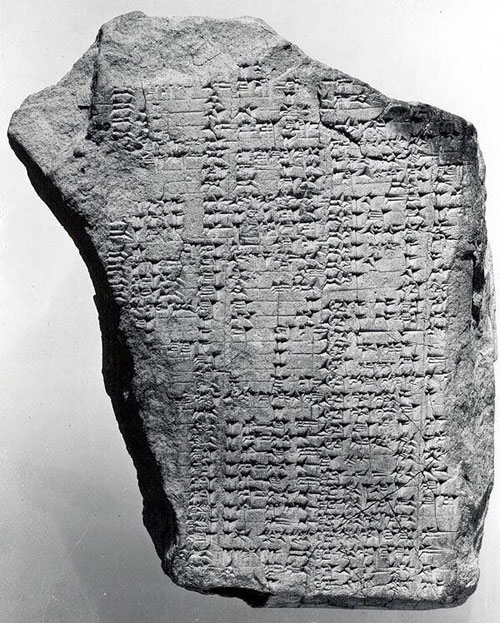
Urra=hubullu Table 23
The Urra=hubullu (ur5-ra — ḫu-bul-lu4) is a major Babylonian glossary or "encyclopedia". It consists of Sumerian and Akkadian lexical lists ordered by topic. The canonical version extends to 24 tablets. The conventional title is the first gloss, ur5-ra and ḫubullu meaning "interest-bearing debt" in Sumerian and Akkadian, respectively. One bilingual version from Ugarit [RS2.(23)+] is Sumerian/Hurrian rather than Sumerian/Akkadian. A partial table of contents: * Tablet 4: naval vehicles * Tablet 5: terrestrial vehicles * Tablets 13 to 15: systematic enumeration of the names of domestic animals, terrestrial animals, and birds (including bats) * Tablet 16: stones * Tablet 17: plants. * Tablet 22: star names The bulk of the collection was compiled in the Old Babylonian period (early 2nd millennium BC), with pre-canonical forerunner documents extending into the later 3rd millennium.
Clay tablet 23, partially broken, is divided into three columns which read from left to right. The tablet records food and drink terms, first in the long-dead Sumerian language, and then in Akkadian translation. This text is known to be the twenty-third tablet in a series of tablets that collected and codified knowledge of the civilized world. Beer and food items listed in this text were an essential part of ritual knowledge as they formed the basis for the daily feeding of the gods in their temples.
Summary of Tablets 23 and 24
from The Babylonian World edited by Gwendolyn Leick
The following list does not aim to be exhaustive but to give a general picture of the types of identifiable foods and drinks consumed in Babylonia in the Old Babylonian period. Ancient lists of terms for item of food and drink are preserved on Tablets 23-24 of the thematic lexical series called Ur5.ra = hubullu and their Old Babylonian forerunners. Tablet 23 lists soups, beers, brewing products, flours and breads; Tablet 24 sweeteners, fats, herbs and spices, milk products, legumes, fruits and vegetables.
Plant-based foods
Plants and their products dominated the Babylonians diet. Staple foods and drinks included barley beer, garlic, onions, dates and sesame oil. Other vegetable and fruits were also important. Many Akkadian (and Sumerian) terms for plants and plant-based foods resist identification and, even when a plant is identified, it can be uncertain which part was used.
Cereals
Barley (ûm; Hordeum spp.) and, less frequently, wheats including emmer (kunāsum; Triticum dicoccum) featured in the Babylonians diet as whole grains and, after milling, as various types of flour (qēmum) and coarser groats (mundum); cereal products were consumed in many types of beers, soups, porridges, cakes and breads. We have a relatively detailed knowledge of the ingredients of a cake called mersum; it was based on flour, usually combined with some kind of fat, and in texts from Mari additions include dates, terebinth nuts, garlic, cumin, black cumin, coriander and fruit syrup or possibly honey. Cereal products in the Yale recipes include a malted barley product called bappiru, also used in brewing beer, which is often translated as beer bread but was probably a powder.
Vegetables
The following list based on cuneiform sources is derived from Powell. The long-lasting bulbs of garlic (sūmū or hazannum; Allium sativum) were central to the diet; the bulbs of onion (suskillu or samaskillum; Allium cepa) and of leek (karasum; Allium porru) were common foodstuffs. The green tops of all three were probably also eaten and all three could be dried. Other vegetables included: lettuce (hassu; Lactuca sativa (?)); probably some kind of Brassica; the cucumber (qissum; Cucumis sativus (?)); the roots, and probably the tops of the turnip (laptum; Brassica rapa ssp. rapa); the radish (puglu; Raphanus sativus); and possible the beet (sumuttum; Beta vulgaris) and an edible crocus bulb (andahsum). Legumes were important and probably hallūrum is the broad bean (Vicia faba), kakkûm the common pea (Pisum sativum) and/or the lentil (Lens culinaris), and appānum the chick pea (Cicer arietinum). In the Yale recipes, alliaceous vegetables are very common, including garlic, leek and onion; other vegetables include the edible crocus bulb and the turnip.
Fruits
This list is based on cuneiform sources and derived from Powell. Dates (suluppū; cf. uhinnum, unripe green dates) from the date palm (gisimmarum; Phoenix dactylifera) were Babylonia’s most important fruit and the palm heart (uqūrum) was also eaten. Other basic fruits include the fig (tittum; Ficus carica) and the grape (karānum; Vitis vinifera), which was probably cultivated in Babylonia more for raisins (muz-qu) and juice, than for wine as in the northern uplands. Sugar came mainly from dates, followed by pricier grapes and figs; all three could be processed to produce syrup (dispum). The other basic fruits are the apple (hashūrum), probably the domesticated apple (Malus pumila) but possibly also the wild crab apple (Malus sylvestris), and the pomegranate (nurmū, lurmûm or lurimtum; Punica granatum). Northern fruits include the olive (serdum; Lea europaea), mainly grown for its oil, the pear (kamissarum; Pyrus communis) and a fruit called sallūrum, possibly a type of pear or plum. All these fruits (or their trees) occur in Mari texts.
Nuts
The main nuts were the almond (siqdum, sāqidum or saq-dum; Amygdalus communis (?)), which may have been grown in Babylonia, and the terebinth (butnu or bututtu; Pistacia spp.), an upland tree.
Herbs and Spices
Identification is particularly difficult, sometime including the part of the plant used, Old Babylonian sources refer to many plants that added flavor to foods and drinks, such as the peppery seeds of cress (sahlû; Lepidium sativum (?)); coriander seeds and possibly leaves (kisibirrum; Coriandrum sativum); cumin seeds (kamūnum; Cuminum cyminum); the unidentified sam-dum; saffron (?) (azup-rum or azupirānum); toothpick plant (?) (n-nûm); seeds of dodder (?) (kasû); and in the north seeds of black cumin (zibûm; Nigella sativa) and juniper kernels (kikkirênū; Juniperus spp.) Other additives included products from cypress (surmēnum) and myrtle (asum).
Oils
The staple fat (samnum) in the Babylonians’ diet was oil from the pressed seeds of the sesame plant (samassammū; Sesamum indicum). Sesame oil also had its elite uses, as in the Yale recipes and a dish of ostrich eggs for the king’s table at Mari. Olive oil was imported into Mari from the west, although not always as a foodstuff.
Vinegars
Vinegar (tābātum) could be fermented from the barley or grapes and was a household staple often grouped together with sauce (siqqum). Vinegar is used in the Yale recipes.
Animal-based foods
Foods derived from animals, whether domesticated or wild, were secondary to plant-based ones and featured more in the diet of the elite and as offerings to gods or the dead. Most domesticated animals were not kept with the primary aim of killing and eating them. High-maintenance cattle were kept primarily for their strength as draught animals, and sheep, and to a lesser extent goats, for their wool, although cows and goats were also milked. Fish were naturally abundant, served primarily as a food and were more widely eaten. Fresh milk and fresh milk products, as well as fresh meat and offal whether of mammals, birds, fish or insects), did not keep well, so fresh products were higher status and preserved products the norm.
Mammals: milk and its products
This section, based on Stol, mainly draws on evidence predating the Old Babylonian period. Fresh milk (sizbum) and cream (lisdum) did not keep well and were not part of the normal diet. Milk from cows and goats only was processed into sour milk. This was churned into buttermilk and butter (possibly itirtum), which was usually clarified into longer-lasting ghee (himētum). Dried cheese made from sour milk or buttermilk could be stored and mixed as powder with water to make reconstituted sour milk. True cheese (eq-dum) was made by curdling milk, and kisimmum, a solid milk product, may be a true cheese. The Yale recipes include sizbum, itirtum, himētum and kisimmum.
Mammals: meat, offal, fat and blood
Meat came from a wide range of animals. Sheep were the most common domesticated animal but goats, cattle and, to a lesser extent, pigs were also eaten. Wild animals, although these were sometimes at least semi-domesticated, included wild boar, hares (arnabātum), deer (nālū), stags (ayalū) and gazelle (sab-tum). A type of mouse (usummum) was a great delicacy. The luxurious Yale recipes mainly use unspecified meat (s-rum) but include lamb broth (mê sab-tim), kid broth (mê un-qi), venison (stag) broth (mê ayali) and gazelle broth (mê sav-tim). Recipe ingredients include offal, specifically blood (dāmu), fat (lipûm), persu-entrails, stomach (karsu) and spleen (tul-mu). The sheep is probably the source of the fat and possibly all the offal.
Birds
The goose (ūsum) and the duck (paspasu) were domesticated and fed on grain; trapped wild birds included marsh birds, the francolin (?) (tarru) and the amursānu-pigeon. Many Old Babylonian bird names cannot be identified. We have references to duck eggs and eggs in general and as cluster of information about the ultimate egg served to the king of Mari, that of the ostrich (lurmum), which could be prepared using oil; eggs were also boiled. Ten of the 35 Yale recipes probably concern bird dishes, including amursānu-pigeon broth (mê amursānu) and francolin (?) broth (mê tarri), and two of these recipes involve birds’ gizzards (sisūrrum) and entrails (esrū).
Fish
The Babylonians ate many different freshwater fish, including those raised in manmade ponds or moats, and some saltwater fish. At Mari fish is mentioned in general (nūnum) and by particular names, including carp (?) (arsuppum), large carp (purādum), eel-like fishes (kuppûm; gir-tum) and, most frequently, the highly prized kamārum fish. Many fish names remain unidentified.
Fish could be preserved by salting, drying, smoking or making the fermented sauce siqqum, a household staple also made from locusts. Four of the Yale recipes use this sauce.
Other animals
Locusts, or grasshoppers when in their migratory stage, were a relatively common foodstuff (types or stages: erbûm; sansar, erhizzum; ergilatum) and at Mari they could be brought to the palace still alive in reed cages or already preserved. They could be processed into a fermented sauce (siqqum) (see Fish above). Honey from wild bees was a luxury item; (for the usual sweeteners see Fruits, above). People ate crayfish or shrimp (ereb tâmti; erbum) and there is evidence that turtles (raqqum; seleppûm) were caught.
Fungi
Most of our information comes from Mari where the highly prized seasonal truffles (kam ātum or kam ū) and similar gib ū grew after rain and were sent to the palace by regional officials.
Minerals
Given the climate, salt (tābtum) was an important element in the Babylonians’ diet and was collected from salines, briny lakes and marshes, after natural evaporation. Salt was important for preserving meat and fish and this may lie behind the large quantities of kinds of salt coming into the palace at Mari. Salt is an ingredient in 17 of the 35 Yale recipes.
Drinks
Water
Water (mû) was the basic drink but, although abundant, it was exploited in many different ways and establishing an accessible source of clean drinking water could be difficult. Water in the form of ice (šurīpum) was used to chill drinks in northern Mesopotamia.
Beer
’Beer is food’ certainly applies to the many varieties of highly nutritious Babylonian barley beer (šikarum). Most of our sources for the brewing process predate the Old Babylonian period. Barley was moistened, allowed to sprout and dried, thereby forming malt (buqlum). The malt was ground and mixed with another malted product called bappirum, probably a powder rather than a bread. The resulting dry mixture (isimmānum) was, in effect, powdered beer and travelers carried it as part of their provisions. Beer was brewed by adding water and letting the liquid mash ferment. This resulted in dense beers that needed straining or filtering, long straws being one solution. Herbs, spices and sweet date syrup were among possible additions during brewing. Sumerian types of beer included golden beer, dark beer and ruby beer and people blended different beers. Four of the Yale recipes include beer.
Wine
Wine (karānum) was imported into Babylonia from the north down the Euphrates and was a luxury item, much less widely drunk than local beers. Not surprisingly, wine is more in evidence at Mari, and Zimri-Lim, King of Mari, records he sent ten jars of his favorite wine to Hammurabi, King of Babylon. As with beers, herbs and spices could be added to wines and different wines could be blended to suit personal taste.
