Record Keeping and the Origins of Writing in Mesopotamia
Early forms of record keeping in Mesopotamia led to the development of the first known writing system called cuneiform. A system which used clay tokens was first developed around the eighth millennium BCE. These clay tokens were used to represent individual commodities. Eventually markings were used on the tokens which led to pictographic writing. The token system also helped to develop our concept of abstract numbers. This evolution of record keeping and writing systems arose due to the need to account for agricultural commodities and the growth of urban environments and trade.
Denise Schmandt-Besserat is a French-American archaeologist and professor emerita at the University of Texas at Austin, best known for her discovery that the ancient cuneiform script evolved from a system of clay tokens used for accounting. Her work revolutionized the understanding of writing's origin in Mesopotamia, demonstrating a link between archaic counting and the world's oldest known system of writing. She has written extensively on the subject
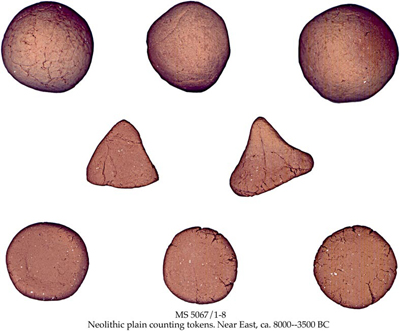
Simple Clay Tokens
Simple Clay Tokens
The token system was first used around 8000 – 7500 BCE with the advent of agriculture. Neolithic clay tokens were made very simply. A small piece of clay was worked into one of about a dozen different shapes, and then perhaps incised with lines or dots or embellished with pellets of clay. Tokens were usually made of clay but some that have been found were also made of stone.
Most tokens were formed in geometric shapes including cones, spheres, and cylinders. Animal and tool shaped tokens have also been recovered. The tokens were one inch or less across in size. The clay tokens were sun-dried or baked baked in a hearth which caused them to vary in color from pink to black. About 8,000 of them dated between 7500–3000 BCE have been found so far.
Each token shape represented a certain quantity of a particular good rather than standing for the actual number one, two or three, etc. For example, if a single ovoid shaped token represented a jar of oil, then five such tokens would represent five jars of oil.
Tokens were not tied to a particular language. No matter what language you spoke, if both parties understood that a cone meant a measure of grain, the transaction could take place. Whatever they were used for, the same dozen or so token shapes were used for some 4,000 years throughout the Near East.
These simple tokens remained in use until around 3500 BCE when complex tokens came into use. Complex tokens had distinctive markings and were styled in new geometric and naturalistic shapes. These new tokens with additional shapes and markings could be used to indicate an increase in the number of goods available to trade. As new items were traded, a specifically designed token was designed to represent it.
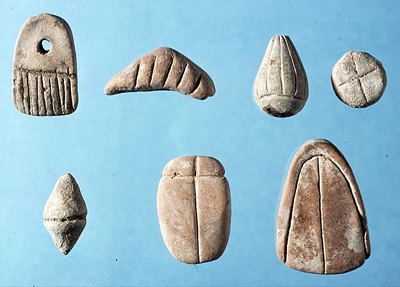
Complex tokens representing (above, from right to left)
one sheep, one jar of oil, one ingot of metal, one garment,
(below, from right to left) one garment, (?), one honeycomb,
from Susa, Iran
Complex Tokens
The earliest token shapes were simple cones, spheres, cylinders, ovoids, disks, and tetrahedrons (pyramids). The premier researcher of clay tokens Denise Schmandt-Besserat argues that these shapes are representations of cups, baskets, and granaries. The cones, spheres and flat disks, she said, represented small, medium and large measures of grain; ovoids were jars of oil; cylinders a sheep or goat; pyramids a person-day of work. She based her interpretations on similarities of the forms to shapes used in the later Mesopotamian written proto-cuneiform language and, while that theory has yet to be confirmed, she may very well be right.
Even though tokens were effective in representing commodities since they were easily identified and duplicated, they could not convey any other information such as the quality of a product. Since tokens were small they were easy to handle, but were not very effective when dealing with large amounts of goods.
They occur in two sizes (larger and smaller), a difference that may have been used as a means of counting and manipulating quantities. The Mesopotamians, who had a base 60 numbering system, also bundled their numerical notations, so that a group of three, six, or ten signs equated to one sign of a different size or shape.
During the Uruk period in Mesopotamia [4000–3000 BC], urban cities blossomed and administrative needs for accounting expanded. Production of what Andrew Sherratt and VG Childe called "secondary products"—wool, clothing, metals, honey, bread, oil, beer, textiles, garments, rope, mats, carpets, furniture, jewelry, tools, perfume—all of these things and many more needed to be accounted for, and the number of types of tokens in use ballooned to 250 by 3300 BCE.
Denise Schmandt-Besserat believed the tokens had a simple purpose: correspondence counting. The tokens that were shaped like loaves could be used to count loaves. The ones shaped like jars could be used to count jars. Correspondence counting is easy: you don't need to know how to count, you just need to look at two quantities and verify that they are the same. But the Uruk tokens took things further: they were used to keep track of counting lots of different quantities, and could be used both to add and to subtract.
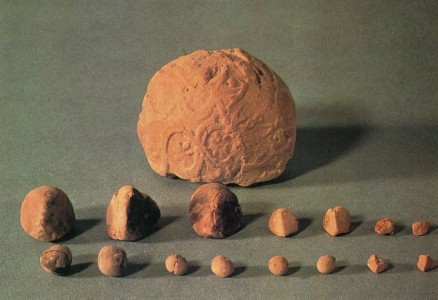
Bullae – Clay Envelope and Tokens
Bullae – Clay Envelope and Tokens
During the Late Uruk period [3500–3100 BCE], clay envelopes were devised to hold large numbers of tokens and to ensure the correct number of tokens reached its destination without incident. These envelopes, also called bullae, were hollow clay balls. They were sealed with geometrical impressions which would need to be broken if the envelope was opened to verify the contents. Some bullae had impressions representing the number of tokens on the outside of the envelope so it would not be necessary to break the seal to count the actual number of tokens enclosed.
Bullae are hollow clay balls about 5–9 cm (2–4 in) in diameter: the tokens were placed inside the envelope and the opening pinched shut. The exterior of the ball was stamped, sometimes all over the surface, and then the bullae were fired. About 150 of these clay envelopes have been recovered from Mesopotamian sites. Scholars believe that the envelopes were meant for security purposes, that the information was kept inside, protected from being changed at some point along the way.
The practice of noting token information on the outside of envelopes evolved into an early version of solid clay tablet writing. Apparently, by about 3100 BCE, bullae were replaced by puffy tablets covered with the impressions of the tokens and there, says Schmandt-Besserat, you have the beginning of real writing, a three-dimensional object represented in two dimensions: proto-cuneiform. It must have been realized that the idea of sending the same information twice was redundant; the tokens themselves and the same token information noted again on the envelope. A realization was made that the same information could be conveyed with the token impressions only carved on a clay tablet.
Cuneiform Writing
Denise Schmandt-Besserat pointed out something else revolutionary. The abstract marks on the cuneiform tablets matched the tokens. Everyone else had missed the resemblance because the writing didn't seem to be a picture of anything.
But Schmandt-Besserat realised what had happened. The tablets had been used to record the back-and-forth of the tokens, which themselves were recording the back-and-forth of the sheep, the grain, and the jars of honey. In fact, it may be that the first such tablets were impressions of the tokens themselves, pressing the hard clay baubles into the soft clay tablet. Then those ancient accountants realised it might be simpler to make the marks with a stylus. So cuneiform writing was a stylised picture of an impression of a token representing a commodity. No wonder nobody had made the connection before Schmandt-Besserat.
This was an important step in the development of writing because these tablets actually communicated a message from one person to another. Eventually small sketches were used to depict other things besides commodities and the pictographic style of writing began. Even the first use of abstract numbers, meaning numerals that were not related to any particular commodity, occurred in pictographic writing. These early numerals were represented by wedges and circular markings on the tablet, and stood for the quantity of an item instead of the token itself indicating the quantity of items.
Although the use of tokens did decrease, tokens continued in use well into the first millennium BC. Ziyaret Tepe is a tell in southeastern Turkey, first occupied during the Uruk period; the Late Assyrian period levels are dated between 882–611 BCE. A total of 462 baked clay tokens have been recovered from those levels to date, in eight basic shapes: spheres, triangles, disks, pyramids, cylinders, cones, oxhides (squares with indented sides in the shape of a tanned animal hide), and squares.
Pictographic writing was a big step forward in the development of writing but there were still limitations. Even though a wider a variety of ideas could be communicated, it was still not possible to document movements or relationships between the items represented on the tablets. It was also impossible to ask a question relating to the items shown. These new pictographic images were called logograms, or word signs. To solve some of the limitation problems, logograms were eventually used to depict a single syllable of a word instead of simply an object. “For instance, they would take a logogram such as the original pictographic star-shaped AN—meaning “star,” “heaven,” and “god”—and read it as the syllable an; unrelated to word sign.” At this stage logograms ceased to be just depictions of objects and became syllabograms, or phonograms, which represented actual sounds used in language; a phonetic script.
Evolution of Cuneiform Script
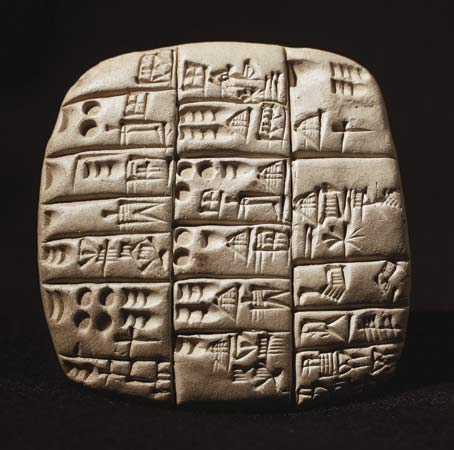
Cuneiform Writing on Tablet
The final step to create a true writing system which could communicate and document speech was the evolution of the logograms/phonograms into stylized linear representations. Called cuneiform, these wedge-shaped signs were incised in clay tablets with a prism-shaped split reed. The main impetus of the change to this true writing script was the use of the Semitic language in in the first half of the third millennium in Sumeria. Over the next five hundred years as Semitic words were added to and translated into the Sumerian vocabulary, cuneiform became based entirely on language itself. Besides the Sumerian and Semitic languages, the Akkadian, Elamite, Hurrian, and Hittite languages also influenced the final development of the cuneiform writing system.
Writing was the exclusive province of the privileged scribal class. The majority of the population would not have been able to read or write cuneiform, including a majority of Mesopotamian kings. Sons of aristocratic families would attend scribal schools to learn to read and write cuneiform by studying and copying texts. Preparing letters and contracts were a professional scribe’s main duties.
Keeping literacy exclusive to the scribal class may have been designed to keep the majority of the population from questioning the policies of the government. Since scribes were the only group allowed to have any control over bureaucratic communications, it was in the government’s best interest to offer them a privileged lifestyle to lessen the chance of political or social unrest among them.
In her essay on the token system, “Record Keeping Before Writing,” Denise Schmandt-Besserat says, “It is remarkable that the first writing system developed from a counting technology.” The simple system of using tokens to represent agricultural commodities evolved over several millennia to become cuneiform, the first true writing system. The progression from simple and complex tokens to bullae set the stage for the early forms of pictographic writing on clay tablets. Pictographic logograms evolved into syllabograms and phonetic writing. An influx of new languages in Mesopotamia assisted in the transformation of phonetic writing into the first true writing system of cuneiform. The invention of writing led to the elevation of the literate class from the illiterate masses, and soon became of tool of government bureaucracy. Today without writing it would be difficult, if not impossible, to study the events, beliefs, and daily lives of the ancient Mesopotamians.
