Yale University's Cuneiform Tablets with Recipes from Old Babylonian Period
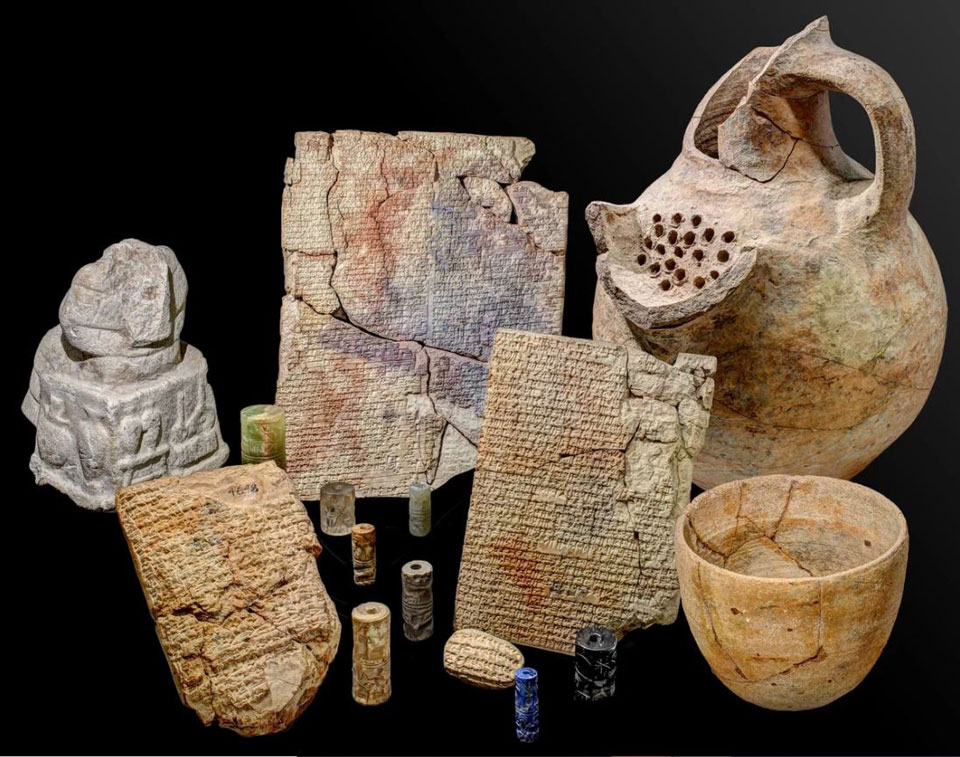
The Yale Babylonian Collection houses four tablets with recipes for various types of stews, soups, and pies.
Three of these tablets date back to the early second millennium and are the earliest written recipes in history.
Among Yale University’s collection of cuneiform tablets are three tablets containing a recipe collection each, a total of 35 recipes. They were composed in the middle of the Old Babylonian period, about 1700 BCE. They are easily the world’s oldest cookbooks, as they antedate by two millennia the next oldest recipe collection, the De Re Coquinaria, the Roman recipes of Apicius, from the late 4th or early 5th century CE. The tablets have been deciphered and translated by Jean Bottéro (see his book "The Oldest Cuisine in the World: Cooking in Mesopotamia," University of Chicago Press, 2004).
These texts are difficult to understand for several reasons, principal among them broken and damaged passages, obscure colloquial Akkadian, unknown vocabulary and technical language. In fact, some of the cooking ingredients are still completely unknown to us; and others, which have been identified, have passed from modern use, so we cannot appreciate what they really are. Add to this the fact that the cooking procedures are not precise, and neither cooking times nor quantities of ingredients are given, then one can appreciate the obstacle of reproducing the recipes accurately and faithfully. Nevertheless, the lack of specificity provides some leeway and leaves room for interpretation, without, hopefully, sacrificing authenticity.
One example will suffice. The recurrent (and key) phrase sirum iz-za-az, which probably means literally "meat/flesh will stand," becomes in the technical French translation of chapter three "il y a de la viande," but in the free translation "il y faut de la viande" and in the English "meat is used." The simple negative of this expression, sirum ul iz-za-az, "il n'y apas de viande" of the technical translation, becomes not only "il n'y faut pas de viande fraiche" / "fresh meat is not used" but also "il n'y faut pas d'autre viande" / "other meat is not used," and is rendered by additional nuances that are not readily apparent in the Akkadian. It seems clear that we are dealing here with a technical use of the verb izuzzum, "to stand." I remain skeptical, however, about whether the proposed interpretations have struck the right nuance, and, for better or worse, this phrase is essential to understanding the overall character of dishes to which it refers.
Bottero emphasizes that this group of texts belongs to the genre of technical literature, and he approaches his subject with all the expertise and caution that could be wished. His cautionary remarks would be well heeded. Not only do many of the ingredients and procedures remain obscure, but the surviving recipes concern only cooking with moisture and do not by any means include all foods known to have been eaten. In other words, this is but a slice of the Mesopotamian culinary pie. However, as the author says (pp. 17, 190), only moist heat permits the development of a true "cuisine," and this judgment would clearly have found the approbation of Apicius some two thousand years later. No one who has taken Apicius in hand and explored the taste sensations that are possible when using cumin and coriander (minus the [black] pepper and other Far Eastern spices) will doubt that Babylonian dishes might well have tasted delicious. However, the sober-minded will also readily agree with the author's judgment (p. 8) that the precise tastes of Babylonian cuisine remain not only irretrievable but probably would not normally strike us as appealing, even if we could recreate them.
How true Bottero's judgment is about irretrievability can be gauged by comparing the list of thirty-six ingredients (in addition to meat and water) compiled in the table printed on p. 161 with the meanings assigned to them in the text and the glossary. Of these, less than half can be identified with much precision: damu (blood), dispu (syrup made from dates, grapes, or from some other fruit source but probably not "miel / honey"), hazannu (probably garlic), himetu (clarified butter or ghee), kamunu (probably cumin), karsu (probably leek), kisibirru (coriander), samnu (oil), sikaru (beer), sizbu (milk), surmenu (probably cypress), susikillu (probably onion), tabatu (vinegar), and tabtu (salt).
Notable also among these moist-heat recipes is the presence of a term that is universally interpreted as "beer" and none that could be plausibly interpreted as "wine." This also, as those who are familiar with Apicius will recognize, represents a distinctive watershed between cuisines that may more properly be described as "Mesopotamian" and those which can properly be called "Mediterranean."
For identifications of ancient terms for foods, we are still profoundly dependent upon etymology, because so few of them are ever significantly described. Moreover, by-forms of such foods are almost impossible for us to recognize in the written sources. For example, we would normally assume that the ingredient "coriander" implies use of the seeds, but whether this implies only seeds or also the leaves (known widely in American usage as "cilantro") is not clear. The same is true of the words we translate as "garlic." We naturally assume that "garlic" means the bulb with cloves. If, however, garlic is grown from the "bulbils" formed at the top of the flower stalk, it will produce plants that resemble the leeks sold ubiquitously in European and American markets. But these garlic plants have a taste that is subtly different from leeks and radically different from mature garlic cloves. With cooking, as with so many aspects of "material culture," it is the details that matter, and this is precisely where the cuneiform sources fail us.
Traditional and medieval Iraqi cooking has the potential to offer valuable insights into practices and possibilities and may help exclude certain translations or interpretations of the challenging ancient terminology. Comparing the Babylonian recipes to what we know of medieval cuisine and present-day culinary practices suggests that the stews represent an early stage of a long tradition that is still dominant in Iraqi cuisine. Today’s staple of the region is stew, aromatic and flavorful, cooked with different cuts of lamb, often slightly thickened, enhanced with rendered sheep’s tail fat, and flavored with a combination of spices and herbs and members of the Allium family, such as onion, garlic, and leek (Nasrallah 2013). These seem to be direct descendants of the Babylonian versions found on the culinary tablet with stew recipes (YOS 11, 25). The sheep-tail fat has also long been regarded as a delicacy and one that until recently Iraqi cooks favored. The fat is used in the dishes to enrich the stews and give them a characteristic sought-after deep flavor of lamb and a less direct but rich umami undercurrent.
Bread has also always remained a key food and is still served along with a daily stew. It is handy as a scoop when eating utensils are no more than the three fingers of the hand, and it can be sopped in the broth of the stew, either as one eats or as a main ingredient in the traditional tharid. The tharid is based on pieces of bread immersed in a vegetable or meat broth. It is especially popular in the holy month of Ramadan. There are endless varieties of this dish, which is known across the Arab world, but especially in Iraq and the Arabian Peninsula. It may well be related to the hundreds of varieties of tu (Akkadian ummaru) listed in the ancient lexical lists, since several of the stew recipes in the culinary tablet (YOS 11, 25) add crumbled bread to the liquid before serving.
Also see:
The Clay Tablet Recipes
Akkadian Food Terms
Some Mesopotamian Ingredients Revealed
The Oldest Cookbooks in the World
The following is from http://www.library.yale.edu/neareast/exhibitions/cuisine.html
These clay tablets from the Babylonian Collection, inscribed in Akkadian contain the oldest known cooking recipes. They date to ca. 1750 BC, the time of Hammurabi, known for his famous law code. The cuneiform writing system was complex and generally only scribes who had studied for years could read and write, so it is unlikely that the cookbooks were meant for the ordinary cook or chef. Instead, they were written to document the current practices of culinary art. The recipes are elaborate and often call for rare ingredients. We may assume that they represent Mesopotamian haute cuisine meant for the royal palace or the temple.
From the thousands of tablets recording deliveries and shipments of foodstuff, from vocabulary lists of various kinds of food and from records of payments to workers and soldiers we can get a fairly accurate picture of the standard Mesopotamian diet.
The meats included beef, lamb, goat, pork, deer and fowl - the birds provided both meat and eggs. Fish were eaten along with turtles and shellfish. Various grains, vegetables and fruits such as dates, apples, figs, pomegranates and grapes were integral to the ancient Near Eastern diet. Roots, bulbs, truffles and mushrooms were harvested for the table. Salt added flavor to the food as did a variety of herbs. Honey as well as dates, grape-juice and raisins were used as sweeteners. Milk, clarified butter and fats both animal fats and vegetable oils, such as sesame, linseed and olive oils were used in cooking.
Many kinds of bread are mentioned in the texts from the lowliest barley bread used for workers' rations to elaborate sweetened and spiced cakes baked in fancy, decorated moulds in palace kitchens.
Beer (usually made of fermented barley mush) was the national beverage already in the third millennium BC, while wine grown in northern Mesopotamia was expensive and only enjoyed by the royal household or the very rich.
YBC 4644 from the Old Babylonian Period, ca. 1750 BC
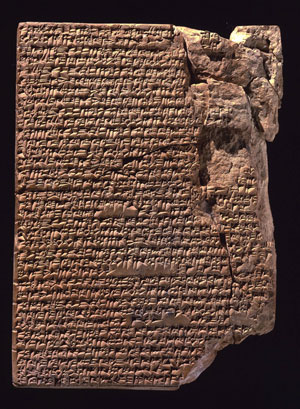
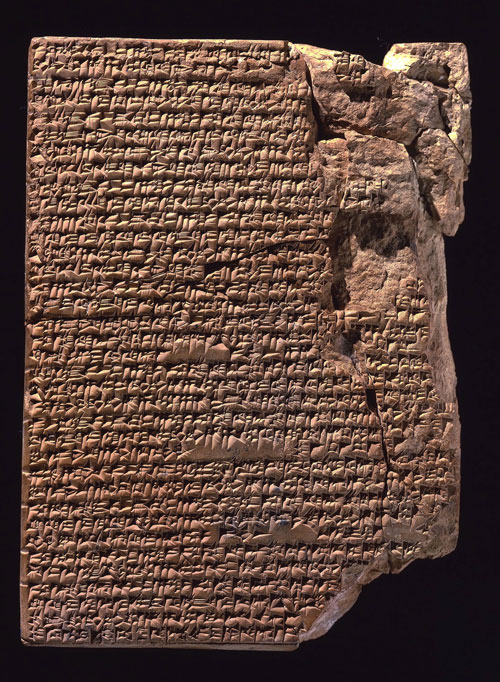
YBC 4644 from the Old Babylonian Period, ca. 1750 BC
YBC 4644 from the Old Babylonian Period, ca. 1750 BC
This tablet includes 25 recipes for stews, 21 are meat stews and 4 are vegetable stews. The recipes list the ingredients and the order in which they should be added, but does not give measures or cooking time - they were clearly meant only for experienced chefs.
All of the recipes have one thing in common: every one of the finished dishes relies on combinations of meat, fowl, vegetables, or grain cooked in water. Cooking in water was an enormous innovation. From other kinds of evidence, we know that before this time entirely different cooking methods were used, like the use of radiant heat in an oven; indirect heat in hot ashes; and direct exposure to flame, as in broiling, grilling, or spit roasting. Cooking in liquid represented a giant step forward in terms of taste and sophistication. It created a richness and diversity of flavor that could not be achieved in the more ancient roasted, grilled, and broiled food.
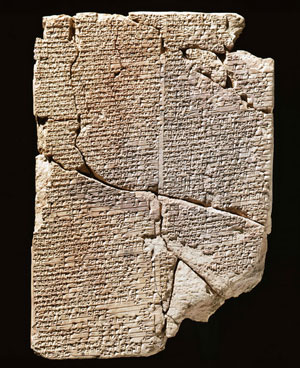
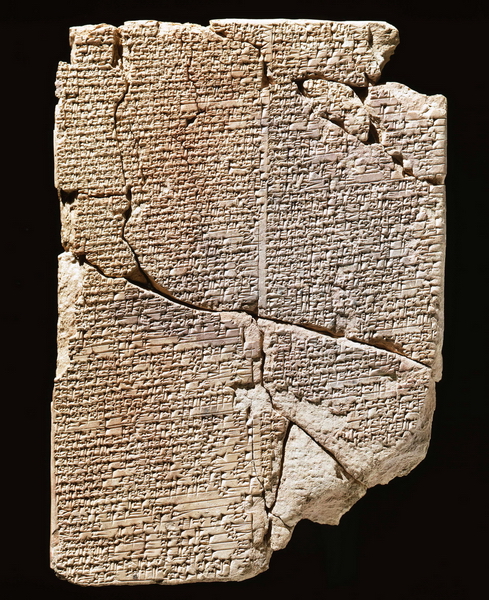
YBC 8958 Old Babylonian Period, ca. 1750 BC.
YBC 8958 Old Babylonian Period, ca. 1750 BC.
YBC 8958 Old Babylonian Period, ca. 1750 BC.
This tablet has seven recipes which are very detailed. The text is broken in several places and the name of the second recipe is missing, but it is a dish with small birds, maybe partridges:
Remove the head and feet. Open the body and clean the birds, reserving the gizzards and the pluck. Split the gizzards and clean them. Next rinse the birds and flatten them. Prepare a pot and put birds, gizzards and pluck into it before placing it on the fire.
[It does not mention whether fat or water is added -- no doubt the method was so familiar that instructions were considered unnecessary. After the initial boiling or braising, the recipe continues:]
Put the pot back on the fire. Rinse out a pot with fresh water. Place beaten milk into it and place it on the fire. Take the pot (containing the birds) and drain it. Cut off the inedible parts, then salt the rest, and add them to the vessel with the milk, to which you must add some fat. Also add some rue, which has already been stripped and cleaned. When it has come to a boil, add minced leek, garlic, samidu and onion (but not too much onion).
[While the birds cook, preparations for serving the dish must be made]
Rinse crushed grain, then soften it in milk and add to it, as you kneed it, salt, samidu, leeks and garlic along with enough milk and oil so that a soft dough will result which you will expose to the heat of the fire for a moment. Then cut it into two pieces. Take a platter large enough to hold the birds. Place the prepared dough on the bottom of the plate. Be careful that it hangs over the rim of the platter only a little. Place it on top of the oven to cook it. On the dough which has already been seasoned, place the pieces of the birds as well as the gizzards and pluck. Cover it with the bread lid [which has meanwhile been baked] and send it to the table.
YBC 4648 from the Old Babylonian Period, ca. 1750 BC
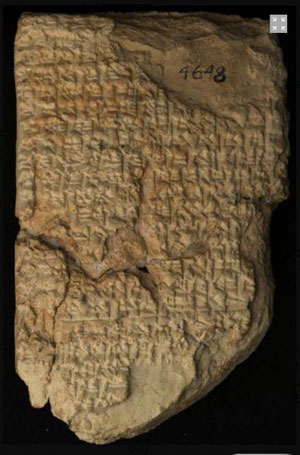
YBC 4648 Old Babylonian Period, ca. 1750 BC.
The third tablet is even more fragmented than the second, giving us just a hint as to what the 3 recipes are of.
