Ancient Roman Cuisine
When people think of ancient Rome and its food, they tend to think of the excesses. -- the orgies, the lying down to eat and the strange foods. Petronius's satirical creation, the very vulgar Trimalchio with his over the top feast which included all manner of decadent items from dormice sprinkled with honey and poppy seeds to young sow stuffed with sausages. And then there is the elaborate cookbook of Apicius, whom Pliny the Elder credited with the idea of fois gras. When first reading these references, it is easy to come to the conclusion that Romans were always decadent and their food probably tasted awful.
In reality, these banquets are described in such exquisite detail precisely because they were extrordinary occasions. As such they were much more artistically exciting than the everyday food of the ordinary citizen - the food of the street-vendor, the inns and taverns, the fried fish shops and the ordinary restaurant, as well as the everyday meals of the Roman peoples.
Ancient Roman food
During the Kingdom (753 BC – 509 BC), Roman food was rather simple and similar to the food in ancient Greece. The Romans then typically ate a porridge called the puls which was made of emmer (a type of wheat, commonly called farro), olive oil, salt, mixed with various herbs. The Romans also ate cereals, legumes, vegetables, fruits, meat, fish and seafood, and used olive oil, vinegar and salt, pepper, mint, saffron and other spices in their food.
Emmer is a 'softer' wheat grain than the bread wheat commonly used today. It is better for keeping whole and boiling than for grinding and using as flour compared to harder bread wheats. The basic grain pottage could be elaborated with vegetables, meat, cheese, or herbs to produce dishes similar to polenta or risotto.
Evolution of Roman cuisine during the Republic and Empire
Roman cuisine evolved from one resembling ancient Greek cuisine to a very diverse cuisine thanks to Rome's expansion during the Republic (510-31 BC) and the Empire (31 BC – AD 476) and the adoption of foreign culinary habits. In the beginning, dietary differences between Roman social classes were not great, but disparities developed with the empire's growth. As Rome expanded, the differences in eating habits between social classes became more pronounced and Roman cuisine became more sophisticated.
In the period of the kings (625-510 BC) and the early Republic, but also in later periods (for the working classes), the cena essentially consisted of a kind of porridge, the puls. The simplest kind would be made from emmer, water, salt and fat. A more sophisticated variation was made with olive oil, and consumed with an accompaniment of assorted vegetables when available. The wealthy commonly ate their puls with eggs, cheese, and honey and it was also occasionally served with meat or fish.
Dietary habits were affected by the political changes from kingdom to republic to empire, and Roman trading with foreigners along with the empire's enormous expansion exposed Romans to many new foods, provincial culinary habits and cooking methods.
Eating three times a day was something that was introduced by the Romans only much later in the history of Rome, but it was only common for the upper class. Roman meals consisted of the jentaculum (breakfast), the cena (lunch) and the vesperna (dinner in the evening). Breakfast was usually light, consisting of a piece of bread with honey or cheese. Lunch was a large meal and the main meal of the day, while dinner consisted of a light supper.
As Rome expanded and became more prosperous during the Republic and the Empire, more foods became available. The cena moved to the afternoon (2 - 3 p.m.) as it became larger, while the vesperna (the light supper) disappeared altogether. Lunch was replaced by the prandium which was like a light lunch. Furthermore, the cena, which initially consisted of only one course, developed into a two-course meal during the Republic: a main course and a dessert served with fruit or seafood. By the end of the Republic, it evolved into a three-course meal: the appetizer (gustatio), the main course (primae mensae) and the dessert (secundae mensae).
Greek Influence
The basis of Roman cooking is Greek cookery and it grew from the influx of Greek cooks as slaves into Rome after the Roman conquest of Greece (146 BC). These cooks brought with them essential Greek ingredients such as the fish sauce, garum, that became such a major component of Roman cookery. Fish sauce adds both salt to the food, but it also adds the umami flavour that's only really been recognized as an important aspect of our taste sensation during the twentieth century.
Garum was one of the Romans' favorite condiments, and it is by far the most misunderstood mainstay of the Roman pantry. It is made from fermented fish (usually anchovies or mackerel). Garum is very similar to Southeast Asian fish sauce. Much like soy sauce, fish sauce is splashed into food in order to add salt and umami to a dish giving it a much richer flavor profile.
The way of eating and preparing Roman food was also different. The only really important equipement in the kitchen was the knife and the pestle and mortar. Food thus seems either to have been chopped into bite-sized pieces or it seems to have been puréed before serving. Sometimes the food was cut into convenient portions by the servent before it was served. Most frying was done with olive oil, but frying wasn't done much before the 5th century BC; up until then, the Greeks mostly braised or boiled their food.
The food itself was served in shallow bowls with bread and a spoon made of bronze, animal bones or wood. Richer Romans used silver cutlery. There was the so-called ligula, a small dessert spoon, and the coclear, a spoon with a standard bowl on one end and was pointed at the other, probably to spear chunks of meat, pull snails out of the shell or for eating an egg. Otherwise food was eaten with the fingers. The so-called rudix is the original mixing tool.
This is not to say that forks were unknown in the Roman world (two-pronged forks are known from a number of Roman sites) but there is no evidence to indicate that they were used regularly (or at all) during dining. The personal table fork was most likely invented in the Eastern Roman (Byzantine) Empire, where they were in common use by the 4th century. It should be noted, however, that one of the signs of good manners was to eat in such a way as not to use the whole hand (barbaric behaviour), as little as possible to get the fingers dirty and not to use the ring and little fingers. Due to the frequent use of fingers in eating in the high society, washing your hands, not only before but also between courses, was quite a natural habit.
This explanation as to why they did not use forks comes from https://quatr.us/romans/people-eat-ancient-rome-roman-silverware-dishes.htm. I have also seen this on other web sites, so they must be copying from each other.
The main reason that Roman people didn’t use forks for eating their food was that they had no practical way to make a lot of forks. The fork in the picture [not here] is made of bronze. But bronze was too expensive, and not really strong enough, to make good forks for everyone to use. Wooden forks and bone forks would just snap off their tines as soon as you tried to use them. The Romans could make iron forks, but they would also break easily. They could make good forks out of silver, but silver was really too expensive for every day.
What you really want to use for forks is steel. That’s what our forks are made of today. The Romans could get steel. But they did not know a cheap way to achieve it. In the time of the Roman Empire, steel was an expensive thing that you used for swords, or for small things like sewing needles.
As an accompaniment to meals, wine was the drink par excellence and this was diluted with water before being drunk, in the Greek manner. After all, only Barbarians drank their wine undiluted. Overeating and conspicuous consumption were thought barbaric by the Greeks. The Greeks approached both eating and drinking alcohol with frugality, to highlight their idea of themselves as poor but free people.
Roman Food & Flavors
The main ingredients used in cooking are not mystifying (fish, birds, meats, olives, cabbages, grapes, barley for bread, garlic, cheese). We are familiar with the techniques (roasting, stewing, grilling, and much use of pestle and mortar to make sauces). The one snag is that proportions of ingredients are not specified. The modern cook can only guess.
One thing in particular stands out in early literary references to food: the lack of any references to spices. Even if these writers were not writing recipes, one would think some would highlight the rich effect of what were exotic and expensive ingredients. Consider that in later centuries, even before the Crusades, Peter Damian referred to “dishes sprinkled with fragrant spices”; later a poet like Champier mentioned green sauce and saffron. The twelfth to thirteenth century fabliaux mention cinnamon, ginger and other spices of the period.
Yet with very rare exceptions Roman writers mention one spice: pepper. Martial himself offers an epigram on pepper, but on none of the other spices. Where he does mention nard, for instance, it is as a cosmetic. He does not mention the most specifically Roman spice – silphium – at all. The strongest flavors he cites for dishes are pepper and onion. Nor does Horace's epicure includes spices other than pepper in his careful description of a sauce. Rather, the varying flavors come from the blend of liquids. It is possible then that the rich use of spices found in cookbooks was a later development and that at the height of the Empire, these were used far less in elegant cooking.
Otherwise, the list of delicacies in these texts is, in the end, pretty limited: oysters, snails, mushrooms, asparagi, thrush, turtledoves, mullets, wild boar, hare, sow's teats and belly, figpeckers, with less mentions of dormice, fattened goose livers and sea urchins. Lettuce and leeks were standard openers. Meals often included pastry of one form or another and cheesecake is often mentioned.
Mentions of specific dishes are rare, but enough are described to suggest unique combinations or even recipes: lobster with asparagus, slices of egg and rue with seafood, sausage on porridge, eggs with fish sauce (garum), wine and pepper as a sauce, poultry or other food in flour and salt, beans with bacon, and fish (probably not lamprey) with shrimp swimming in a sauce of oil, fish sauce, Italian wine, Greek wine, pepper and vinegar.
The resulting selection is scattershot and, even taken together, does not constitute anything like a complete cookbook. Still, it includes some unique items, such as quince with honey baked into it, an unusual type of poached egg, peppered wine and must-cakes for weddings, in addition to variants on familiar standards like mustard.
Unlike the spices we find being used during Medieval times, Roman food relies on oil, vinegar, wine, garum, herbs and other greens, onions and leeks, pepper, and honey to flavor foods.
One of the most prized (and pricey) flavourings with both Greek and Roman cooks was a spice of North African origin, which they knew as silphium. Widely discussed by ancient authors including Herodotus, Strabo, Pliny, Theophrastus, and Dioscorides, it was said to cure such a wide variety of medical ailments that it was extolled as a panacea. Silphium vanished from the face of the planet, according to contemporary sources, but modern research suggests it is a relative of Indian asafoetida (pronounced as in fetid), the sulphurous and smelly Indian spice hing, otherwise known as Devil's Dung. Asafoetida is sold in some Indian stores in tins and comes as hard lumps of resin. You grate it to use in vegetable dishes to give a savoury, almost meaty flavour. You need to heat it first in a pan, like so many Indian spices, in order to develop its flavour.
Used with a heavy hand, it is truly horrible, as Ms Grainger found when preparing a dish of lentils for a dinner. But she had the presence of mind to use sugar to counter its bitterness (the Romans didn't have culinary sugar, of course).
If silphium was thought exotic, garum was the most common condiment. Garum is no longer viewed as one of the mysteries of the ancient world, for it is now seen to be identical to (or very similar to) Vietnamese nam pla (or nuoc mam), a clear salty fish essence like soy sauce. Far from being the product of decay, it is the result of a chemical process called proteolysis. Enzymes in the gut react with the whole salted fish to produce this strongly flavoured brine. The Romans knew it as both garum and liquamen, and there were factories for its manufacture. Even in Roman Britain there was one, close to a little trading post on the Thames, known then as Londinium.
Salty garum and pepper were predominant flavours. And honey, grape juice (defrutum), spiced wine (mulsum), sweet wine (passum) and vinegar. There was a wide range of strong herbs such as lovage (the celery-flavoured leaf) and rue (which is searingly bitter), bay leaves (and bay berries), coriander and cumin leaves, sage, rosemary, parsley.
As a cook herself, Ms Grainger assumes that skillful cooks, then as now, sought to balance salt and bitter notes, as well as sour and sweet. She makes a distinction between Greek cooking and Roman cooking. It was the refined and educated Greeks who created the haute cuisine of their day, aspiring to elevated levels of social behaviour. Food and wine was but part of an evening symposium (literally drinking together) which included discussion, music, plays, poetry, even acrobatics.
Until around 200BC, says Ms Grainger, the Romans had been considered "porridge-eating barbarians." Now Rome absorbed the kitchen skills of the Greeks and further added the concept of conspicuous consumption. So this nouvelle cuisine arrived, and the newly-rich could display their wealth through their food, spices like silphium being very costly.
The Roman Day
The day begins at dawn and the average Roman dresses with considerable speed, as the process of washing and changing clothes occurs when they visit the baths later in the day. Breakfast is a scratch meal of the barest minimum: water and a piece of bread, or cold left-overs from the night before. Time is at a premium if one is to do the day’s labour or social activities in the comfort of the morning’s heat rather than the afternoon. The length of the Roman ‘hour’ fluctuated according to the seasons but, according to Carcopino, it seems the day’s labour did not extend beyond seven hours in summer and probably six in winter. For those of secure means, whether through their own labour or through private income from their land, the afternoons were free. Lunch for the non-labouring classes was, as with breakfast, a snatched meal of left-overs, cheese, fruit, bread, simple single items involving the minimum of cooking. The whole gourmet experience was confined to the evening meal: the cena. We may assume that the labouring classes who needed to keep their energy levels up during the working day may well have consumed considerably greater volume of food at mid-day.
The proletariat of Rome – traders, craftsmen, skilled labourers, retailers of all kinds as well as the unskilled labouring masses – lived in the urban sprawl in insula, flats constructed of wood above the stone- and brick-built houses and businesses on the ground floor. The higher up you lived, the poorer you were, and the less likely you would have access to cooking facilities. Street food, or to be precise ‘fast food’, was a common factor in the diet of the proletariat. Therefore we can imagine ordinary labourers buying such things as pasties made with a coarse oil-based pastry filled with pulses and mince meat; meatballs; blood sausages as well as offal; white sausages with cooked pulses; and simple patinae: the Roman frittata with any amount of meat, fish or vegetables in them. All these were potential lunch items available from street vendors, but also available at home.
The classical poet, Martial, gives us a great visualization into the bustling activities of the vendors and cafés that lined the narrow streets. The noise and aroma began way before sunrise —‘Get up! The baker is selling the boys their breakfast, and the crested birds of dawn are singing all around’ (Martial 14.223) He also tells us of a man selling aromatic chickpea soup, and of the fine aroma of smoking sausages, whose scent was hanging in the air. (14.222)
As the day moves towards the time for dinner, the leisured classes and those now free from labour headed for the baths. Women had already been to their ablutions at mid-day. Wealthy men had private bath houses in their own homes or exclusive clubs but the labouring classes had access to large-scale public bath complexes such as the baths of Caracalla or Diocletian where thousands could engage in the same basic routine. This was to exercise, socialize, bathe and get a massage, change your tunic, possibly shave and get a hair cut, attempt to get a dinner invitation if you didn’t have one, snack on small delicacies and ultimately wander home to a lavish or more humble dinner.
There are many examples in Apicius of food that might be on sale at the baths. We actually have two recipes in Apicius that are specifically designed for after bathing. These are meatballs in a sauce (Apicius 2.2.7) and cuttlefish (Apicius 9.4.3). The Roman fort of Caerleon in south Wales had a bath complex with a vast swimming pool designed for amphibious training. Archaeologists have found that the drains were blocked with the bones from chicken wings and lamb chops.
Thermopolium of Vetutius Placidus
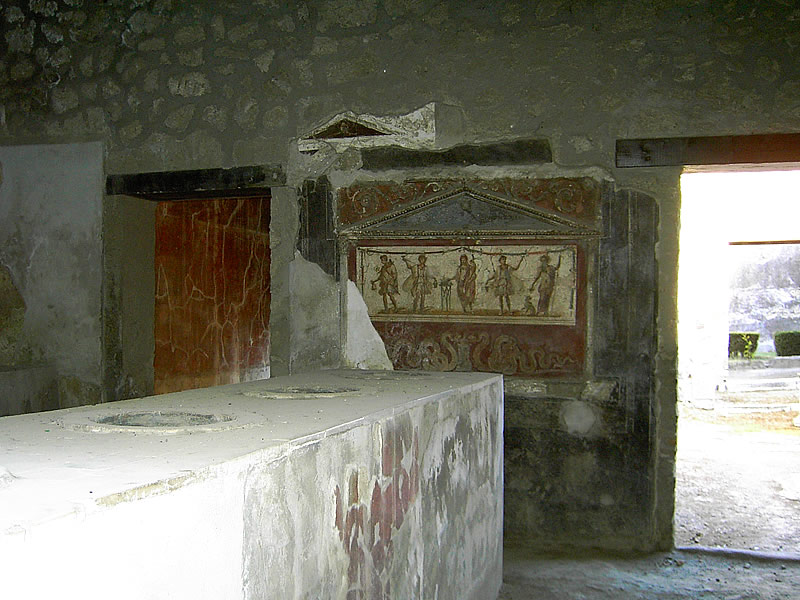
Thermopolium of Vetutius Placidus - Pompeii
One of the 89 thermopolia in Pompeii, these public establishments served food and drink and this one is a typical structure: one room open to the road with dolia (jars) holding the goods sunk into the counter. Note the frescoed aedicula (shrine) portraying the Lares (protectors of the house) as well as Mercury (god of trade) and Dionysus (god of wine).
Embedded in this counter were earthenware jars (called dolia) used to store dried food like nuts (hot food would have required the dolia to be cleaned out after use, and because they are embedded in the counter, it is believed that they were not used to store hot food, but rather dried food where constant cleaning wouldn't be necessary).
What are Thermopolia?
Those who didn’t live in the posher houses mostly lived in more or less salubrious apartments, which didn’t have any kitchen, so they would have cooked, if at all, over the braziers they used for heating. Because this was a fire hazard, they mostly ate takeaway food cooked elsewhere: if you wander around Pompeii or Herculaneum, you can’t help noticing that there are takeaway food outlets on every other street corner.
"From sunrise to sunset, Roman urbanites passed the day entirely outside their homes...Inevitably, many of them would grab a bite to eat in the city center. This custom brought about the appearance of restorative establishments that came to flourish in the Forum and around the thermal baths: from simple taverns (popinae or thermopolia), which offered hot or cold wine according to season, cakes made with chick peas, focaccias, and other ready-to-eat items...
These public gathering places...looked approximately like this: a brickwork serving bar facing the street, containing large amphoras for wine, water, and oil; shelves for mugs and glasses; and against the back wall, stoves for preparing a few hot foods or for a quick reheating. Further within there were usually at least one rooms sparsely furnished with tables and benches for those customers with the time and desire to eat seated, as was the custom among the lower strata of society...
The staff in these places is always described in the ancient sources as an assorted collection of lowlife: the proprietor was on the same social scale as a thief, and the servants commonly provided less than reputable services to their customers upon request...Many popinae were conveniently located immediately inside the baths and in the porticoes around the outside...only men ate in the popinae..."
---A Taste of Ancient Rome, Iliaria Gozzini Giacosa, translated by Anna Herklotz, forward by Mary Taylor Simeti [University of Chicago Press:Chicago IL] 1992 (p. 207-209
Ancient Roman taverns
"Rome had countless bars, restaurants and inns...Tabernae, taverns, were found chiefly near the bathhouses, but also near temples, libraries and other public buildings. There were several different kinds. Engravings show that they all had an L- or horseshoe-shaped bar made of stone and cement. In comparison with a modern bar, it was low-just over a metre height. Four or five clay pots were permanently bricked into the bar, sometimes with a mortar. This meant that they were well insulated so food and drink could be kept warm or cold in them for a long time. Near the bar stood a small bronze oven, usually portable, in which water was kept at a boiling point. The larger taverns had a separate kitchen and a cellar. If the space was large enough, low tables and stools were arranged close to the bar; otherwise customers had to stand...Food in the taverns was less spectacular than in wealthy houses, but the proprietors prepared it freshly. Typical dishes would have included the popular puls (a porridge or rissoto) and dishes with beans, peas or lentils. From the time of Emperor Vespasian these were the only dishes dishes taverns were permitted to serve. Claudius and some other emperors had prohibited the sale of boiled meat, and any tavern foolish enough to offer it was closed down. Thus to circumvent the law, meat was usually boiled on the street...We can conclude form this that boiled meat was popular. Frescoes, ancient graffiti and other sources suggest that roasted meat was also served, such as ham and pig's head, with eel, olives, figs, possibly sausage, fishballs, meatballs, salads, poultry, marinated vegetables, cheese, eggs, omelettes and all manner of light snacks (think of Italian antipasto and Spanish tapas)...Fornax means oven', and this restaurant was a sort of pizzeria."
---Around the Roman Table, Patrick Faas [Palgrave MacMillan:New York] 2003 (p. 41-2)
"The more convival side of Rome's night-life is represented by the taverns and hot food stalls. These were more than a nocturnal luxury: they were also a daily necessity in a crowded city many of whose poorer inhabitants could not possibly have risked lighting a cooking fire in their tenements...The noise and aroma of Rome's street food began before sunrise...and continued throughout the day...Everybody ate street food, even emperors. It was slightly less respectible to eat in the pervigiles popinae ever-open cookshops'...The bars and taverns in and around the great Baths were the nearest thing that Rome had to restaurants. In some you could choose wither to sit or to recline; and in some you could spend serious money...while the snacks available in others would be converted into a full meal only by a miser...In some you could demand a certain level and variety of cuisine for which the ordinary cookshops had no time at all..."
---Empire of Pleasures: Luxury and Indulgence in the Roman World, Andrew Dalby [Routledge:London] 2000 (p. 218-220)
[NOTE: some of the foods referenced in this section include: sausages, hot chickpea soup, lettuce, eggs, chub mackerel, beetroot, gourds, radishes, black pudding, white bread, salad (dressed with oil), mustard, ham, grilled fish, venison, wild boar, chicken, hare, cabbage, boiled meat, turtle-doves, pheasant, honey, fatted goose, pickles, yogurt, halva, and wine. Water was for washing, not drinking.]
Pompeii - Via dell' Abbondanza
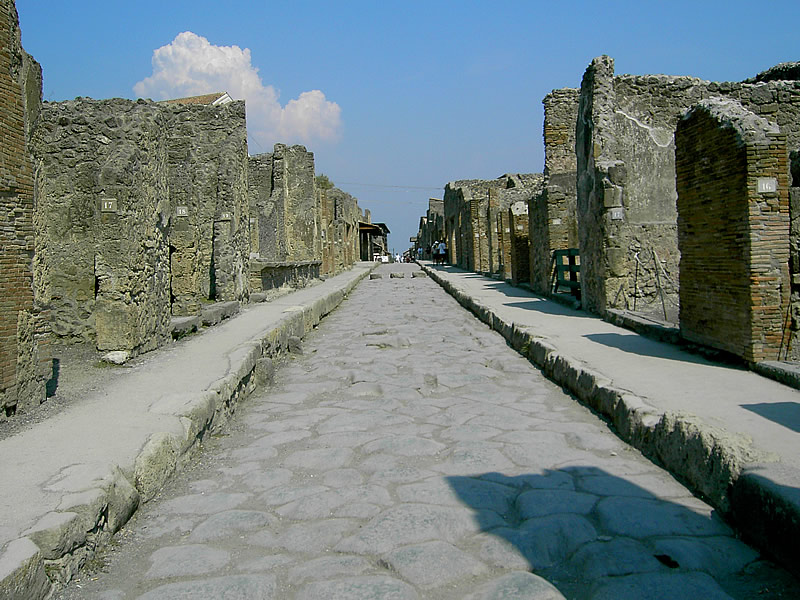
The ruined doorways of an endless series of shops line the Via dell' Abbondanza - 'the street of abundance'. Once this street bustled with crowds buying and selling, drinking and eating as they promenaded from the forum to the amphitheatre.
Now it bustles with hordes of tourists strolling down its cobbled length.
