Ancient Roman Fruits & Nuts
Nuts
Among the nuts were the walnut, hazelnut, filbert, almond (after Cato’s time), and the pistachio (not introduced until the time of Tiberius, 42 BC - 37 AD). Almonds are one of the world's oldest cultivated crops. The ancient Mesopotamians used almond oil as a body moisturizer, perfume and hair conditioner. Almonds have been found in the Minoan palace in Knossos and were a favorite dessert food of the Greeks. Almonds and pistachios are the only two nuts mentioned in the Bible. Nuts were used in pastries, tarts and puddings sweetened with honey, as were pine nuts and sesame and poppy seeds.
Fruits
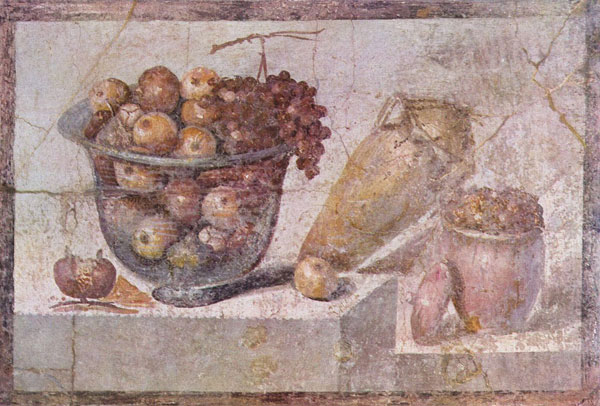
Fruit was eaten fresh when in season, and dried or preserved over winter. Popular fruits included apples, pears, figs, grapes, quinces, citron, strawberries, blackberries, elderberries, currants, damson plums, dates, melons, rose hips and pomegranates. Less common fruits were the more exotic azeroles and medlars. Cherries and apricots, both introduced in the 1st century BC, were popular. Peaches were introduced in the 1st century AD from Persia. Oranges and lemons were known but used more for medicinal purposes than in cookery. Although known to the ancient Romans, lemons were not cultivated in Italy until the Principate. At least 35 cultivars of pear were grown in Rome, along with three types of apples. Cato described pear culture methods similar to modern techniques. There are recipes for pear and peach creams and milk puddings flavored with honey, pepper and a little garum. Columella offers advice on the preservation of figs by crushing them into a paste with anise, fennel seed, cumin and toasted sesame to be wrapped in fig leaves.
Major crops included grapes, olives, figs, pears, apples, peaches, cherries, plums and walnuts. Romans grafted apple trees and spread apple cultivation throughout their empire. Scientists believe that Malus sieversii was hybridized with crab apples native to Central Asia. Most likely these hybrids, not Malus sieversii itself, became the ancestors of the apples that people eat today. By the 3rd millennium B.C. eating apples were being cultivated over a wide area around the Tien Shan. By the 3rd millennium B.C. eating apples were commonplace around the Mediterranean. The Romans spread apple cultivation throughout their empire.
The Greco-Romans grew and ate olives, figs, grapes, pears, various types of apples, often in poor soils. Romans grafted apple trees and spread apple cultivation throughout their empire. Harold Whetstone Johnston wrote in “The Private Life of the Romans”: The apple, pear, plum, and quince were either native to Italy or, like the olive and the grape, were introduced into Italy long before history begins. Careful attention had long been given to their cultivation, and by Cicero’s time Italy was covered with orchards. All these fruits were abundant and cheap in their seasons, and were used by all sorts and conditions of men. By Cicero’s time, too, had begun the introduction of new fruits from foreign lands and the improvement of native varieties. Great statesmen and generals gave their names to new and better sorts of apples and pears, and vied with one another in producing fruits out of season by hothouse culture. Every fresh extension of Roman territory brought new fruits and nuts into Italy.
Among the fruits the peach (malum Persicum), the apricot (malum Armeniacum), the pomegranate (malum Punicum or granatum), the cherry (cerasus, brought by Lucullus from the town Cerasus in Pontus), and the lemon (citrus, not grown in Italy until the third century of our era).
Pomegranates are ancient fruit. They are mentioned in the Bible, the Koran and the Odyssey. According to one of the most famous Greek myths, Persephone spends six months in the underworld because she ate six pomegranate seeds while held there by Hades. The Assyrians made necklaces of gold pomegranates. Pomegranates are thought have originated in Southeast Asia. They were found in much of the ancient world and are thought to have been introduced to several places by the Phoenicians. The ancient Egyptians, Greeks and Romans used the fruit in their medicines.
Figs have been around since ancient times, when they were associated with magic and medicine. The Egyptians buried entire basketfuls with the dead and valued them as a digestive aid. The Greeks called them “the most useful of all the fruits which grow on trees." In the Middle Ages, fig syrup was a popular sweetener.
Melons are one the earliest cultivated crops along with wheat, barley, grapes, and dates. Native to Iran, Turkey and western Asia, they are depicted in an Egyptian tomb painting dated to 2400 B.C. Greek documents from the 3rd century B.C. refer to them. Pliny the Elder described them in the 1st century A.D. in his multi-volume Natural History. Watermelon originated in Africa. Domesticated watermelon seeds dated to 4000 B.C. were found in the 1980s in southern Libya. Dorian Fuller of the University College London told the New York Times, “The wild watermelon is a horrible, dry little gourd that grows in wadis of the northern savannas, but it has seeds you can roast up and eat." The watermelon we eat was not developed until Roman times.
Lemons and citron — the first cirtris fruits- introduced to Rome — were highly valued and only enjoyed by the rich in Ancient Rome: “Laura Geggel wrote in Live Science: “Lemons were the acai bowls of the ancient Romans — prized by the privileged because they were rare, and treasured for their healing powers. The upper crust of society likely viewed the citron and the lemon as prized commodities, likely “due to [their] healing qualities, symbolic use, pleasant odor and its rarity,” as well as their culinary qualities, Langgut said. [Source: Laura Geggel, Live Science, July 21, 2017]. Although known to the ancient Romans, lemons were not cultivated in Italy until the Principate.
Lemons and the citron were the only citrus fruits known in the ancient Mediterranean. Other fruits in the same group, oranges, limes and pomelos, arrived centuries later from their native Southeast Asia, a study led by Dafna Langgut, an archaeobotanist at Tel Aviv University in Israel, revealed. “All other citrus fruits most probably spread more than a millennium later, and for economic reasons,” Langgut, told Live Science. The study was published in the June 2017 issue of the journal HortScience. [Source: Laura Geggel, Live Science, July 21, 2017 ~]
“The citron (Citrus medica)was the first citrus fruit to reach the Mediterranean, “which is why the whole group of fruits is named after one of its less economically important members,” she said. The citron spread west, likely through Persia (remains of a citron were found in a 2,500-year-old Persian garden near Jerusalem)and the Southern Levant, which today includes Israel, Jordan, Lebanon, southern Syria and Cyprus. Later, during the third and second centuries B.C., it spread to the western Mediterranean, Langgut found. The earliest lemon remains found in Rome were discovered in the Roman Forum, and date to between the late first century B.C. and the early first century A.D., she said. Citron seeds and pollen were also found in gardens owned by the wealthy in the Mount Vesuvius area and Rome, she added. ~
“It took another 400 years for the lemon (Citruslimon) to reach the Mediterranean area. Lemons, too, were owned by the elite class. “This means that for more than a millennium, citron and lemon were the only citrus fruits known in the Mediterranean basin,” Langgut said. The citrus fruits that followed were more likely grown as cash crops, she said. At the beginning of the 10th century A.D., the sour orange (Citrus aurantium), lime (Citrus aurantifolia) and pomelo (Citrus maxima) made it to the Mediterranean. These fruits were likely spread by Muslims through Sicily and the Iberian Peninsula, Langgut said. ~
Olives
Olives and olive oil were staples in ancient Greece and Rome. Olives were used as food and fuel as well as a trade commodity. Sophocles called olives "our sweet silvered wet nurse." Olives were valued more as a source of fuel for oil lamps than as a food. They were also used to make soap. Olives were regarded as so precious that killing an olive tree was sometimes punished by death.
Olives are fruit that comes from a gnarled tree and are still a staple of the Mediterranean diet. People eat them for meals and snacks, and use olive oil for cooking and to dip bread in. Olives come in a host of colors and textures: salty, wrinkled and black, oily and green, and even massive and purple. Italy alone is home to 60 different types of olive tree. [Source: Dora Jane Hamblin, Smithsonian; Erla Zwingle, National Geographic, September 1999]
The ancient Egyptians, Phoenicians, Greeks, and Romans all consumed olives and olive oil. Olives were first cultivated in Palestine around 4000 B.C., spread to Syria and Turkey and reached ancient Egypt around 1500 B.C. (the Egyptians were using olives purchased from Palestine long before that). The Phoenicians took olives to Carthage and Greece and the Greeks took them to Italy, southern Spain, and Sicily. The Romans brought them to southern France.
Romans burned it on the altars of their gods. When they worked out and competed, Greek athletes anointed their bodies with olive oil scented with flowers and roots (the Romans knew nothing of distillation by means of alcohol).
“The olive was eaten fresh as it ripened and was also preserved in various ways. The ripe olives were sprinkled with salt and left untouched for five days; the salt was then shaken off, and the olives dried in the sun. They were also preserve sweet without salt in boiled must. Half-ripe olives were picked with their stems and covered over in jars with the best quality of oil; in this way they are said to have retained for more than a year the flavor of the fresh fruit. Green olives were preserved whole in strong brine, the form in which we know them now, or were beaten into a mass and preserved with spices and vinegar. The preparation called epityrum was made by taking the fruit in any of the three stages, removing the stones, chopping up the pulp, seasoning it with vinegar, coriander seeds, cumin, fennel, and mint, and covering the mixture in jars with oil enough to exclude the air. The result was a salad that was eaten with cheese.” |+|
Quinces, apricots, peaches, cherries, plums, currants, strawberries, blackberries, ancient, elderberries, mulberries, azaroles and melons were grown. The Romans ate walnuts, hazelnuts, almonds, chestnuts and pine nuts!
The Romans distinguished between grapes for wine-making and grapes as food. Raisins were also produced. After grapes, figs and dates played a major part and pomegranates were eaten in many varieties.
