Ancient Roman Vegetables
The farm garden contained the commonest of these for home consumption, with herbs for seasoning and for the home remedies, bee plants, and garland flowers. These last were not for garlands at banquets, unless the farm lay near a town and they were grown for sale, but for garlands to deck the hearth in honor of the household gods on festival days. Near the towns market-gardening was profitable, and vegetables, fruits, and flowers were grown. In early days a garden had lain behind each house, and the excavations at Pompeii show occasional traces of small gardens even behind large town houses.
Also see Foods Not Known in Ancient Rome (they did not grow cucumbers. This is a misinterpretation of the texts; see Cucurbits section below)
- Several kinds of vegetables were usually enjoyed with vinegar, kale was cooked in salt and both the green and the white parts of chard were used.
- Cabbage was eaten both raw (sometimes dipped in vinegar) and cooked. Cato greatly esteemed cabbage, believing it to be good for the digestion, and also believed that if a sick person ate a great deal of cabbage and bathed in his own urine, he would recover.
- The leaves of many shrubs and weeds were cooked to a mush and strongly spiced; examples are elder, mallow, orache, fenugreek, nettles and sorrel.
- Pickled fruit and vegetables such as escarole, olives, chicory, chard, cardoons, mallows, broccoli, asparagus, artichokes, leeks, carrots, turnips, parsnips, beets, peas, green beans, radishes, cauliflower, cabbage, lettuces and field greens, onions, cucumbers, fennel, capers and cress [disambiguation needed] were called acetaria and were thought to be appetizing.
While the precursors of Brussels sprouts, artichokes, peas, rutabaga, and possibly cauliflower probably existed in Roman times, the modern cultivated forms we think of were not developed until the late Middle Ages and early Renaissance times. - Mushrooms, such as boletus, field mushroom and truffles.
- Apart from lettuce and rocket many plants were eaten raw—watercress, mallow, sorrel, goosefoot, purslane, chicory, chervil, beet greens, celery, basil and many other herbs.
From Athenaeus, Book 2 (Wild Vegetables)
Diocles of Carystus, in Book I of his Health, says: "Wild vegetables fit to boil are the beet, mallow, sorrel, nettle, orach, iris-bulbs, truffles, and mushrooms."
Marshwort. — Speusippus, in Book II of Similars, says that this grows in water and has a leaf like marsh celery. Hence Ptolemy II Euergetes, once ruler of Egypt, thought that in Homer we ought to write: "And all about soft meadows bloomed of marshwort and celery." For marshwort, he maintained, grows where there is celery, but violets do not.
The Greco-Romans grew and ate cabbage, leeks, onions, chick peas, fava beans and turnips, often in poor soils. Harold Whetstone Johnston wrote in “The Private Life of the Romans”: “The garden did not yield to the orchard in the abundance and variety of its contributions to the supply of food. We read of artichokes, asparagus, beans (fava), beets, cabbage, carrots, chicory, cucumbers (snake melon), garlic, lentils, melons, onions, peas, the poppy, squash, radishes, and turnips, to mention only those whose names are familiar to us all. It will be noticed, however, that the vegetables perhaps most prized by us, the potato and the tomato, were not known to the Romans. Of those mentioned the oldest seem to have been the bean (fava) and the onion, as shown by the names Fabius and Caepio already mentioned, but the latter came gradually to be looked upon as unrefined and the former to be considered too heavy a food except for persons engaged in the hardest toil. Cato pronounced the cabbage the finest vegetable known, and the turnip figures in the well-known anecdote of Manius Curius. [Source: “The Private Life of the Romans” by Harold Whetstone Johnston, Revised by Mary Johnston, Scott, Foresman and Company (1903, 1932)
- Cabbage: Cabbage was a very common vegetable in the Roman diet, both for the rich and the poor. It was eaten cooked and raw, and was also thought to have medicinal properties.
- Onions and Garlic: These were staple ingredients, used in many dishes for flavoring.
- Lettuce: Lettuce was a popular green, often served in the beginning of meals.
- Leeks: Romans enjoyed leeks, which were often cooked in soups or served as a side dish.
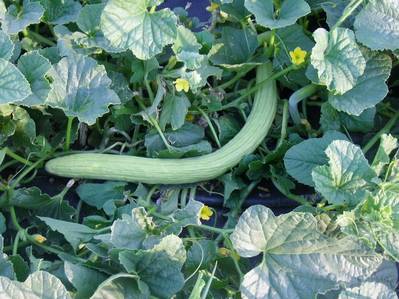
- Cucumis melo: Snake melon or gourd was commonly cultivated and eaten.
- Radishes: Radishes were another common vegetable, sometimes eaten raw as a part of the gustatio (the first course).
- Carrots: Carrots were known and used, but they were not the orange variety we know today. Ancient carrots were likely white or purple.
- Beets: Both the roots and the leaves of the beet plant were eaten.
- Asparagus: Asparagus was a delicacy in ancient Rome.
- Legumes: Various types of beans and lentils were grown and served as an important source of protein.
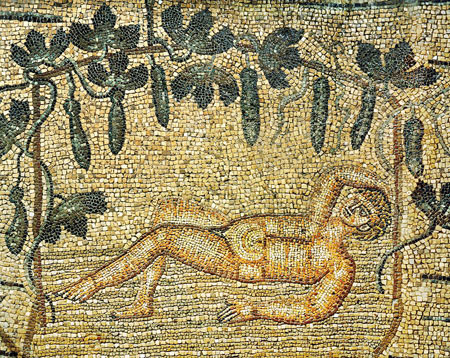
4th Century mosaic of Jonah resting under gourd vine
Cucurbits
The question in learning about Roman foods is how to identify different kinds of cucurbits, that immense botanical family of vines which produce large fruits, like cucumbers, melons, watermelons, pumpkins, squashes, gourds, and luffa sponges. Many of these were introduced after the Americas were discovered.
Before the mid-19th century, the evidence about the origins of Cucurbita was mixed. The names of the plants suggested they came from the “old world”, but depictions of Cucurbita species don’t show up before the mid-1500s. For instance, in Leonhart Fuchs’ 1542 herbal, De Historia Stirpium, we get one of the first European depictions of the pumpkin plant, the species Cucurbita pepo L. Fuchs, however, calls it cucumis turcicus, the Turkish cucumber, a name which might lead one to think the plant was native to the “old world”.
The Cucurbitaceae, also called cucurbits or the gourd family, are a plant family consisting of about 965 species in around 95 genera. Perhaps more than 20 genera are used for culinary purposes, which usually includes consumption of the mature fruit flesh, whole immature fruits, and/or seeds. Three genera, Cucumis (cucumbers, melons), Cucurbita (pumpkins, squash), and Citrullus (watermelons), rank among the top 10 in economic importance among the vegetable crops of the world, and several others have regional importance.
Those most important to humans are the following:
Cucurbita – squash, pumpkin, zucchini or courgette, some gourds (unknown in ancient Rome)
Lagenaria – calabash, and others that are inedible
Citrullus – watermelon (C. lanatus, C. colocynthis) and others
Cucumis – cucumber (C. sativus - unknown), various melons and vines
Momordica – bitter melon
Luffa – the common name is also luffa, sometimes spelled loofah (when fully ripened, two species of this fibrous fruit are the source of the loofah scrubbing sponge)
Cyclanthera – Caigua
Old world” cucurbits include a lot of different genera: Cucumis, the cucumbers (although cucumbers were not known in ancient Rome) and melons; Citrullus, the watermelons and colocynths; Lageneria, the bottle gourd or calabash, probably native to Africa; and a few others like Luffa and Bryonia. No one is quite sure where in the old world they first evolved, but the recent consensus is somewhere in Africa. In other words, they could have existed in the Greco-Roman world.
“New world” cucurbits, however, are the vines descended from plants native to the Americas. They almost certainly could not have been known in antiquity, and the group includes all species of the genus Cucurbita. It is universally accepted that the genus Cucurbita was unknown to the ancient Greeks or Romans. This includes zucchini, courgettes, pumpkins, squashes, decorative gourds, and even those 1000 kg monsters at fall fairs. None of them were known in Europe before Columbus.
Excerpt from https://www.ncbi.nlm.nih.gov/pmc/articles/PMC2759226/. Very interesting and complete analysis:
A critical analysis was made of cucurbit descriptions in Dioscorides' De Materia Medica, Columella's De Re Rustica and Pliny's Historia Naturalis, works on medicine, agriculture and natural science of the 1st century ce, as well as the Mishna and Tosefta, compilations of rabbinic law derived from the same time period together with cucurbit images dating from antiquity including paintings, mosaics and sculpture. The goal was to identify taxonomically the Mediterranean cucurbits at the time of the Roman Empire.
Cucumis melo subsp. melo Flexuosus (Snake melon)
Eaten raw they taste like a cucumber.
They can be cooked, added to preserves, and can be pickled.Findings
By ancient times, long-fruited forms of Cucumis melo (melon) and Lagenaria siceraria (bottle gourd) were selected, cultivated and used as vegetables around the Mediterranean and, in addition, bottle-shaped fruits of L. siceraria were employed as vessels. Citrullus lanatus (watermelons) and round-fruited forms of Cucumis melo (melons) were also consumed, but less commonly. A number of cucurbit species, including Bryonia alba, B. dioica, Citrullus colocynthis and Ecballium elaterium, were employed for medicinal purposes. No unequivocal evidence was found to suggest the presence of Cucumis sativus (cucumber) in the Mediterranean area during this era.
The textual and iconographic evidence, in our opinion, makes it doubtful that Tiberius grew cucumbers (Cucumis sativus) as indicated by the translators of Columella and Pliny and as assumed by Darby et al. (1977), Stol (1987) and many others, and we propose that snake melon (Cucumis melo Flexuosus Group) is the correct identification.
The cucumis of Columella and Pliny was not cucumber, as commonly translated, but Cucumis melo subsp. melo Flexuosus Group (snake melon or vegetable melon). [If you cannot find snake melon, zucchini and summer squash are the best substitutes for snake gourd owing to the similarity in taste and texture.]
Conclusions
The descriptions of Columella and Pliny, the Jewish writings, and the artistic legacy from around the Mediterranean Sea are consistent with the growing and food use of several cucurbit crops in this area during Roman times. We identify these taxonomically, in order of importance, as Cucumis melo (melon), Lagenaria siceraria (bottle gourd) and Citrullus lanatus (watermelon). The long-fruited vegetable forms of Cucumis melo were the most widely grown cucurbit from ancient times and through the Roman period, and round-fruited melons were of lesser importance. L. siceraria was also widely grown, for use of long-fruited forms as a vegetable and of the round and bottle-shaped forms as vessels or utensils. The text of Dioscorides indicates that several other species of the Cucurbitaceae were collected or grown mainly for medicinal purposes, but not for human consumption of the fruits. These included Bryonia species (bryony), Ecballium elaterium (squirting cucumber) and Citrullus colocynthis (colocynth). There is no compelling evidence for the existence of Cucumis sativus (cucumber) around the Mediterranean in this time period.
Cabbage is the world's most widely consumed vegetable and one of the first to be harvested. Native to the Mediterranean, it was eaten by Achilles in the Iliad and is believed to have been introduced to Europe and other parts of the world by the Romans. Asparagus was a favorite of the Romans. It was used mostly as a medicine in the Middle Ages before it became a popular food in the 17th century.
Onions originated in Egypt. Egyptians believed that onions symbolized the many-layered universe. They swore oaths on onions the way oaths are sworn on the Bible in modern times. Radishes were cultivated by the ancient Egyptians at least 4,000 years ago. They were eaten with onions and garlic by laborers. Egyptians believed that radishes were aphrodisiacs, and Ovid wrote of them in the same way. Leeks were also eaten in ancient Egypt. In a popular epigram the poet Martial wrote, "If your wife is old and your member is exhausted, eat onions in plenty."
Legumes were limited to dried peas, fava beans (broad beans), chickpeas, lentils, and lupins. The upper class preferred lentils imported from Egypt. The Romans knew several varieties of chickpea, such as venus, ram, and punic. They were either cooked down into a broth or roasted as a snack. The Roman cookbook Apicius gives several recipes for chickpeas.
Field Peas: The genetic origin of peas is thought to be southwest Asia, somewhere in the vicinity of Afghanistan. The ancestral pea is now extinct, although its immediate descendants, the wild pea (Pisum sativum, spp. elatius and spp. humile ) survive in the Middle East. This is a vining plant with tiny flowers (often crimson or rose) that rambles over rocks or climbs on low bushes for support. Like modern peas, it has tendrils that allow it to use the limbs of nearby plants so that the pods are raised up and out of reach of rodents and other small animals. Stone Age sites in Greece and coastal Turkey dating from about 5700 b.c. have yielded carbonized remains of the elatius subspecies, whereas sites from the same period more inland in present Israel and especially the Tigris Valley, have produced remains of the subspecies humile. The general conclusion is that wild peas were recognized for their food value at an early date and were gathered both as a fresh vegetable in June (when the seeds are green and sweet) and as a dry seed for use during the rest of the year.
Wild peas later appear in the remains of Swiss lake dwellings (about 3000 b.c.e.), so it is evident that they were carried out of their native habitat into Europe and maintained either as a cultivated plant or as a managed plant in the wild. Since the pea formed a dietary triumvirate with lentils and such ancient grains as emmer, einkorn, and barley, it is likely that peas traveled as a useful weed along with the migration of early grains. Archaeological evidence suggests that wild peas were commonly found in areas planted with grain and that the entire plants were harvested, hung up and dried, then threshed as needed. Wild peas were mashed and cooked alone or with grains to make porridges, or they were ground into flour and mixed with other flours to make flat breads. Pea flour was also used as a medicine, especially in the treatment of wounds.
The next step in the evolution of the pea was the appearance of the field pea, which is written botanically as Pisum sativum, spp. arvense. This is a form of pea that evolved artificially through human intervention and supplied early agricultural societies from China to Ireland with one of the most important staple foods down to the eighteenth century. Pease pottage was a common dish in the Middle Ages, and in India, vatana (dal made from peas) is still an important element of everyday diet. In the southern portion of the United States, people commonly refer to cowpeas as field peas, but the practical point is clear: this is not a plant grown in kitchen gardens; it is an American substitute form for the true field peas of Europe. Field peas, like wild peas, were harvested on the vine and dried in the barn. The peas were threshed as needed and the straw given as fodder to the livestock.
Regardless of where they are cultivated, all field peas share certain common features that separate them from the so-called garden peas which later became more important. The vines are generally shorter and stronger than those of wild peas, the plants are more compact, and through natural mutation and careful selection over time, they normally yield a higher number of pods often with large seeds. However, to the casual viewer, the most distinctive feature is the flower, which is multicolored. Some of the most beautiful flowers in this species appear on field peas. Furthermore, the dry seeds are normally speckled. The tiny, speckled Jämtlands Grä Förder Ärt of Sweden, and the tan-seeded Groch Pomorski (Pomeranian Pea) of medieval Poland are two surviving examples of this type.
Garden Peas: Dwarfism is a recessive gene in peas, and every so often short plants will appear in the field. This dwarfism was noted by Dutch growers in the seventeenth century and manipulated through careful selection to produce a variety of so-called bush types. Holland Capucijners with two-foot vines, and the delicious raisin Capucijners (which actually do look like dried raisins) represent a further evolution of this old category of pea. While they are technically field peas, these bush varieties were also adapted to kitchen gardens and therefore moved up a notch in culinary status. This brings us to the true garden pea, which is genetically different from its cousins in the field.
The garden pea is written botanically as Pisum sativum, spp. sativum and is readily recognized by its white flowers. The white flower suggests albinoism, especially since the flowers of wild peas are not naturally white. Genetic mutation is further supported by the fact that the seeds are generally very light in color, from near-white to yellow, and when dry are either smooth or wrinkled. Horticulturists now group garden peas by these seed textures since the two types yield peas with different culinary characteristics. Both types, however, contain more sugar than field peas when green, and it was this unusual sweetness that probably first caught the attention of observant gardeners in the Mediterranean some two thousand years ago.
The common white flowering garden pea was known to the ancient Greeks and Romans, but its precise place of origin and date of appearance is unknown. It appears to have been treated as an aristocratic vegetable, hence its mention by Apicius and other classical authors. It was raised in the gardens of the great Roman estates for the luxury of the nobility, but it was not food for the masses: field peas were their sustenance. Garden peas continued to be grown during the Middle Ages, again as food for the aristocracy and church princes. It is not until the horticultural revolution of the 1600s that we find this pea moving into middle-class gardens. The Dutch took the lead in developing new varieties like the tender mangetouts (snap or sugar peas) and the dwarf petit pois, but it was the French court of Louis XIV that made green peas fashionable. During the reign of William and Mary, Dutch horticultural enthusiasm caught on in England, and England has remained the center of pea development ever since.
