Artolaganon – Ancient Greek Bread with Sourdough
from https://historicalitaliancooking.home.blog/
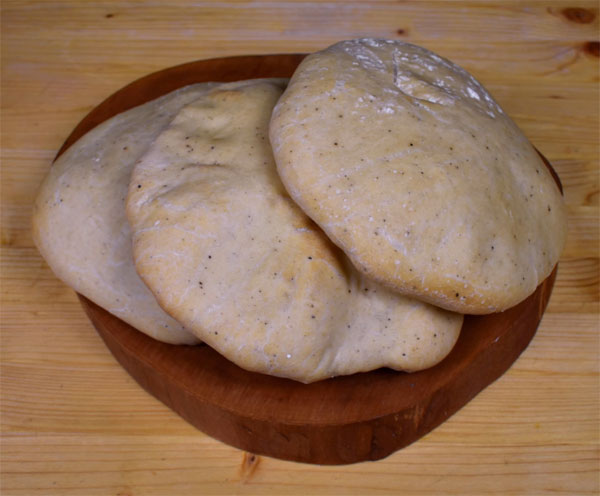
Flatbread flavored with wine, olive oil and black pepper
The artolaganon was a Greek bread called in this way because delicious (a deliciis [appellati] ut artolagani), Pliny writes. This bread is mentioned also by Cicero, but we do no find recipes in the Latin sources, but there is a complete description in the Deipnosophists (which can be translated as “the learned in the art of the banquet”), a beautiful book written by Athenaeus of Naucratis (2nd century) which collects information about banquets, music, dance, and other aspects of the daily life of Greeks as well as quotations of sources otherwise lost. It is the most important source of ancient Greek cuisine.
The recipe of the artolaganon comes from a book about baking, unfortunately not survived, written by Chrysippus of Tyana. We know little about this author, except that he came from Tyana, in Cappadocia, which in the 1st century became an important eastern province of the Roman Empire.
Artolaganon means laganon bread. Laganon appears frequently in both Greek and Roman sources. Hesychius, a Greek grammarian lived in the 5th century, describes it as a circular sheet of dough made with water and white wheat flour, dried and fried in olive oil. Athenaeus confirms the shape of the laganon, adding that it is thin.
We prepared the artolaganon keeping the shape and the thinness, with the ingredients mentioned by Chrysippus. The author does not describe the method to cook it, but ancient Romans and Greeks usually baked their bread in the oven or under the testum or the clibanus. We used our hand-made testum, copied from the archaeological artifacts.
Chrysippus writes about two kinds of yeast, dried and fresh, but does not specify which kind to choose for this bread. We used a recipe from the Naturalis Historia by Pliny, in which the author describes the ways to make the yeast.
Sourdough Starter from Fermented Barley (used as leaven for bread) - or use sourdough starter
Original text
Quo libeat vero tempore ex aqua hordeoque bilibres offae ferventi foco vel fictili patina torrentur cinere et carbone, usque dum rubeant. Postea operiuntur in vasis, donec acescant. Hinc fermentum diluitur. Cum fieret autem panis hordeacius, ervi aut cicerculae farina ipse fermentabatur; iustum erat II librae in V semodios.
(Naturalis Historia by Pliny)Translation
In any time of the year, once there were prepared two-pound cakes with water and barley, warmed up on the fire directly or in a clay vessel on ash and charcoal until they turn red. Then they were put in vessels until they acidify. From this preparation, the leaven was diluted. When people made barley bread, they fermented it with vetch or grass pea flour, two pounds [of yeast] in two and a half modii.
500 gr barley flour
water
Knead well the flour with warm water until you reach a smooth consistency. Shape a cake and place it in a pan. Warm it up until it begins browning. Remove from the fire and place the cake in a vessel, leaving it there for a few days until it turns sour.
[In the video they briefly cooked the round cake of barley dough on both sides. The inside of the cake was still raw and is what fermented. They scooped out some of this inside soft dough to use as the leaven,]
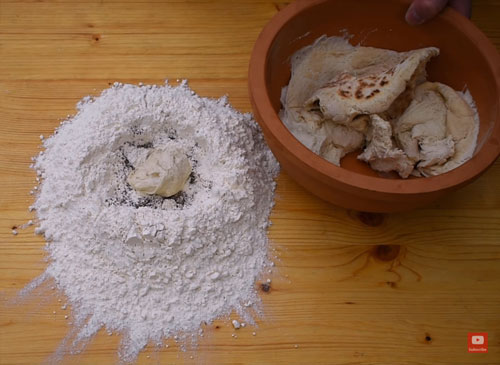
Sourdough Leavener from fermented Barley used to make bread
Note about the method
The time needed to obtain the sourdough changes depending on the temperature of the room and the season. We obtained our sourdough in about a week.
This method, so different from the ones used today, has probably a practical reason: cooking the external part will form a crust that will protect the growth of the bacteria necessary for the fermentation process. We suggest not reducing excessively the amount of the ingredients to prevent the dough from cooking internally and killing in this way the wild yeasts.
Pliny’s recipe is for a cake weighting 650 grams (one Roman libra weights 327 grams), necessary to ferment about 22 liters of flour. To prepare our bread, we used a tablespoon of sourdough.
Artolaganon
Original text from Chrysippus in Deipnosophists
εἰς δὲ τὸ καλούμενον ἀρτολάγανον ἐμβάλλεται οἰνάριον ὀλίγον καὶ πέπερι γάλα τε καὶ ἔλαιον ὀλίγον ἢ στέαρ.Translation
About the so-called artolaganon, put together a little wine, pepper, milk, and a little oil or fat.
600 gr white wheat flour
white wine
olive oil
milk
black pepper
salt
sourdough
Grind in the mortar the pepper. Pour the flour on the table adding two pinches of salt, pepper, one tablespoon of sourdough, a little wine and olive oil, and the milk. Knead well and continue to add milk until the dough reaches a smooth consistency. Let it rest at least overnight, then knead again and divide it into four pieces. Shape a ball of dough and roll it out using a rolling pin until 2 - 3 mm thick keeping a circular form. Let the bread rest for at least 15 minutes. Bake it in the oven or under the testum for about 15-20 minutes. Serve still hot or warm.
Note about the method and the ingredients
The author does not provide information about the kind of yeast needed for this recipe, but the artolaganon is listed among leavened breads made with wheat. Wheat was the most common cereal used by Greeks and other populations, Galen writes in the 2nd century, but Athenaeus mentions breads made with barley, rye, spelt, and rice.
Galen writes that the bread easiest to digest is prepared with a good amount of leaven, salted, cooked for a long time, and made with white wheat flour. Galen and Athenaeus write also about breads made with flour containing more or less bran, from the white one to the bran bread, the hardest to digest.
To prepare this recipe, you can use also other kinds of leaven, for example, the mustei we made a few months ago. Ancient Romans knew also ale yeast, according to Pliny used mainly for cosmetic purposes, while in other countries, for example Gaul and Spain, people used it to leaven bread.
