Another Cold Asparagus Patina (w/ fig-peckers)
by Apicius - 132 A.D., from http://www.coquinaria.nl/english/recipes/05.3histrecept.htm
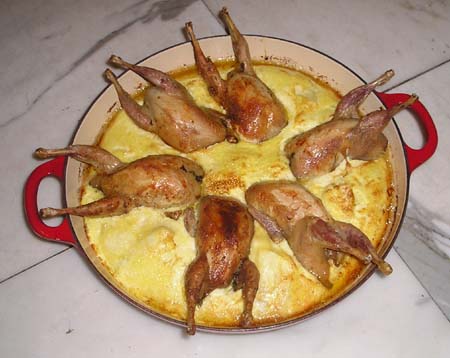
Cold Asparagus Patina with Quail
The original recipe, taken from De Re Coquinaria, in the beautiful edition of Christopher Grocock and Sally Grainger (Prospect Books 2006, pp.178/179).
For another Asparagus Patina, see below.
aliter patina de asparagis frigida:
accipies asparagos purgatos, in mortario fricabis; aqua suffundes, perfricabis; per colum colabis, et mittes fecitulas curatas; teres in mortario piperis scrupulos sex, adicies liquamen; fricabis; uini ciatum I, passi ciatum I; mittes in caccabum olei uncias tres; illic ferueant. perungues patinam; in ea oua VI cum enogaro misces; cum suco asparagi inpones cineri calido. [mittes inpensam super scriptam]* tunc ficetulas conpones, coques; piper asparges et inferes.
* According to Grocock/Grainger this passage is corrupt and added by a later scribe.
English translation:
Another cold asparagus patina.
Take cleaned asparagus, pound in the mortar, add water, beat thoroughly and pass through a sieve. Next put in a saucepan fig-peckers* which you have prepared for cooking. Pound in the portar 6 scruples of pepper, moisten with liquamen, grind well, add one cyathus of wine and one cyathus passum. Put in a saucepan 3 oz. oil. Bring the mixture to the boil. Grease a patina pan, and mix in it 6 eggs with oenogarum, put it with the sparagus purée in the hot ashes, pour on the mixture described above, and arrange the birds on top. Cook it, [let it cool], sprinkle with pepper, and serve.
*small songbirds called ficedulae, 'fig-peckers' (Sylvia hortensis). These are very small, about the size of a robin. Faas mentions other possibilties, like the Garden Warbler (Sylvia borin), Dunnock or Hedge Warbler (Prunella modularis) and the Pied Flycatcher (Ficedula hypoleuca). When you imagine these small birds plucked of their feathers they are even smaller. If making this dish, substitute quail for the fig-peckers.
Modern adaptation of the recipe
For 4 persons as first course, for 2 persons as main course; preparation in advance 30 minutes; preparation 35 minutes.
500 gram (3 cups) white asparagus
1/4 decilitre (1 cup) white wine
1/4 decilitre (1 cup) Vino Santo (see note for passum)
freshly ground pepper to taste (but please use less than the original recipe, because that is half a tablespoon full)
fish sauce to taste (this is the salt. Use Eastern fish sauce, or home made), 1 tsp. to 1 Tbsp.
1/2 deciliter (1/4 cup) olive oil
4 eggs
2 or 4 quails
Preparation in advance
Soak the asparagus in cold water for an hour before peeling them. Then peel the asparagus, and cut off the wooden ends of the stalks. Cut off the asparagus heads (5cm/3 inches) and keep them apart. Boil the asparagus stalks in salted water for about ten minutes (very thick ones fifteen) (when you add the asparagus peel you'll end up with an excellent base for asparagus soup). Take the stalks out of the water, boil the heads in the same liquid for five minutes. Green asparagus do not have to be peeled, you can either boil them a few minutes, or fry them in olive oil.
Purée the asparagus stalks. It is very important that you have removed ALL the peel from the stalks, because any leftover peel will remain in the purée as hard, disagreeable strings.
Fry the quails in olive oil for twenty minutes (or poach them, or roast them). Leave them whole or cut them in two.
Temper white wine with Vino Santo and fish sauce (this mixture is called oenogarum). Add pepper and olive oil. According to the original recipe you should bring this to the boil and then mix it with the eggs. This would cause the eggs to curdle. It is best to add the oenogarum in small quantities at the time, stirring the eggs all the while. When this is done, add the asparagus purée.
Preparation
Preheat an oven to 200dgC (392dgF). Grease a round or oval dish with olive oil and pour in the egg-mixture. Divide the saved asparagus heads over the eggs (they will probably sink into the eggs), and the quails. Cover the dish with aluminium foil, and place it in the middle of the oven for 20 to 30 minutes. Remove the foil after 10 to 15 minutes.
If you prepare this dish in larger quantities you'll have to leave the dish in the oven longer (and use a larger dish).
To serve
The patina is served in the dish in which it is prepared. According to the title of the recipe it must be served cold (that is, at room temperature), but when you are hungry and do not want to wait, it is also very tasty when hot.
The other Asparagus Patina
In his book Around the Table of the Romans Faas provides us with the other recipe for patina with asparagus, and he remarks that it is almost the same as this recipe. So: simply put quails in the patina with green asparagus, and you have made this one. In my opinion these two recipes are not interchangeable. Because according to Faas in the recipe for the "aliter patina de asparagis," green asparagus are explicitly mentioned, I take it that in the "patina frigida de asparagis," white asparagus are used. Moreover, in the 'aliter' green herbs are added (lovage, coriandre leaves, satureia), and an onion, and passum is not mentioned (although that could simply have been forgotten).
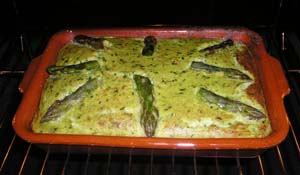
As you can see on the picture on the left, this patina looks different: it is green. No wonder, with green asparagus instead of white ones, and green herbs. The taste is also different, cilantro leaves and lovage are quite distinctive. To me, this patina is less subtle and refined than the patina with white asparagus, but it tastes good nevertheless.
The recipe is clear and does not need to be interpretated (just look at the recipe above), I just present the translation with the Latin text from the edition by Grocock and Grainger. They interpretate the 'asparagorum praecisuras' not as (green) asparagus tips as do Flower and Rosenbaum (and Faas), but as the coarse, hard root-ends of the stems (Grocock and Graingers p.180). So the recipe would be a way of using kitchen waste. In my rendering of the recipe I chose for the interpretation of Flower and Rosenbaum, simply because I like the combination of green asparagus with green herbs better, but I think Grocock and Grainger are right.
aliter patina de asparagis:
adicies in moratrio asparagorum praecisuras quae proiciuntur; teres, suffundes uinum, colas, teres piper ligusticum coriandrum uiridem satureiam cepam uinum liquamen et oleum; sucum transferes in patellam perunctam et si uolueris oua dissolues ad ignem ut obliget, piper minutum asparges.
Another patina of asparagus (translation)
Put in a mortar the trimmings of asparagus which are thrown away, pound them, pour on wine and strain them. Pound pepper, lovage, green coriander, savory, onion, wine, liquamen and oil. Pour the liquor into a greased dish and if you want stir eggs in over the fire so that it thickens, sprinkle with ground pepper.
