Making Cheese with The Romans - Columella’s Cheese
from https://tavolamediterranea.com/
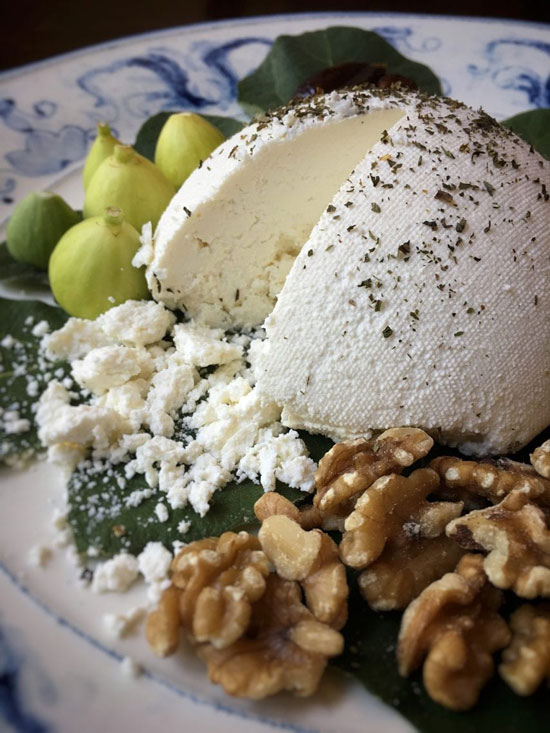
Columella tells us about cheese-making in De Re Rustica (Book VII, Chapter VIII) in the following passages:
Liber VII: “VIII. Casei quoque faciendi non erit omittenda cura, utique longinquis regionibus, ubi mulctram
devehere non expedit. Is porro si tenui liquore conficitur, quam celerrime vendendus est, dum adhuc viridis succum retinet : si pingui et opimo, longiorem patitur custodiam. Sed lacte fieri debet sincero et quam recentissimo. Nam requietum vel aqua mixtum celeriter acorem concipit. Id plerumque cogi agni aut haedi coagulo; quamvis possit et agrestisi cardui flore conduci, et seminibus cneci, nee minus ficulneo lacte, quod emittit arbor, si eius virentem saucies corticem. Verum optimus caseus est, qui exiguum medicaminis habet. Minimum autem coagulum recipit sinum lactis argentei pondus denarii. Nee dubium quin fici ramulis glaciatus caseus iucundissime sapiat.“
et
Liber VII: “VIII. Nam is, qui recens intra paucos dies absumi debet, leviore cura conficitur. Quippe fiscellis exemptus in salem muriamque demittitur, et mox in sole paulum siccatur. Nonnulli antequam pecus numellis induant, virides pineas nuces in mulctram demittunt, et mox super eas emulgent, nee separant, nisi cum transmiserint in formas coactam materiam. Ipsos quidam virides conterunt nucleos, et lacti permiscent, atque ita congelant. Sunt qui thymum contritum cribroque colatum cum lacte cogant. Similiter qualiscunque velis saporis efficere possis, adiecto quod elegeris condimento. Ilia vero notissima est ratio faciendi casei, quem dicimus manu pressum, Namque is paulum gelatus in mulctra dum est tepefacta, rescinditur et fervente aqua perfusus vel manu figuratur, vel buxeis formis exprimitur. Est etiam non ingrati saporis muria perduratus, atque ita malini ligni vel culmi fumo coloratus.“
We can translate from these passages that:
“Book VII: “VIII. It will be necessary too not to neglect the cheese-task of cheese-making, especially in distant parts of making the country, where it is not convenient to take milk to the market in pails. Further, if the cheese is made of a thin consistency, it must be sold as quickly as possible while it is still fresh and retains its moisture; if, however, it is of a rich and thick consistency, it bears being kept for a longer period. Cheese should be made of pure milk which is as fresh as possible, for if it is left to stand or mixed with water, it quickly turns sour. It should usually be curdled with rennet obtained from a lamb or a kid, though it can also be coagulated with the flower of the wild thistle or the seeds of the safflower, and equally well with the liquid which flows from a fig-tree if you make an incision in the bark while it is still green. The best cheese, however, is that which contains only a very small quantity of any drug. The least amount of rennet that a pail of milk requires weighs a silver denarius and there is no doubt that cheese which has been solidified by means of small shoots from a fig-tree has a very pleasant flavour.”
and:
Book VII: “VIII. Cheese which is to be eaten within a few days while still fresh, is prepared with less trouble; for it is taken out of the wicker-baskets and dipped into salt and brine and then dried a little in the sun. Some people, before they put the shackles on the she-goats, drop green pine-nuts into the pail and then milk the she-goats over them and only remove them when they have transferred the curdled milk into the moulds. Some crush the green pine-kernels by themselves and mix them with the milk and curdle it in this way. Others allow thyme which has been crushed and pounded through a sieve to coagulate with the milk; similarly, you can give the cheese any flavour you like by adding any seasoning which you choose. The method of making what we call ” hand-pressed ” cheese is the best-known of all : when the milk is slightly congealed in the pail and still warm, it is broken up and hot water is poured over it, and then it is either shaped by hand or else pressed into box-wood moulds. Cheese also which is hardened in brine and then coloured with the smoke of apple-tree wood or stubble has a not unpleasant flavour.”
Making Cheese with The Romans – Columella’s Cheese
1 gallon (4 litres) of whole goat’s milk (or cow’s milk) – 3.5-4% Milk Fat.
20 fig-leaf stems to make fig rennet (or vegetable rennet)
Salt
*Optional: Dried mint, walnuts, figs.
Colander or basket
Cheese cloth
Whisk
Large pot and small saucepan
Kitchen clamp
Fig-Sap Rennet (Optional)
Stems from 20 fig leaves
To make the fig-sap rennet, cut 20 fig leaves from the tree at the base against the trunk. You’ll see white latex fluid dripping from the base and this is the liquid we are trying to contain. *Use caution in handling the sap if you have sensitive skin. Cut the stems from the leaves and make a lateral slice down the centre of each stem. Place in a saucepan with one cup of water and boil on medium until the water is reduced from 1 cup to approximately 3 tbsp. The water will be opaque by the end of the reduction and will have a distinct herbal tea-like smell to it. Set this rennet aside and use it when it is called for in the recipe.
Cheese Preparation
Step 1. Use a large pot to bring your milk to a boil on high. Whisk the milk the entire time to ensure that it doesn’t burn, clump or stick to the bottom of the pot.
Step 2. Wait for it to boil over. It’ll happen at about the 10 minute mark and when it does you want to quickly turn off the element. Make sure that you’re using a deep pot or one that will allow the milk to overboil to almost twice its height without overflowing onto the oven-top.
Step 3. Let the milk stand for 15 minutes.
Step 4. Pour in your choice of rennet and stir it in gently. *If you decide to make the fig rennet, see the instructions above. If you are using vegetable rennet, a teaspoon should do the trick. If you’re using vinegar, a tablespoon will be ample for this recipe. If you’re using lemon, cut the lemon in half and squeeze the juice from both halves into the boiled milk. Let stand for 30 minutes as curds separate from whey.
Step 5. While the milk is separating, get a colander or a basket and some cheese-cloth. Cover the colander with a 2-ply layer for cheese-cloth so that you have enough room on all sides to eventually pull it over the curds. Once it is apparent that the curds and whey have separated, gently pour the liquid into the cloth-lined colander and place it in a pot or in a clean sink. Let stand for an hour until most of the whey has drained out. This may take a while and you don’t want to rush it too much.
Step 6. Once most of the whey has drained, dispose of the whey. Some folks may want to keep it but the rennet flavouring of fig-sap, lemon or vinegar may remain in the whey and may not be too palatable.
Step 7. Grab all corners and edges of the cheese-cloth and gather it over the curds. Twist it and gently squeezing out any remaining whey. Using a kitchen clamp, clamp the top of the cloth to create a tight environment for the curds to further drain, this time under weight. We are going to press our cheese!
Step 8. Under a clean and heavy object in your kitchen (I used my marble mortar) let the curds stand for another hour or so to further drain. By the end of this step, we’ll be ready to wash the curds and salt the cheese. You have the option to serve and eat the cheese at this stage as a fresh ricotta-like soft cheese. It’s beautiful and creamy at this stage. If you’d like to salinate or solidify the cheese, keep following along.
Step 9. For this step, I have decided to take some license and replicate sea-water to make a muria (brine) for washing and salting the curds. My milk is not raw and it is pasteurized so I decided, for simplicity’s sake, to salt brine the cheese instead of age it as Columella describes in other lines of his cheese-making process. Salt was a prime commodity for Romans and it wasn’t always readily available. Apicius used seawater for cooking boar. Sea water was sometimes used by cheese-makers, historically, to salinate and separate curds so I decided to try to replicate that for this salination process; it also firms fresh cheese without having to let it sit and age for a long period of time (Sea water is approximately 3.5% salination so I filled a deep pot with 2 litres (4 cups of water) and 70 ml (5 tbsp of salt) and brought it to a boil). Drop the clamped curds in the cheese-cloth into the boiling salt-water and turn it down to low to simmer for one hour.
Step 10. Remove the cheese and leave the cheese-cloth and clamp on while placing it in a colander and in the fridge to chill over night.
Step 11. In the morning you will have a firm, crumbly, rich and tangy goat-cheese that can be served with a myriad of complementary pairings. I chose to taste the cheese with Roman foodstuffs that go beautifully with goat-cheese: walnuts, figs, dates, olives and dried mint.
The end result was absolutely amazing. Just the right amount of salt and a crumbly texture much like feta. Once in the mouth it turns creamy and has a beautiful, fresh, open flavour. I was rather proud of myself on this one. The fact that the fig rennet worked like a charm made me feel pleased but also excited to taste the results of this unusual and historically Roman method of cheese-making. Again, it does have a slightly bitter aftertaste but I’ll bet you that it tastes a lot better than if I’d decided to use fresh animal rennet from a rumanant’s stomach! No thank you! Experimental food archaeology wins again!
