Globuli
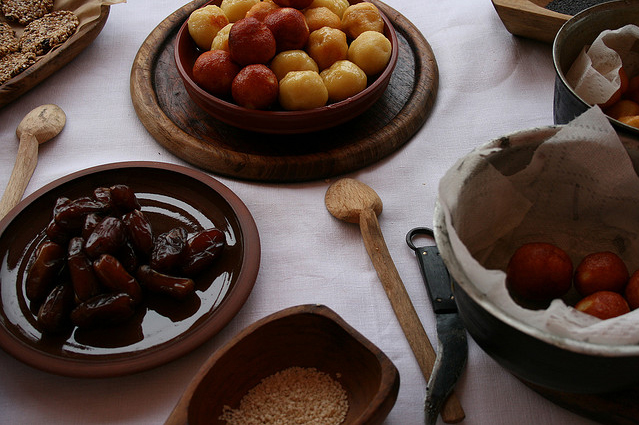
Roman Food: plate of dates with Globuli center back.
Fried pastries are hardly new. Deep-fried dough was popular among Romans, including, as recounted by Cato the Elder (around 160 BCE), cheese fritters called globi/globuli (balls).
Later, the Roman cookbook author Apicius (c. 400 CE) described the making of vermiculos (Latin for "little worms"), deep-fried strips of dough bathed in the ubiquitous pungent Roman condiment liquamen (fermented fish sauce). After the fall of the Roman Empire, however, these fried doughs disappeared from much of Europe.
Today, Italians make what are called Struffoli, or Honey Balls, a traditional sweet served at Christmas. Struffoli do not traditionally contain cheese as Globuli do.
Globuli
We can grasp that the shape of Cato’s delicacies is a ball; the word 'globus' in Latin mean 'sphere' or 'globe.'
"Mix the [soft white] cheese and spelt flour in equal parts, sufficient to make the number desired. Pour fat into a hot copper vessel, and fry one or two at a time, turning them frequently with two spoons. Remove when done, coat them with honey, and sprinkle poppy seeds on it. They are ready to serve." (Cato, the Elder)
Globi
from https://historicalitaliancooking.home.blog/
Original text (Cato, De Agri Cultura)
Globos sic facito. Caseum eum alica ad eundem modum misceto. Inde quantos voles facere facito. In ahenum caldum unguen indito. Singulos aut binos coquito versatoque crebro duabus rudibus, coctos eximito, eos melle unguito, papaver infriato, ita ponito.Translation
Prepare in this way the globi. Mix the same quantity of cheese and alica and shape all the globi you want. Pour fat in a hot copper pot. Cook one or two globi at a time, turning them frequently with two spatulas. Remove them from the fire when they are cooked, pour over honey, sprinkle with poppy seeds, and serve them.
The globi are made with just alica, husked spelt coarsely pounded without reducing it into flour, cheese fresh enough to be mixed with the spelt, honey, and poppy seeds. As Pliny writes, ancient Romans preferred white poppy seeds to prepare food.
Alica and cheese are mixed in equal parts. Cato, in this passage of the book, does not specify how to prepare alica for this recipe, but for two other recipes he states clearly that it must to be soaked in water: for the placenta he writes, “alicam in aquam infundito,” and then again, to make the puls Punica, “libram alicae in aquam indito”.
To fry the globi, we used lard (in Latin unguen, a generic term for fat), but if you prefer, use olive oil.
We suggest serving the globi still hot.
200 gr spelt
200 gr fresh cheese
lard
honey
white poppy seeds
Pound a little the spelt in the mortar without reducing it to flour, then steep it in water overnight. Discard the water and mix the spelt with the cheese until the mixture reaches a smooth consistency. Shape little balls of dough with your hands.
Melt a good amount of lard and fry the globi one or two at a time. When they are cooked, pour over honey and sprinkle them with white poppy seeds. Serve still hot.
