Baked Ham in Pastry with Figs (Ham Pernam)
"[287] [Baked picnic] Ham [Pork Shoulder, fresh or cured] Pernam The hams should be braised with a good number of figs and some three laurel leaves; the skin is then pulled off and cut into square pieces; these are macerated with honey. Thereupon make dough crumbs of flour and oil. [1] Lay the dough over or around the ham, stud the top with the pieces of the skin so that they will be baked with the dough [bake slowly] and when done, retire from the oven and serve. [2]"
---Apicius, Book VII, IX, Apicius: Cookery and Dining in Imperial Rome, edited and translated by Joseph Dommers Vehling, facsimile 1936 edition [Dover Publications:Mineola NY] 1977 (p. 169)
[NOTES (appended to this recipe: [1] Ordinary pie or pastry dough, or perhaps a preparation similar to streusel, unsweetened.
[2] Experimenting with this formula, we have adhered to the instructions as closely as possible, using regular pie dough to envelope the parboiled meat. The figs were retired from the sauce pan long before the meat was done and they were served around the ham as a garnish.]
Compare with this Latin text, English translation and modern instructions:
"Pernam, ubi eam cum caricis plurimis elixa veris et tribus lauri foliis, detracta cute tessellatim indicis et melle complebis. Deinde farinam oleo subactam contexes et ei corium reddis et cum farina cocta fuerit, eximas furno ut est et inferes."
Boil the ham with a large number of dried figs and 3 bay leaves. Remove the skin and make diagonal incisions into the meat. Pour in honey. Then make a dough of oil and flour and wrap the ham in it. Take it out of the oven when the dough is cooked and serve. (Ap. 393)...
"Cover the base of a pan, large enough to take the ham, with figs and lay the ham, stuffed with figs, on top. Fill the pan with water, and add 3 bay leaves. Cover, and boil the ham for 1 hour over a low heat. In the meantime make the pastry...When the ham is cooked, dry it well and make incisions all over the flesh. Baste it with honey while it cooks. Then wrap it in the dough and decorate it. Preheat the oven to 200 C/400 F/Gas 6, and bake for 30 minutes until the crust is golden. leave to cool." (p. 268)
"Pastry dough: Roman pastry dough was made with lard or olive oil rather than butter. Use double the weight of fat in flour. Spelt flour needs rather less fat than wheat flour. Rub the fat into the flour until it resembles breadcrumbs. Pour in a little salted water and press the crumbs into a ball. Leave in a cool place for several hours. Then roll it into a sheet on a marble surface dusted with flour, and use as the recipe requires." (p. 195)
---Around the Roman Table: Food and Feasting in Ancient Rome, Patrick Faas [Palgrave MacMillan:New York] 2003 ?
Immediatedly after this Apicius gives a recipe for ham cooked in the same way with figs, but served diced with croutons or mustaceum bread.
Another Modern Recipe
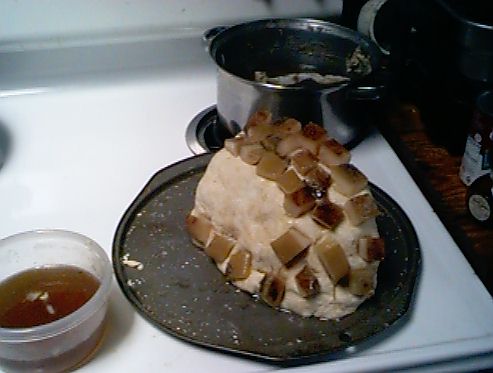
Pernam Ham before being baked
In Rome and Greece of the time, names for things were not always what we currently use. Ham has long been an alternate name for a haunch or thigh of an animal. It does not always mean cured with salt as our ‘boiled’ or cured hams are today. For this recipe I use a picnic shoulder. Laurel leaves are called Bay leaves now.
1 pork picnic shoulder/fresh pork ham of about 4 lbs
1 lb dried figs, coarsely chopped
3 bay leaves
dash of garum [fish sauce]
black pepper to taste
honey
4 large handfuls of spelt or regular flour
olive oil
Place pork picnic, figs and bay leaves in a pot just large enough to comfortably hold them.
Just enough water to come about one third to one half up the sides of the pot. Place in a 350 degree Fahrenheit oven for 2 hours covered. After 2 hours, remove and let cool.
Remove the fat and skin.
Reserve the braising liquid - remove the cooled fat from the broth and simmer until slightly thickened. Force through a sieve to puree and put back into the pot. Add a dash of garum [fish sauce] and black pepper to taste, and simmer for another 15 minutes or so. This is not mentioned in the recipe, and there are other sauce recipes in Apicius’ cookbook but I hate wasting perfectly good sauce ingredients!
Take the fell (fat and skin) and cut it into squares, and marinate for at least an hour in good honey.
Make a dough of about 4 large handfuls of flour. You can use regular flour, I used spelt, which is actually a form of wheat used by the Romans. You simply add olive oil in small amounts until it makes a dough about the consistency of buttermilk biscuit/scones.
I make a small one third of an inch oval of the dough [sized to fit the roast] and then make a larger sheet to drape over the top. I use some more oil to moisten the edges to seal them together. Then you take the little pieces of fell and stud them over the dough.
Bake the resulting lump in a sort of slow oven, for modern terms about 300 degrees Fahrenheit until the dough has browned nicely, and the fat is mostly rendered out of the fell [like modern 'cracklings' for American southerners.] Crack the dough off after picking off the pieces of fell. Slice into fingers of meat, garnish with the pieces of fell. I added almond stuffed dates and although it doesn't mention doing so, a simple sauce of simmered down braising liquid with a dash of garum and some black pepper added.
