Ancient Honey and Sesame Fritters - (Arxaies Tiganites Me Meli Kai Sousami)
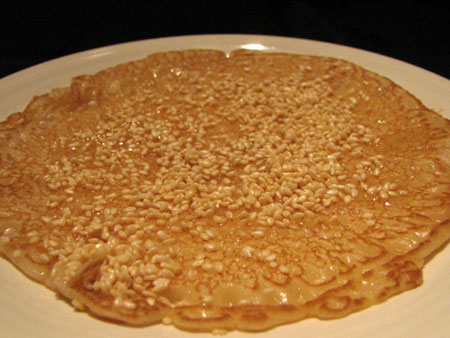
The oldest testimony of teganitai comes from the 5th century b.c. and is found in the corpus of the comic poets Cratinus and Magnes. Although only fragments are saved to our days, we learn from Cratinus that they were served steaming in the morning, while Magnes tells us they are topped with or soaked in honey. A later author of the Hellenistic times, Galen of Pergamon, describes the preparation in detail, in his book ''On the properties of foodstuffs''.
Galen was a Greek physician, writer and philosopher who lived during the Roman Period, between 129-216 CE. Galen wrote a lot of books about medicine and health-related philosophy, but this one is focused mostly on Greek dietetics, or the properties of certain types of common foods in the Greek diet. Galen built upon Hippocrates’ theory of the four humours, and his work later formed the basis of Arab and European medical and dietary practices in the Middle Ages and beyond.
Galen believed that cakes cooked with honey had superior health benefits to those without. He supplies this description of a type of unleavened pancake called Teganitai. Tiganites (tee-gah-NEE-tes)
from Galen, On the Capacities of Foods 1.3 (6.490–492 K.)
Περὶ δὲ τῶν ἄλλων πεμμάτων, ὅσα σκευάζουσιν ἐξ ἀλεύρου πυρίνου, καιρὸς ἂν εἴη λέγειν. οἱ μὲν οὖν ταγηνῖται παρὰ τοῖς Ἀττικοῖς ὀνομαζόμενοι, παρ' ἡμῖν δὲ τοῖς κατὰ τὴν Ἀσίαν Ἕλλησι τηγανῖται σκευάζονται δι' ἐλαίου μόνου. βάλλεται δὲ τὸ μὲν ἔλαιον εἰς τάγηνον ἐπικείμενον ἀκάπνῳ πυρί, καταχεῖται δ' αὐτῷ θερμανθέντι τὸ τῶν πυρῶν ἄλευρον ὕδατι δεδευμένον πολλῷ. διὰ ταχέων οὖν ἑψόμενον ἐν τῷ ἐλαίῳ συνίσταται καὶ παχύνεται παραπλησίως ἁπαλῷ τυρῷ τῷ κατὰ τοὺς ταλάρους πηγνυμένῳ. τηνικαῦτα δ' ἤδη καὶ στρέφουσιν οἱ σκευάζοντες αὐτό, τὴν μὲν ἄνωθεν ἐπιφάνειαν ἐργαζόμενοι κάτωθεν, ὡς ὁμιλεῖν τῷ ταγήνῳ, τὸ δ' αὐτάρκως ἡψημένον, ὃ κάτωθεν ἦν πρότερον, εἰς ὕψος ἀνάγοντες, ὡς ἐπιπολῆς εἶναι, κἀπειδὰν ἤδη καὶ τὸ κάτω παγῇ, στρέφουσιν αὖθις αὐτὸ δίς που καὶ τρίς, ἄχριπερ ἂν ὅλον ὁμαλῶς αὐτοῖς ἡψῆσθαι δόξῃ.
εὔδηλον οὖν, ὅτι παχύχυμόν τε τοῦτ' ἐστὶ καὶ σταλτικὸν γαστρὸς καὶ χυμῶν ὠμῶν γεννητικόν. διὸ καί τινες αὐτῷ μιγνύουσι μέλιτος, εἰσὶ δ' οἳ καὶ τῶν θαλαττίων ἁλῶν. εἴη δ' ἂν ἤδη τοῦτό γε πλακοῦντός τι γένος ἢ εἶδος ἢ ὅπως ἂν ὀνομάζειν ἐθέλῃς, ὥσπερ καὶ ἄλλα πολλὰ τοιαῦτα πλακούντων εἴδη συντιθέασιν αὐτοσχεδίως οἵ τε κατ' ἀγρὸν ἄνθρωποι καὶ τῶν κατὰ πόλιν οἱ πενέστατοι. τοιγαροῦν καὶ ὅσα διὰ κριβάνου τῶν ἀζύμων πεμμάτων ὀπτῶσιν, εἶτ' ἀφελόντες ἐμβάλλουσιν εὐθέως εἰς μέλι θερμόν, ὡς δέξασθαι δι' ὅλων ἑαυτῶν αὐτό, καὶ ταῦτα πλακοῦντός τι γένος ἐστὶ καὶ τὰ διὰ τῶν ἰτρίων σκευαζόμενα μετὰ μέλιτος πάντα.
Translation - On pastries
Now might be the time to speak of the other sweetmeats that they make from wheaten flour. What are called girdle-cakes [tagenitai] by the Athenians but griddle-cakes [teganitai] by us, the Asiatic Greeks, are prepared with olive oil alone. The oil is placed in a frying pan that is put on a smokeless fire, and when it has become hot the wheaten flour, soaked in a large amount of water, is poured into it. When cooked in the oil, it rapidly sets and thickens, resembling soft cheese solidifying in the wicker baskets. At this point those making it turn it to bring the upper surface underneath, in contact with the pan, bringing what was previously underneath, in contact with the pan, bringing what was previously underneath, which has been sufficiently cooked, to the top; when the underpart is now set, they turn it again, perhaps two or three times, unitl it seems to them that the whole has been cooked evenly.
It is obvious that this has thick juice, restrains the stomach and gives rise to crude humours. This is why some mix honey with it, and there are those who also mix in sea salt. This, then, would be a class (or species, or however you want to refer to it) of flat-cake, just as country folk and very poor town-dwellers make many other such flat-cakes from whatever is to hand. For that reason those unleavened sweetmeats which they bake in a kribanos and immediately remove and put into warm honey, so that they are saturated with it, are also a type of flat-cake; and so too are all such items made with honey.
~ Galen, De alimentorum facultatibus (On the Properties of Foods) 1, 3, Translation by O. Powell
This recipe doesn’t mention sesame, but other Greek literature does. Traditional tiganites are often topped with toasted sesame seeds or crushed walnuts, so there is no reason you can’t top your pancakes with either ingredient.
Source: The Classical Cookbook, Andrew Dalby and Sally Grainger.
It's amazing how little food changes from one millennium to the next. When reading the Roman physician Galen's description of making pancakes, it is hard to remember that he is writing 1,800 years ago! The early Greek poet Hipponax had written of pancakes 'drugged with sesame seeds'. This was likely a breakfast meal and one that was possibly sold on the streets of ancient Athens from portable braziers. These pancakes are thicker than the crêpe-style pancakes familiar to us (more like a blini, or even thicker) and they are served with honey and toasted sesame seeds.
120 g (4 1/4 oz.) flour
225 ml (1 cup) water
2 tablespoons honey, plus more for topping
oil (for frying)
15 g (1 tablespoon) toasted sesame seeds
Start heating the oil.
Mix the flour, the water and honey and make a dough. [It should pour easily and will likely be a little more watery than the pancake batter you're used to. If you feel it's too watery, add a bit more flour.]
Heat 2 spoons oil in a frying pan and pour ¼ of the mixture.
When it thickens turn it upside down 2 -3 times to fry it in both sides. Prepare 3 more fritters following the given instructions.
Serve them hot, pour over the rest of the honey and dredge sesame seeds over them.
4 fritters
