Panis Strepticius (Kneaded Bread)
Panem depsticium sic facito. Manus mortariumque bene lavato. Farinam in mortarium indito, aquae paulatim addito subigitoque pulchre. Ubi bene subegeris, defingito coquitoque sub testu. (Cato, R. R. LXXIV)
Kneaded bread is made as follows: the flour is placed in a baking trough, and some water is poured over it. Knead. When the dough has been kneaded, roll it out and bake it under a cover. (Cato, R. R. LXXIV)
- translation from Patrick Fass, Around the Roman Table: Food and Feasting in Ancient Rome, p.189
Considering all the techniques known for making all kinds of simple and fancy bread, this looks entirely too simple and short a recipe. But it is the exact formula for sourdough bread (according to one website), which doesn't use yeast but takes its enzyme from the ambient air, and given time of several days (not specified clearly enough here) will rise, to be pushed down (subigo exactly) several times. Technically the title says depsiticum = kneaded. Apparently cooked simply overt a hot plate on an open fire, with an inverted pottery crock serving as a neat little oven. This should give round not long loaves, like those we often see from Italian style bakeries.
Cato's Roman Bread
from http://pass-the-garum.blogspot.com/
Today we're going to start with the simplest of all recipes, and we're going to bake some bread. I'm taking inspiration from Cato the Elder's agricultural handbook, de agri cultura. This manual, written around 160 BCE, is the oldest piece of Roman prose we have, and is a guide to managing a farm. I like this recipe because it's a simple recipe dating from simple times and thus requires few ingredients and relatively little preparation - it's the kind of bread any Roman could have been making at any stage of Roman history. Cato writes:
Recipe for kneaded bread: wash both your hands and a bowl thoroughly. Pour flour into the bowl, add water gradually, and knead well. When it is well kneaded, roll it out and bake it under an earthenware lid. - Cato, On Agriculture, 74
I'm going to take some liberties when it comes to baking the bread under an earthenware lid, as I don't actually own one, but his advice on washing hands and equipment is timeless. As Cato doesn't provide quantities or timings, I've experimented and come up with the following:
500g Spelt flour
350ml Water
A Pinch of Salt
A Splash of Olive Oil
Preheat an oven to 180°C.
Wash hands and wash a large bowl - we're being authentic here!
Add the flour to the bowl along with the pinch of salt. Give it a bit of a mix to distribute salt.
Pour a splash of olive oil into the bowl.
Slowly add in the water, mixing as you go, until you get a dough which isn't too floury and isn't too sticky.
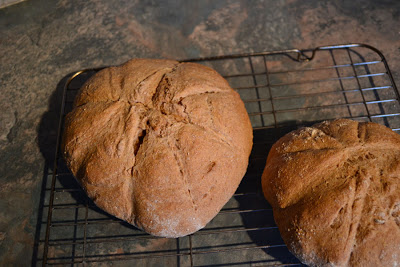
Knead the dough well and form into a circular shape. With a knife, score the top of the loaf, dividing it into 8. This doesn't particularly help with the baking process, but it's how the bread preserved at Pompeii looked, and it's how it's often depicted.
Place on some greaseproof paper on a baking tray and place in the oven for 45 minutes. By this stage the bread should be lovely and crispy and golden on the outside. A good way to tell if it's ready on the inside is to tap the bottom of the loaf - if it's ready it will sound hollow. Because there is no yeast, the bread won't have risen much if at all.
I added the olive oil because it keeps the bread softer for longer, and added salt to enhance the flavour of the bread a bit. I need some bread leftover for my moretum recipe. These two ingredients are ones which any Roman might have access to, so are not inauthentic.
The bread lasted four days before it started to go mouldy.
The bread was a success, and everybody who tried it enjoyed it. The texture and the taste were very 'wheaty' because of the use of Spelt, and I personally am not sure what to make of this flavour. At the minute I find it quite overpowering, but with olive oil and vinegar for dipping the bread is very tasty indeed. Do I envy the Romans? In this instance, not quite.
