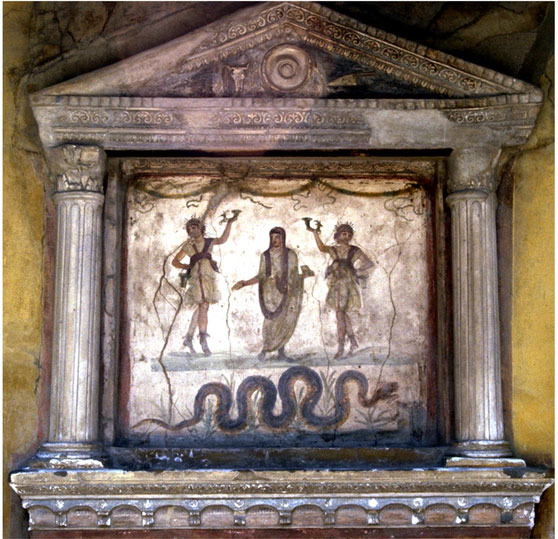
Lararium from the House of Vettii, Pompeii
Lares is represented on both sides of the guardian spirit
of the household who is giving the offering.
The serpent is a symbol of peace and prosperity.
Libum
Libum was a sacrificial cake sometimes offered to household spirits during Rome's early history.
Many ancient cultures placed great faith in their gods, and the Romans were no exception. Although the great and powerful members of the Roman pantheon, like Minerva, Mars, and Jupiter, are well-known today, quite a few religious figures are often overlooked.
They weren’t worshipped in gilded temples and may not have even had names, but the lares and penates were two groups of humble deities with invariably significant impacts on Roman society. These gods were believed to watch over their respective homes and the people within them. Whenever a family had a meal, a bit of the food would be thrown into the hearth to invoke the protection of their home’s lares and penates.
Some homes, particularly the stately villas of patricians, even gave the gods their own shrines called lararia. Occasionally, the eldest man in the house, or the paterfamilias, would organize large offerings to be left in the shrine. From what I [the author] read, these offerings could take place any time, but I would presume they would happen on important dates (holidays, weddings, etc.).
Some of the types of things given included sheaves of wheat, grapes, wine, and, most memorably, a type of honey cake called libum. Though this cake was sold and eaten by the common people of Rome, it appears to have been most commonly used in rituals, both domestic and public.
The recipe below comes from the Roman consul Cato's agricultural writings, which included simple recipes for farmers. Libum, sometimes served hot, is a cheesecake he included.
Libum means ‘cake’. Libare means ‘to offer to the gods’. Libum, according to Virgil, Ovid, Horace, and other Latin authors, was a ritual food prepared as an annual offering to the gods. There were many ways to prepare it. Virgil writes of a libum offered with milk to Priapus; Ovid of one prepared with millet for Vesta, of another eaten with honey for Liber. In the latter case, the author specifies that the libum is prepared by an old woman and split, still hot, between the faithful and the god, identified with Bacchus and considered the discoverer of honey and inventor of beekeeping.
The poet Ovid gave tantalizing descriptions of libum, and described its origins through history into mythology with the discovery of honey by the god Bacchus. It is possible that these cakes were included in Cato’s farming book for religious reasons - to appease the gods, or to ensure the farm’s fertility. It seems that ancient writers associated libum with honey, although Cato did not, and his is the only actual recipe we have.
from Ancient Roman Libum Recipe (from Cato's On Agriculture, reprinted in The Classical Cookbook)
Latin text:
'Libum hoc modo facito. Casei P. II bene disterat in mortario. Ubi bene distriverit, farinae siligineae libram aut, si voles tenerius esse, selibram similaginis eodem indito permiscetoque cum caseo bene. Ovum unum addito et una permisceto bene. Inde panem facito, folia subdito, in foco caldo sub testu coquito leniter.'English translation:
Libum to be made as follows: 2 pounds cheese well crushed in a mortar; when it is well crushed, add in 1 pound bread-wheat flour or, if you want it to be lighter, just 1/2 a pound, to be mixed with the cheese. Add one egg and mix all together well. Make a loaf of this, with the leaves under it, and cook slowly in a hot fire under a brick.A second translation:
'Make libum by this method. Break up two pounds of cheese well in a mortar. When they will have been well broken up, put in a pound of wheat flour or, if you wish it to be more delicate, half a pound of fine flour and mix it well together with the cheese. Add one egg and mix together well. Then make into bread, places leaves beneath, and cook slowly on a hot hearth under an earthen pot.'
LXXV – Of libum
How to make bread for the sacrifice. Crush two pounds of cheese well in the mortar; when it is done, mix in a pound of wheat flour, or only a half-pound of the best flour, if you want it less compact, and mix all this well. Shape your loaves, place them on leaves, and let them cook slowly under the bell on a hot hearth.
Nearly all English translations suggested the leaves in question were bay leaves, picked from the bay laurel tree, a common sight around much of the ancient Mediterranean basin.
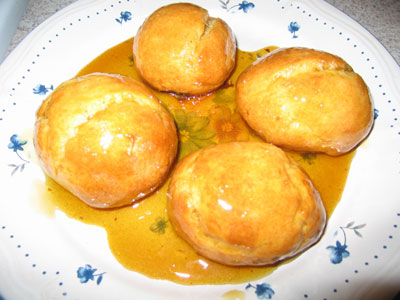 Modern Roman Libum Recipe (serves 4)
from A Taste of Ancient Rome by Ilaria Gozzini Giacosa
1 cup [4 1/4 ounces] plain, all purpose flour
8 ounces ricotta cheese
1 egg, beaten
bay leaves
1/2 cup clear honey
Sift the flour into a bowl. Beat the cheese until it's soft and stir it into the flour along with the egg. Form a soft dough and divide into 4.
Mold each one into a bun and place them on a greased baking tray with a fresh bay leaf underneath. Heat the oven to 425° F. Cover the cakes with your brick* and bake for 35-40 minutes until golden-brown.
Warm the honey and place the warm cakes in it so that they absorb it. Allow to stand 30 minutes before serving.
*The Romans often covered their food while it was cooking with a domed earthenware cover called a testo. You can use an overturned, shallow clay pot, a metal bowl, or casserole dish as a brick.
Libum
reprinted from The Classical Cookbook by Andrew Dalby and Sally Grainger
Andrew Dalby and Sally Grainger give us two recipes for Libum, one sweet and the other savory. Cato’s recipe includes just cheese, flour and egg. But ancient Romans often baked their cakes on bay leaves. Other sweets were served with honey. So to add some interest to the cakes, Andrew Dalby and Sally Grainger give us a recipe for each variation: Sweet Cheesecake and Savoury Cheesecake.
10 oz ricotta cheese
1 egg
2 1/2 oz plain flour
Runny honey
Beat the cheese with the egg and add the sieved flour very slowly and gently. Flour your hands and pat mixture into a ball and place it on a bay leaf on a baking tray. Place in moderate oven (400ºF) until set and slightly risen. Place cake on serving plate and score the top with a cross. Pour plenty of runny honey over the cross and serve immediately.
Serves 2
Another Source that says this recipe is from The Classical Cookbook by Andrew Dalby and Sally Grainger
1 lb (450 g) feta cheese
4 oz (1 cup/ 120 g) plain all-purpose flour
1 egg
2-3 bay leaves
This is ideally made in a food processor. Break up the feta and place in the bowl. Process for 30 seconds until the mixture is smooth. Add the sifted flour and egg and process for a few seconds until you have a soft dough. Mould into a loaf and shape into a slightly flattened circle. Score the top with 3 lines that divide the loaf into 6. Heat the oven to 425 degrees F (220 degrees C/ gas mark 7). Place 2-3 fresh bay leaves under the leaf, cover with your alternative cover and bake for 25 to 30 minutes. Serve while still hot as an accompaniment to meal. Serves four.
3rd Source that says this recipe is from The Classical Cookbook by Andrew Dalby and Sally Grainger
Cato's Cheesecake (Libum)
Cato was a Roman politican of the 1st century BC. Famed for his strict, traditionalist outlook, he wrote about farming, wine making and cooking among other things. This is his recipe for 'libum,' the small sweet cake often given as a temple offering.
1 cup (4 oz) all-purpose flour
8 oz ricotta cheese
1 egg, beaten Fresh bay leaves
1/2 cup (4 oz) clear honey
Heat the oven to 425°. Sift the flour into a bowl. In another bowl, beat the cheese until it is soft then add to the flour along with the egg. Form a soft dough and divide into 4. Mold each one into a bun and place on a greased baking tray with a fresh bay leaf underneath.
Cover the cakes with foil and bake for 25 to 30 minutes until golden brown.
Remove from the oven, score the cakes and pour warmed honey over them. Allow to stand for 10 minutes before serving.
(Taken from The Classical Cookbook by Andrew Dalby and Sally Grainger)
