Lucanian Sausages
This is the most influential of all Roman recipes. The idea was brought back to Rome by soldiers who had served in Lucanica, in the "heel" of Italy, probably around Cato's time. Peppery, spicy, smoked sausages are still made in many parts of the world, from Palestine to Brazil, under names that can be traced back to Lucanica. In Brazil, for example, they are called linguica. Recipes change with time, and modern versions (even the Italian ones) contain few of the original ingredients. Nowadays salami is not smoked anymore, just cured and dried (although some cooked sausages are still smoked as well).
Lucanicae were traditionally smoked above the fireplace and not otherwise cooked. This is no longer possible in the home, but we can still give them a smoky flavour before grilling them. If you have an open fireplace, they can be suspended from the mantelpiece for a few hours while you burn wood. Alternatively you can use your barbecue: sprinkle wood chips over the coals and suspend the sausages at least 30cm/12in above the fire for an hour.
Ancient Roman Lucanian Sausage Recipe (Apicius)
from A Taste of Ancient Rome by Ilaria Gozzini Giacosa
"Lucanian sausages... Pepper is ground with cumin, savory, rue, parsley, condiments, bay berries, and garum. Finely ground meat is mixed in, then ground again together with the other ground ingredients. Mix with garum, peppercorns, and plenty of fat, and pine nuts; fill a casing stretched extremely thin, and thus it is hung in smoke."
Modern Lucanian Sausage Recipe
from Sally Grainger, The Classical Cookbook
1 pound belly pork, minced
2 tablespoons pine kernels
20 black peppercorns
1 teaspoon chopped fresh or dried rue
2 teaspoons dried savory
1 heaped teaspoon ground cumin
1 teaspoon ground black pepper
30 bayberries (if available)
2 teaspoons chopped fresh parsley
3 tablespoons fish sauce
sausage skins
Combine all the filling ingredients and mix well. Use a food processor if available.
If you have fresh sausage skins, they will be preserved in salt and need to be washed. You will need about six 12-inch lengths. Tie a knot in the end of each one.
Put a 1/2 inch plain tube in a piping bag and 1/2 fill with the mixture; do not put too much in at one time or it will be difficult to squeeze. Take the open end of the skin, pull it over the tube and push down repeatedly until the majority of the skin sits like a collar half way down the tube. Grip this with your finger and thumb and slowly release the skin as you squeeze the bag. Stop squeezing well before the skin runs out, leaving 2-3 inches of skin to allow for shrinkage. It will take some practice before you get this procedure right.
When you have used up all the meat, twist each length of sausage into 4 even or similar segments.
If you are able to smoke the sausages, drape them over a coat hanger or similar item and suspend in smoke. You can still give them a smoky flavor before grilling them. If you have an open fireplace, suspend them from the mantelpiece for a few hours while you burn wood. You can use your barbecue: Sprinkle wood chips over the coals and suspend the sausage at least 12 inches above the fire for an hour or so. Otherwise, cut them into individual sausages and grill them under a medium heat.
Serves 6
Smoke Sausages (Lucanicae) - same recipe as above - different instructions
Recipe courtesy Sally Grainger
450g/1lb belly pork, minced (ground)
30g/2 tablespoons pine kernels
20 black peppercorns
1 teaspoon chopped fresh or dried rue
2 teaspoons dried savory
1 heaped teaspoon ground cumin
1 teaspoon ground black pepper
30 bay berries (if available)
2 teaspoons chopped fresh parsley
45ml/3 tablespoons fish sauce
sausage skins
Combine all the filling ingredients and mix well: use a food processor if available. If you have fresh skins, they will be preserved in salt and will need to be washed. You will need about six 30cm/ 12in lengths. Tie a knot in the end of each one. Put a 1cm/12in) plain tube in a piping bag and half-fill with the mixture; do not put too much in at a time or it will be difficult to squeeze. Take the open end of the skin, pull it over the tube and push it down repeatedly until the majority of the skin sits like a collar half-way down the tube. Grip this with your finger and thumb and slowly release the skin as you squeeze the bag.
Stop squeezing well before the skin has run out, leaving 5-7.5cm/2-3in of skin to allow for shrinkage. It will take some practice before you get this procedure right. When you have used up all the meat, twist each length of sausage into four even segments. If you are able to smoke them, drape them over a coat-hanger or similar item and suspend them in the smoke. Otherwise cut them into individual sausages and grill them under a medium heat.
Sausage skins can be bought freshly made from animal gut; synthetic skins are also available. An independent butcher, who makes his own sausages, will be able to help. You will need the chipolata-size skin. There is no need for an elaborate sausage-stuffing machine: a piping bag and a 1cm/12in) icing tube are quite adequate.
Serves 6
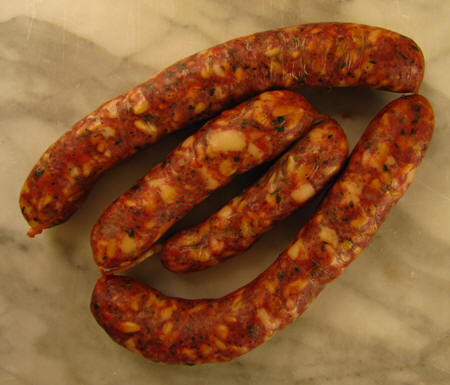
Lucanian sausage
from http://www.coquinaria.nl/
The text is cited from the gorgeous edition of Grocock and Grainger (Apicius, a Critical Edition With an Introduction And English Translation, 2006), pp. 152-154. My translation deviates a little from theirs. They mention liquamen with the spices that have to be pulverized, and translate et with and. Since liquamen is a liquid, I chose to translate et as too and add the liquid to the ground meat; the spices are pounded dry.
LVCANICAE
lucanicas similiter ut supra scriptum est. [lucanicarum confectio]: teritur piper cuminum satureia ruta petrosilenu condimentum bacae lauri liquamen et admiscetur pulpa bene tunsa ita ut denuo bene cum ipso subtrito fricetur; cum liquamine admixto pipere integro et abundanti pinguedine et nucleis inicies in intestinum perquam tenuatim productum et sic ad fumum suspenditur
Lucanian sausage (translation)
Lucanian sausage [is prepared] as written above. Pound pepper, cumin, savoury, rue, parsley, spice of bay berry (or spices, bay berries?). Also add liquamen and meat that has been pounded well, in such a way that it blends well with the pounded [spices]. Add liquamen with whole pepper corns, plenty of fat and pine nuts. Put it in skins, draw them quite thinly, and hang them in the smoke.
For drying and smoking to preserve them, the sausages should not be hung too close to the fire. The fat will melt, and the meat will be cooked. The sausage still tastes good, but it will not be conserved; it will be more like a barbecued sausage. So clearly a hot-smoking box is out of the question. Below I will describe two methods: home-smoking and asking your favourite butcher to smoke the sausages for you. How long the sausages are smoked depends on the smoking temperature, from 4 to 20 hours. If you smoke for just a short while, the sausages will not be not preserved, but can be used in other dishes, or roasted on a barbecue (after steeping them in hot water).
If the sausages are not smoked at all, use ordinary salt instead of curing salt.
650 gram lean pork and 350 gram lard, minced
200 gram lard, diced small, and put in the freezer for one hour
150 gram/1.2 cup pine nuts, dry-roasted and crushed
1 Tbsp whole black peppercorns
3 Tbsp garum plus 2 tsp (10 gram) salt
2 tsp or 10 gram curing salt
sausage skins (preferably hog casings), prepared
Spices (dried)
1 Tbsp ground black pepper corns
1 Tbsp cumin seeds, ground
1 Tbsp bay berries, or 6 bay leaves, ground
1/2 Tbsp dried savoury
Herbs (fresh)
30 gram/ 0.75 cup chopped parsley
1 Tbsp chopped rue
Preparation in advance
Steep the prepared casings in tepid water for 30 minutes.
Make your working environment as cool as possible, and be very careful to work cleanly and hygienically.
Chop the meat (650 gram lean pork and 350 gram lard) and then mince it in an electric or manual mincer. Pound the spices. Mix them with the meat, together with garum, salt and curing salt. Warning - Curing salt can NOT be replaced by kitchen salt! When everything is mixed, mince it once more in a mincer. Then add the crushed pine nuts and whole pepper corns, and the diced lard.
Taste it - It would be a shame when you only find out after smoking the sausages that you added too much or little salt or pepper or anything to the meat. So, tasting is important. Most of you won't want to taste the raw stuffing; you can form a little ball and cook it or fry in some oil.
Preparation
Take three pieces of skin of about a meter/three foot, open the skins up with a jet of water. You can also take one long piece of casing, but I personally find that difficult to handle. Could be my lack of experience.
Tie a knot at one end of each length of casing. Pull one piece over the nozzle of the sausage filler, like you would a nylon stocking before pulling it on. Put the sausage meat on the tray and push it into the filler. Ease the skin slowly off the nozzle as it fills, but not too slowly. According to the original recipe, the sausages must be rather thin. The faster the skin is coming off the nozzle, the thinner the sausage. When nearly the whole length of skin is filled, tie a knot in the remaining skin.
Now divide the long filled skin into sausages by twisting the skin at regular intervals. If there are air pockets, perforate the skin with a sterilized needle. To smoke the sausages, I took two thirds to the butcher, the remaining third I smoked at home. Below is described how to do this.
Cold smoking
As expected, cold smoking is done at a lower temperature than hot smoking. It also takes longer to cold-smoke food, from several hours up to one or even more days. Officially you only need two coals. If you use more, the temperature will become too high. This is a painstaking task, especially when you have to keep an eye on them for hours to see whether the coals are not burning too much or have just burned out. I lack the patience and expertise, so I used something that does not need coals; it makes the wood dust smoulder slowly without generating any extra heat. Do not use hickory for authentic Roman sausages, as that is an American tree.
If you do not want to smoke - Maybe you do not like smoked sausages, or find it too complicated. Just roast the sausages on the barbecue, or fry them. Do not use curing salt, but ordinary salt.
To serve This sausage is a great snack or appetizer, but can also be served as part of the promulsum, the first course of a classic Roman meal. Apicius also uses Lucanian sausage with several other ingredients in a kind of omelette (Patinam ex lacte IV.2.13 ), and in an expensive dish with peas (Conchlicam Apicianam, V.4.2).
