Roman Cooking
Text from "Food & Cooking in Roman Britain" written by Marian Woodman
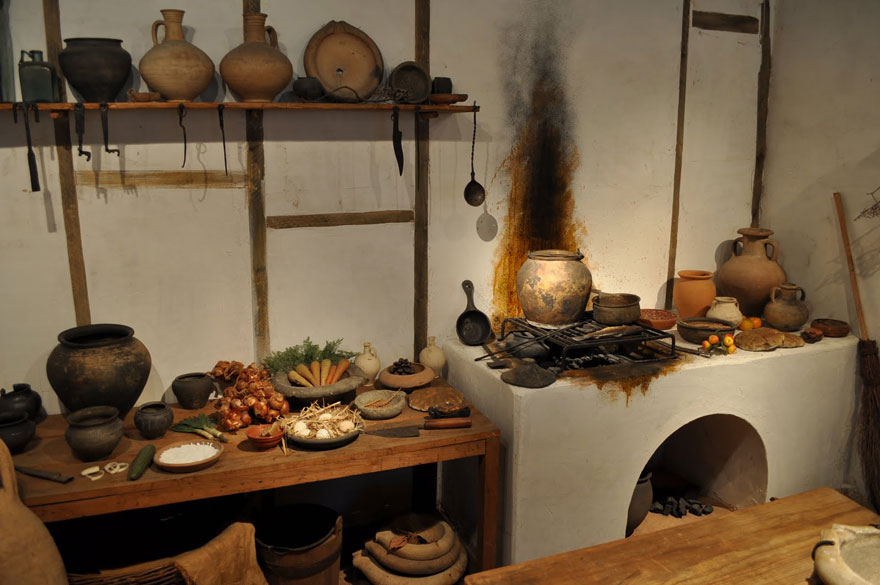
Reconstruction of a Roman kitchen at the Museum of London
Herbs, Spices and Condiments
Highly flavoured sauces often containing as many as a dozen ingredients were extensively used to mask the natural flavours of Roman food. The most commonly used seasoning was liquamen, the nearest equivalent today being a very strong fish stock, with anchovies as its main ingredient [Nam Pla, a Thai fish sauce]. This was so popular that it was factory-produced in many towns in the Roman empire.
Silphium, a herb much prized by Roman cooks, came mainly from the former Greek colony of Cyrenaica. To make an ounce of silphium last longer, the Apician cookery book recommends keeping it in a jar of pine-kernels, which would absorb the flavour, much as a vanilla pod is used today in a jar of sugar. However, it seems to have become unobtainable after the first century A.D. and substitute herbs would have been used.
Other herbs often mentioned in Roman recipes include thyme, bay leaf, basil, fennel, hyssop, rue, savoury mint, parsley, pennyroyal and dill, while spices such as ginger, cumin, cardamon, cinnamon and saffron flavoured their many sauces. Spices were used in large quantities, either to disguise the taste of food which had become rancid through overstoring, or to ensure that the guests were made fully aware of the expense the host had incurred in providing their meal.
One theory about Roman society and its preference for highly flavoured foods is that lead poisoning was prevalent among the aristocracy, due mainly to the use of lead lined pots used for boiling a preservative syrup required by wine merchants. As the symptoms of this complaint include a metallic taste in the mouth and loss of appetite, it would follow that a chronic sufferer would seek to kill this unpleasant taste and stimulate his jaded appetite.
The final collapse of a great empire had a strange connection with one of the most highly prized spices of the time. The barbarians who gathered at the gates of Rome in the fifth century A.D. demanded, amongst other tributes of land, subsidies and military titles, no less than three thousand pounds of pepper.
In The Careful Housekeeper Apicius tells his readers 'How To Make Stale Meat Sweet' by cooking it first in milk, then in water. 'How To Make Bad Honey Good' by mixing one part bad honey with two parts good honey. Many other tips were given for preserving and keeping food fresh which must have been a major problem in the days before refrigerators; perishable food such as fish had to be transported many miles at a time when the horse was fastest method of communication.
Roman Kitchen
Food and cooking are timeless and universal. The Babylonians used the same basic equipment to be found in their modern equivalents today. Colanders and saucepans, strainers and skillets were used in Pompeii and pastry cutters were part of cooking equipment in Gaul in 200 A.D. From excavations in Britain we can deduce that the daily business of preparing and serving food has always been one of the main social activities of mankind. Although the twentieth century housewife would not have found the Roman kitchen 'labour-saving', (but with that we must remember that neither has she the substitute number of slaves), she would nevertheless be able to use many Roman ingredients and utensils with little noticeable difference.
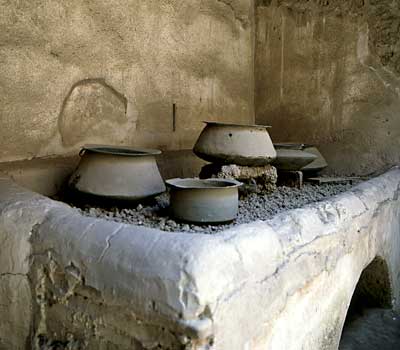
Kitchen from the House of the Vettii in Pompeii
Shown here is the stone cooking range from the House of the Vettii, along with bronze cooking vessels that were found in the kitchen of this house.
Cooking took place on top of the range - the bronze pots were placed on iron braziers over a small fire. In other houses, the pointed bases of amphorae storage jars were used instead of tripods to support vessels. Firewood was stored in the alcove beneath the range.
Typical cooking vessels include cauldrons, skillets and pans, and reflect the fact that food generally was boiled rather than baked.
Pictured is a typical Roman kitchen in about 200 A.D. The most recognizable feature is the raised hearth, a masonry construction of table height, on which was placed the charcoal, and over this most of the cooking was done in vessels supported by iron tripods or grid irons. A fine example of a grid iron from Silchester has been copied in this reconstruction. Wood was also used, as some recipes refers to certain dishes being smoked. Arrangements for providing water for cooking and washing up are sometimes found, and stone or wooden tables for food preparation.
For baking and roasting an oven was used, shaped like a low beehive, and constructed of rubble and tiles. A flue to provide a draught would be made accessible at the front, very similar to the bread ovens which persisted for many centuries after. Charcoal or wood was burnt inside until sufficient heat had been generated; the ashes were then raked out and bread, meats or pastries put in, the aperture of the oven being covered to retain the heat during cooking.
Portable ovens made of earthenware, iron, bronze or occasionally of more precious metals have been found. These presumably for cooking smaller items, such as leeks rolled in cabbage leaves, or pastry dishes. Ornamental water heaters for keeping dishes warm, or cooking by the 'double saucepan' method have also been found.
Cauldron chains, such as the example displayed in the Corinium Museum, were used for suspending large cooking pots over a wood fire. Large animals such as boar or venison were roasted on spits.
A variety of kitchen equipment was available to the serious cook. Texts of the time use the word cacabus to mean pans in general. The frying pan (fretale or sartago) made of bronze or iron, round or oval in shape, with a lip for pouring, is well known, as are rectangular iron trays with handles for roasting or frying. The pultarius was a saucepan, and the testa or clibanus a small portable oven for roasting or baking bread.'Oven to table ware' in the form of shallow pans and earthenware dishes was common. These are referred to as patellae and patinae.
Choppers, cleavers, and knives of all sizes were used, made of iron, with bone, wood or bronze handles. Spoons of bronze, silver and bone have also been discovered. Ladles, dippers, strainers and choppers all found a place in the Roman kitchen. Mortaria were stout pottery bowls used for grinding and pounding, made with a sprinkling of grit baked into the clay to form a rough surface. Stone or wooden pestles were used with them.
When the food was ready to serve, there was a variety of dishes to use: large platters, called discus, and shallow bowls of silver, bronze, pewter or fine pottery. From the first century BC each course was brought into the dining room on a tray, generally made of wood but sometimes silver. Small tables made trays essential even in humble houses. Before this date the courses were placed on three-legged tables and carried in to the banqueters, hence the expressions “first tables” for the first course and “second tables” for the second.
Bronze strainers with holes arranged in ornamental patterns were used to serve wine, although sieving was concerned less with catching lees than the herbs andd spices that were often added to impart extra flavor to an average vintage. The preparation of food centered on the knife and the pestle and mortar. As food was eaten at the table with fingers and bread, everything was either chopped into manageable chunks or pureed before serving. Spoons were the only pieces of cutlery that seem to have been used regularly. Their handles, which had sharp, pointed ends, are commonly thought to have been used for hooking snails out of their shells. On the other hand, virtually raw eggs heated quickly in boiling water were a popular delicacy and pointed spoon handles may have been used to puncture the shell and allow the contents to be sucked out. Most ordinary people ate off wood or pottery dishes.
The difficulty in cleaning these utensils is understandable. Metalware could be cleaned with sand, but earthenware dishes and pots would soon become unfit for use and would need constant replacement which could account for the considerable quantity of broken items revealed by excavations. Fortunately local potteries would have been able to turn out cheap dishes for ordinary use.
Not all houses in Pompeii have masonry ranges or even separate kitchens - indeed, distinct kitchen areas generally are found only in the larger houses of the town. It is likely that in many houses cooking took place on portable braziers. A brazier is a kind of portable grill, usually made out of clay but sometimes out of bronze or iron, which held charcoal or wood fires. Romans used it to heat their apartment, or to cook on. A brazier can be used cook the same kinds of things that can be cooked on top of a stove today. Things like vegetables, mushrooms, eggs, and sausages could be fried in a frying pan, for instance. Pancakes or flat breads could be made. It could be used to boil a small amount of water. And a larger pot on could be placed on it and left to simmer all day to make stew. Brziers were less common in northern Europe, where most people just cooked over open wood fires. They already had a fire going to heat the house, so they just used that to cook their food, too.
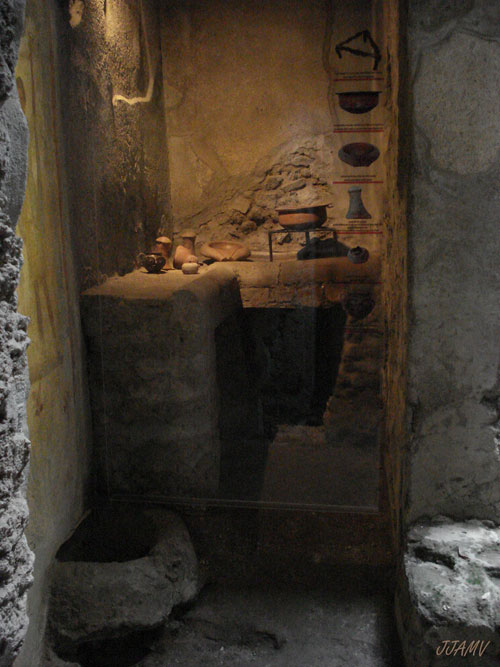
In most of the kitchens excavated at Pompeii, the only permanent feature left is a
masonry hearth with a tiled top and arched recesses at the bottom for storing fuel.
Cooking was done on this open hearth, with pots set on iron tripods over burning
charcoal or wood. Some houses also boasted a small oven, much like a modern
woodfired pizza oven, at the corner of the bench, with a vent near the stove for the
smoke to escape.
The only other furnishings in the Pompeian kitchen were a basin to hold water for
cooking and washing up, and sometimes supports for tables to prepare the food.
Roman Foods
When the food was ready it was served on a discus, a large circular plate. Groups of large platters of silver, bronze and pewter have been excavated, the most notable in Roman Britain being the silver collection from Mildenhall in Suffolk.
The daily diet varied considerably between rich and poor. The latter would have had little variation in their daily food beyond course bread and bean or pea broth, with the occasional meat addition.
Life in a villa in Roman Britain would have been secure and pleasant for the wealthy owner and his family. Home ground flour and freshly make bread, home grown vegetables, a well stocked orchard of apples, pear, cherry and plum trees; specially reared pigs, sheep and oxen, together with an abundance of wild fish and game, would have assured the inhabitants a variety of good food.
Honey was the main source of sweetening, a preservative for meat and fruit and a common ingredient in many dishes and sauces. Beekeeping was, therefore, an important industry, most farms employing one man known as the apiarus to look after the hives.
Cheeses were many and varied and much enjoyed. Smoked cheese was a particular favourite, many foreign varieties being imported by the Romans. It was eaten freshly made or preserved, and formed an important ingredient of bread and fancy cakes.
If bread was baked at home, the flour was first ground by hand on a rotary quernstone. Pies and pastries would be put in the oven after the main bread baking was over. Several kinds of flour were used, the fine white variety being considered the best, while dark bread was given to the unimportant visitor.
Not everyone cooked at home. Town dwellers would have handy access to the local bakers, pastry cooks and cooked meat shops, as the stone reliefs and excavations of Pompeii illustrate.
Oysters, cockles and mussels would be brought from the coast in barrels of brine to be sold inland. Salt was an important commodity, obtained from the many salt pans round the shores of Britain.
The native Briton would have seen little change in his diet after the Roman occupation. Most people would have had to exist on meagre and monotonous meals, with flat bread made from course grain flour, bean pottage or porridge, cooked on an open hearth fire, in cramped conditions, as the normal daily food. Excavations in Cirencester or skeletons from the Roman period have revealed evidence of dental damage beginning early in life and largely the result of a course and insufficient diet.
