Food In The Anglo-Saxon Period
from http://oakden.co.uk/
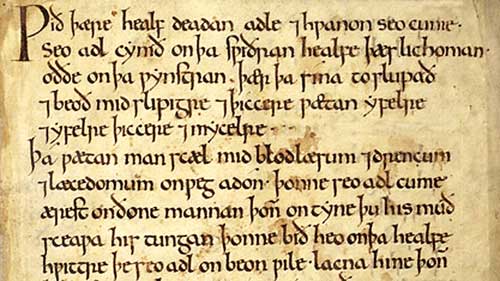
A Manuscript Page From Bald’s Leechbook (Cockayne Manuscript) Anglo-Saxon 9th Century
There are no British or Irish “cook books” earlier than the fourteenth century, (The Forme Of Cury c.1390 A.D. was the first). So, actually ‘The Dark-Ages’, is quite an apt description for a food historian. The major written sources of this period (before 1066 A.D.) tell us remarkably little about the types of food and the eating habits of those in the lower reaches of society in Anglo-Saxon England. That does not mean to say that there are no records, it is just that the extant written sources, the archaeological evidence, and the anthropological records, all have to be very carefully considered in order to make some sense of the Anglo-Saxon diet.
Having read most of the surviving accounts, it must also be admitted that Anglo-Saxon authors, writing in Old-English, were just not that interested in what was eaten, but rather in how it was eaten; the literature which has survived mainly uses the symbolism of food and drink to explain the social hierarchy and customs of the day – which can be clearly seen in such works as the Anglo-Saxon poem Beowulf for example (see the end of this post).
And at this point it is worth clarifying an important issue: any ‘recipe book’ (or online sources) purporting to have Anglo-Saxon recipes is doing it from a ‘best guess’ standpoint, or more generously, an educated deduction, (we ourselves at Oakden are doing exactly this). Recorded recipes of every day food simply do not exist until the Medieval period, when we move from a society based on an oral tradition to a written tradition.
Typical Foods in the Anglo-Saxon Period
However, what we do have are Old English medical writings by physicians of the day. These documents contain not only ingredient lists for medicines, but, most importantly for us, also several recommendations for their patients diet and some suggested ‘medical recipes’ which they should follow. The most typical recipes of the period are the ‘briw‘, a kind of soup, broth or stew.
Bald’s Leechbook, II.1 and II.2, (Cockayne Manuscript II, pp.264 and 254.) tells us: “… ‘foods that have a cooling and strengthening virtues, such as apples, not too sweet at all, but sour-sweet, and pears and peaches, and bread put in cold water or hot … or the meat of small animals and little birds boiled and roasted, and various kinds of apples, pears and medlars, peas thinned down and boiled in water and in vinegar, or in wine, good and sweet.'” [The Leechbook of Bald is an Old English medical text probably compiled in the ninth-century, possibly under the influence of Alfred the Great’s educational reforms].
There are other suggestions and recipes mentioned in the same text … broths of mint and carrot [or parsnips] and ginger, peas and cumin … broths of juicy peas and beaten eggs, with bread crumbled in … broths of shelled winkles with peas, [and] with oxymel (vinegar and honey) … bread placed in hot water. Even suggestions for … scrambled eggs with butter beaten in and fried in oil (like an omelette) … or clean new butter and new barley meal or oats made into a briw. Bread, being mentioned many times, would have played a major part of the Anglo-Saxon diet – both leavened and unleavened. While lard, and other animal fats, are also mentioned, indicating the central role livestock had in Anglo-Saxon life – much of the live stock was killed in the ‘blood-month’ of November, to eat and store (salted) food over winter – the remaining herd or flock survived through the winter with small stores of grain – meat would have been more plentiful in these months than others.
All these recipes prescribed by physicians can easily be imagined as a slightly more seasoned and rich dish with meat and fish added and these would have been the staple foods of the Anglo-Saxon era. Particularly in the light of the way the descriptions were written down in manuscript form, with ingredients of recipes running into each other, and with some suggestions ending with a phrase that gives licence to the reader to modify them to taste, ” … make into a briw together as cooks know how“. This phrase used by Bald makes it clear that these were very common methods of cooking, widely known to Anglo-Saxon cooks, so common that he felt no need to write them down.
We also have surviving accounts of food served at an Anglo-Saxon funeral, and from this we can determine that bread, bacon, cheese, milk and fish were also parts of the diet, although being worthy of mentioning and costing out at a funeral suggests that these food stuffs were probably expensive and not always common among the poorest. Honey was the only way of sweetening dishes in Anglo-Saxon times, and frequently appears in the records as payment for rent., but was probably most often used in the production of mead.
Spices and seasoning (both fresh and dried) were widely used, with pepper being of particular importance as an expensive ingredient, (pepper was one of the luxury items that the Venerable Bede gave away on his deathbed). Cumin we know was used to flavour a warming broth, as did coriander, ginger, cinnamon and bay leaf, and mustard we know was also being grown in England in Anglo-Saxon times, but evidence of its use as an ingredient only starts in the medieval period.
Finally we have salt, a precious traded commodity reaching all areas of Anglo-Saxon England from coastal production and from salt springs in Worcestershire and Cheshire. Salt being vital in food preservation, as in salt cod, and in the seasoning of dishes. Many of the very high class pottery fragments found in Anglo-Saxon archaeological digs (from broken jars) probably contained and stored the expensive seasoning salt.
Cooking Methods From Archaeological Evidence
Objects found in pagan graves suggest that most men and women would have their own set of fire steels, flints and tinder boxes, to start a fire in order to keep warm and to cook on. In terms of cooking in the home a simple hearth was often lined with clay tiles or stones (dependant on what was easily available) and this was placed at the centre, or heart, of each house. Commonly this would take the shape of a fire pit in the centre of the room, where smoke from the burning fuel would escape through a hole in the roof, or just out through the porous thatch (this is very similar to simple cooking fires still seen in many homes in developing countries today).
Another way of heating food in Anglo-Saxon homes was to use heated stones (heated on the fire). These were dropped in pots of water or broth to boil it or reduce the cooking times by pre-heating – typically this would be a soup or broth (briw). In more grand homesteads, and larger settlements, large brick ovens for cooking and baking would often have been located in a separate building – these brick ovens would have burnt wood faggots, reaching very high temperatures, and in some of these ovens there was a dual system introduced, consisting of a chamber for the fire with flues to carry hot air to another chamber where the food was cooked.
When the Anglo-Saxons were on the move, an encamped army for example, an earth oven was fashioned. This was created from a pit dug in the earth where on top of glowing embers (of a once hot fire) stones would then be laid on top. Animal meat, either brought along, caught or hunted, which had been covered with clay and leaves (to stop the meat from burning and to keep it clean) were then laid in the pit on the hot stones and the food was then covered over with more hot stones, and finally earth or the removed sod packed on top – this is a very efficient way of cooking in the field.
Pots and Cauldrons (the most common cooking method in Anglo-Saxon England) to cook the food in were made from such metals as iron, bronze, copper and tin – clay pots were still used in many homes, but carved out soapstone cookware was becoming more popular, as it was tougher and easier to clean. In terms of baking, in smaller-poorer households, bread and other baked food items were baked in a pan with a lid, (over or near a fire) or under an upturned pot, upon special hearth stones (bakestones) or later in small brick ovens.
Two other records we can study are also considered reliable, but both come right at the end of the Anglo-Saxon ruling dynasty in England. These are the Bayeux Tapestry and the ‘Doomsday Book’. It might sound strange staring at a tapestry that for the most part is like a child’s drawing, but by understanding what we have read so far we can start to piece together what was being eaten. In the image of the Bayeux Tapestry (an image of which is used to illustrate this article – a tapestry made shortly after the Norman Invasion of England in 1066 A.D.) you can clearly see cooks with the Anglo-Saxon army depicted preparing and serving a banquet.
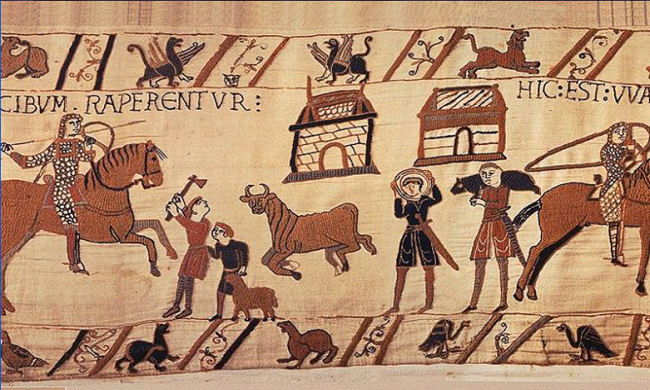
A raiding party would return from the countryside with a cow, sheep or pig (stolen from a local farm)
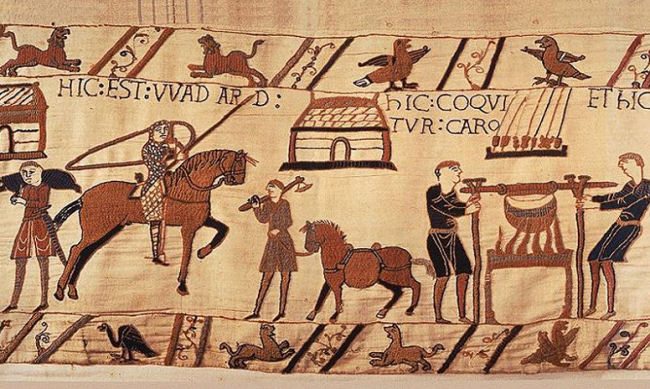
The resultant feast was cooked in the open air, roasted on spits, while a cauldron bubbled over a fire –
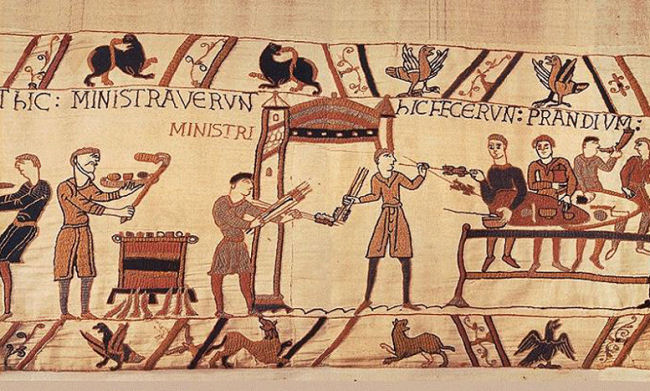
From this we should be able to correctly infer that the meal would have been of roast meats, a briw (stew or broth , probably of peas, beans and root vegetables) and fresh baked bread.
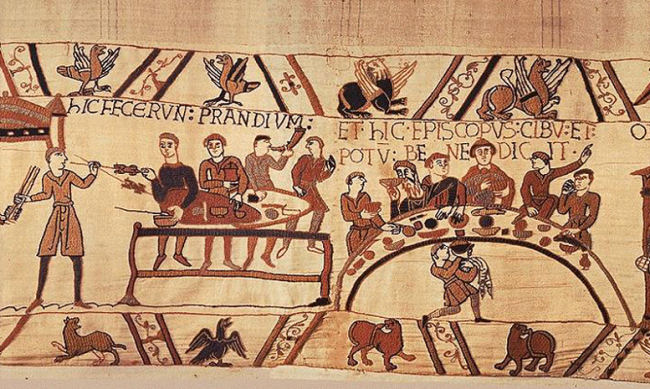
The images also tell us that the food was then passed to the servants, who ate the coarser fare on a table assembled from shields. They in turn served their masters who sat at a table and dined in some style.
Monastic and Peasant Diet
By contrast to this scene we know from surviving monastic writings that monks were supposed to eat a frugal diet, and their rules and customs usually outlawed the eating of meat except by the sick. In theory their standard fare was two simple dishes a day – cereal, beans, vegetables, eggs, cheese and bread – although in practice many Benedictine communities ate very well. From looking at the second source, the Doomsday Book, (an account of all the lands conquered by William in the invasion) it showed meat, fish, butter, lard, dripping, milk and honey all appearing on monastic tables at this time, although do note: the reformed orders which sprang up from the late 11th century eschewed excessive eating.
Most of the peasants in the villages of Domesday England had no such choice – from this record we know theirs was a subsistence diet of bread, with beans, peas and root vegetables cooked as a a briw, stew or broth, supplemented occasionally by cheese, fish and fowls and more rare still, by red meat. It must be noted that of the skeletal remains that have been examined from this period, over a quarter show they suffered some kind of malnutrition of one sort or another (particularly in childhood). However, it is also important to note that neither scurvy nor rickets are commonly found in their remains, indicating fruit, nut and dairy products (gathered from the surrounding forest areas) were part of the wider diet.
Some Anglo-Saxon practices relating to farming food do survive. In AElfric’s Colloquy the shepherd states, ” … at the crack of dawn I drive my sheep to pasture, and I stand over them in heat and cold with my dogs, so that wolves don’t devour them, and I take them back to the folds, and milk them twice a day, and move their folds, and on top of that I make cheese and butter … ” Milk, butter and cheese was common from sheep, goats and cows, although this would not have been a year round occurrence like it is today, older breeds of these farm animals only give milk in the spring and summer seasons, hence fresh cheese and butter would also have been seasonal. Eggs are also seasonal, (hens laying all year round are a modern breed) and were either made into a type of omelette or eaten hard-boiled or mixed in wine and used as a thickening agent.
For all of society, an Anglo-Saxon Ale was the basic beverage. Although it was brewed at a weak strength it was consumed in vast quantities: the average monk had an allowance of at least three gallons a day. Mead, a drink based on honey, was consumed on special occasions. There are many entries in Domesday for bees kept in Essex and Norfolk, and honey of good quality is recorded in both of these counties and many others. Honey was an important ingredient in Anglo-Saxon cooking, used to sweeten broths, glaze roast meats etc., and to make drinks like mead.
Also the Domesday Book records many vineyards, but an attempt to establish a significant English wine industry by the Norman invaders was to prove short lived, with a cooling of the climate and an increased rainfall making a wine harvest difficult. But wine did start to establish itself once again in Britain (like it had in Roman times) with an ever increasing import of it from the continent (this trend continuing right through into the medieval age) although this is not to say that wine was not already commonly being used in Anglo-Saxon cooking for the noblemen.
What we should understand is that there is a distinct difference between the Anglo-Saxon period, and the way of eating and serving a meal, and where the country was headed under the new Norman rule. The incoming Normans were heavily influenced by the continent, and the growing middle classes and ruling elite of Medieval Britain could afford to import more food, exotic ingredients and drink from the expanding trade routes. And unlike in the Medieval period there were no food courses and elaborate entertainments in the Anglo-Saxon period; all the food was served at once, on platters made of wood; while it was expected that the guests would have brought their own knife, spoon, wooden bowl and drinking vessel.
Hunting, particularly in the winter period, of forest game was considered an appropriate past-time of the elite, who also employed hunters to catch something for their table and feasts. At these occasions roast meats of animals and birds would be placed in front of the guests, with the best cuts given to those honoured hunters or favoured guests – boiled food, including seasoned broths of barley, oats and rye grains, would be served from the cooking pot into the wooden bowls each guest had brought, and anything that was not too juicy or moist, including bread, fruit and cheese would have been eaten out of hand, and taken from wooden bowls and platters put out in front of them.
Beans, peas, onions, garlic and leeks are mentioned frequently in passing reference in Anglo-Saxon texts and became descriptive place-names of places where they were grown, and as locally grown agricultural crops they would have played a large part in their diet, along with the cereals and grains already mentioned. Fresh fish would only be served if caught locally, (if the hall or village was by the coast for example) otherwise, inland, it would have been salt-preserved cod (similar to Salt Cod). Ale, wine and mead would all be served at the meal of the richer households, with just ale at the poorer. Trade was certainly thriving in England, yet we should note that most of the available food at this time was mainly seasonal, and was picked, hunted, grown and reared locally to where it was cooked and eaten.
Anglo-Saxon Bread
The earliest breads baked in Britain were flat bread, unleavened. However, from surviving poems, we know that the leaven, wheaten-breads and mixed grain breads (very similar to the Medieval Manchet Bread or plainer Maslin Bread) had become prized, if not yet altogether common in the Anglo-Saxon period. Rents to the lord of the land were often paid in leaven bread – in one source a recorded food-rent suggests that bread given in rent was distinguished as being either ‘sour’ or ‘clean’. This is certainly a reference to breads risen either with a yeast from a sourdough or from a brewer’s yeast.
The open field system used by the Anglo-Saxons meant harvests were often thin and poor, frequently failing because of blight, disease and the weather. In order to maximise the availability of food grown (and surviving to maturity) the Anglo-Saxons planted a varied crop each season so that blight etc. did not decimate a whole single crop and leave them with nothing. They grew various hardy cereals, like barley and rye etc. and other crops such as beans, peas, vetches and ‘weeds’ (for their animals to eat).
Note: The word ‘Korn’ (corn) in Anglo-Saxon refers to all types of cereal grains, today the word corn (or maize) refers to a single type of crop brought from the Americas 800 years after the middle of the Anglo-Saxon period, and therefore this ‘modern’ crop would not have been known to Anglo-Saxon farmers or anyone in England until the 16th Century.
If ‘corn’ failed in the fields (wheat frequently failed in the wetter years) then the Anglo-Saxon farmers (as a diversification programme to ensure the continuation of food supplies) grew other food stuffs to feed them through the year, particularly grains, grasses and beans more tolerant and hardy to the local climate, the soil, and the relief of the land. This also meant that in their bread they added as a matter of course various ground mixed cereals (not just wheat) and dried ground beans and peas as flour to their bread. This made a course ‘black bread’ leavened with beer barm, (and which was also made as a sourdough) – mixed grain flours never rise as well as wheat based flours, having less yeast activity, making a flatter, chewier, heavier bread.
Growing Cereals such as Wheat & Barley
However, unlike in the medieval period, where bread was a universal foodstuff, the personal energy and time expended in grinding grains of wheat and barely with dried beans and peas, into flour to make bread, and the cost of having it done by the emerging commercial water mills appearing on the nobleman’s estate, probably meant that bread eaten as the predominant food stuff served in all meals was the preserve of the rich and the more well off in Anglo-Saxon society. And yet, although bread was probably not a daily food source for the poor, cereal grains still made up a bulk of their diet, being used as bulking and thickening agents in broths, as an altogether easier way of cooking them; after grinding and pounding them to speed up their cooking.
In good years, when the cereal grain became fat and the harvest was good, the crop was reaped and used several times. First the cereal grain or ‘ears’ were harvested to grind into flour, then the long stalks of straw were cut to make ropes and baskets, thatch for houses and the roofs of farm buildings, and ‘skeps’ for keeping bees. The stubble closest to the ground after both cuttings was kept uncut and used for cattle fodder and then the pigs and sheep were left to graze over the ground to get the last remaining forage.
Keeping the ears of cereal grains and using them when needed was an art-form in itself. The cereal grains were kept in the driest place in the home, and the grain was left still in the husk and in the ear to give further protection, (to stop it from sprouting in any damp). When needed a handful was taken up at a time, held by the short stalks, and was quickly cast into the fire, setting flame to the ears. Then with a stick in the other hand the ears, which are now aflame, are beaten just as the husks become burnt. This process, known as ‘parching’ dries the grain in the husk and frees it ready for grinding into flour. It takes some skill to do this but with experience it can be done in a communal setting while chatting.
Invasion and Assimilation of Ideas and Recipes
Did the incoming Anglo-Saxons take any culinary ideas or techniques from the Celtic and Romano-Celtic peoples they slowly replaced in Southern England? They obviously had to adapt to the established seasonal local produce of the area they inhabited, and there is very good evidence to suggest that instead of a catastrophic flood of migrants into Southern England after the Romans left in around 410 A.D. occupation evolved more slowly than that.
There is evidence to suggest there was a continual presence of families and farmers at already established communities, indicating that saturation by the Anglo-Saxons was less dramatic and slower than at once first thought. As the historian Don Mackreth says, “There is no incontrovertible evidence that there had been a distinct break in occupation [at Orton Hall Farm] too many of the proven Anglo-Saxon features only make sense if Roman structures were still standing.” This is excellent archaeological evidence of a Romano-British farm adapting over time to Anglo-Saxon settlers, settlers who would have absorbed local ideas, customs, tools and recipes.
At this important archaeological dig site [Orton Hall Farm] shards of a mortarium were also found, and this is very interesting for us, as this was an Anglo-Saxon copy of a Roman designed mortar for grinding spices, which we know the Celtic Briton’s themselves absorbed into their way of cooking, fully embracing the Roman way of seasoning and spicing of foods. The Historian Francis Pryor goes on to say about this, “It would seem that they [Anglo-Saxons] liked the food of the people they overran so much that they went to the trouble of imitating a Roman mortar in their own pottery workshops.”
This is all a long way from what earlier historians had thought happened, namely that the Anglo-Saxon people invaded and stood self-sufficient and apart from their Celtic neighbours, whom they pushed out of Southern England in the fourth and fifth centuries. Historian Nicholas Higham, “This continuity of habitat and rural activity is a crucial component of our revised perception of Roman-British/Saxon interface and is entirely incompatible with the notion of wholesale depopulation on the eve of, or in the course of, Anglo-Saxon settlement.”
Yet there is also no doubt that the date 410 A.D. was momentous for Britain, a genuine turning point for the Romano-Celts in the south, Alaric the Goth had sacked Rome and the last two Roman British legions departed to protect what was left of the Empire; Emperor Honorius wrote to the leading citizens of Britania explaining that Rome was unable to protect them, he told them that they would have to defend themselves against the barbaric incursions from the east … from then on four cultures shared these islands.
Food and feasting have always been ways for the ruling elite (of whatever age, complexity and scale) to impress guests and ensure their continued pre-eminence and fealty of their subjects. Which is why they are so popular in song, tale and the earliest British manuscripts. Unfortunately, everything but the food is normally discussed in these tales, with only the briefest descriptions of ‘abundance’ and ‘indulgence’ giving us any idea of the importance of food at a feast. It was not what was served, but what impression it made. Descriptions of Anglo-Saxon feasts that have survived in written form are no different in this regard.
Anglo-Saxon Literature
Although Beowulf, the last Anglo-Saxon source we shall look at, does not describe the food the warriors eat, it does give us an idea of the grand occasion of feasting in an Anglo-Saxon hall. It also clearly expresses the duty of the Lord to feed, keep and reward his men, in return for their service. Songs, harps and story-telling are an important part of a feast, as is the strict hierarchy and order of eating and particularly drinking, with honour and rank deciding the seating plan and who gets served food and drink first (along the mead seats). The poem and poet is English, (although describing events of the Danes and Geats) and given that many writers write from their own experiences we can be reasonably sure that this tale would have been told as entertainment in an English hall, at a feast just like the one in the poem …
Beowulf
Beowulf is the conventionally used titleof an Old English (Anglo-Saxon) heroic epic poem consisting of 3182 alliterative lines. The poem, although written in England, is set in Scandinavia, and it is commonly cited as one of the most important works of Anglo-Saxon literature. It survives in a single manuscript known as the Nowell Codex and was thought to be composed by an anonymous Anglo-Saxon poet, or series of poets adapting and evolving an older tale, it is nominally dated between the 8th and the early 11th century.
Where we are in poem: After Grendel kills all the revelers in Hrothgar’s new hall the hero, Beowulf, comes to challenge the monster … but first Hrothgar and his Queen honour him with a feast …
Then was laughter of liegemen loud resounding
with winsome words. Came Wealhtheow forth,
queen of Hrothgar, heedful of courtesy,
gold-decked, greeting the guests in hall;
and the high-born lady handed the cup
first to the East-Danes’ heir and warden,
bade him be blithe at the beer-carouse,
the land’s beloved one. Lustily took he
banquet and beaker, battle-famed king.
Through the hall then went the Helmings’ Lady,
to younger and older everywhere
carried the cup, till come the moment
when the ring-graced queen, the royal-hearted,
to Beowulf bore the beaker of mead.
She greeted the Geats’ lord, God she thanked,
in wisdom’s words, that her will was granted,
that at last on a hero her hope could lean
for comfort in terrors. The cup he took,
hardy-in-war, from Wealhtheow’s hand,
Beowulf after adventures has killed the monsters and a celebration feast is ordered …
THERE was hurry and hest in Heorot now
for hands to bedeck it, and dense was the throng
of men and women the wine-hall to cleanse,
the guest-room to garnish. Gold-gay shone the hangings
that were wove on the wall, and wonders many
to delight each mortal that looks upon them.
Arrived was the hour
when to hall proceeded Healfdene’s son:
the king himself would sit to banquet.
Ne’er heard I of host in haughtier throng
more graciously gathered round giver-of-rings!
Bowed then to bench those bearers-of-glory,
fain of the feasting. Featly received
many a mead-cup the mighty-in-spirit,
kinsmen who sat in the sumptuous hall,
Hrothgar and Hrothulf. Heorot now
was filled with friends; the folk of Scyldings
Then song and music mingled sounds
in the presence of Healfdene’s head-of-armies
and harping was heard with the hero-lay
as Hrothgar’s singer the hall-joy woke
along the mead-seats, making his song
of that sudden raid on the sons of Finn.
As briefly explained earlier most of the extant Anglo-Saxon literature, as shown in this famous example, mainly used the symbolism of food and drink to explain the social hierarchy of the day. Who sat where, who got fed first, (in what order) and who got the ‘choicest foods’, delicacies, cuts of meat etc. were all dependant on the rank and the perceived importance (and therefore power) of the person in the household, or the guest at a gathering. Feeding your guests well (and understanding the dining etiquette of the day) was essential for an upwardly mobile class hoping to join the ranks of the nobility.
Beowulf clearly shows how complex, evolved and rigid were the customs of Anglo-Saxon feasting (although the poem is set in Scandinavia the poet would have coloured the description and language from his own experiences of Anglo-Saxon life in England). Yet the poem also displays the warmth, graciousness, joy and almost courtly manners of the feasters, a display of courtesy similarly seen in later Medieval Romances. And one last thing that we can perhaps take away from the poem is the importance of mead and beer to the feast; with it having a deep ritualistic significance beyond the mundane act of drinking.
