Classic British Fish and Chips
from https://www.seriouseats.com/
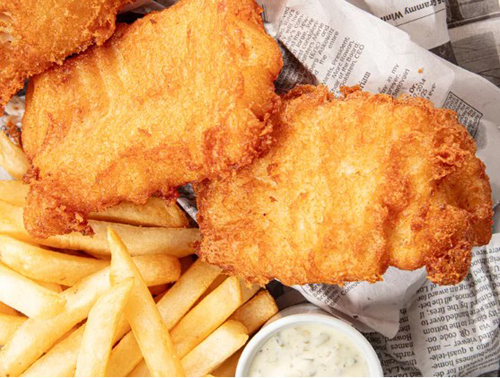
Coated in a crisp, airy batter, fried until light golden, then spritzed with malt vinegar, these fish and chips are gloriously crunchy and tender.
Genevieve Yam spoke with Ed Szymanski from the Dame restaurant in Greenwich Village, whose method is inspired by the British chef Heston Blumenthal of the famous modern British restaurant Fat Duck in Bray, to get his tips for making the very best fish and chips at home.
The Fish: Whatever you do, stick to meaty, mild, and flaky white fish—just not tilapia, nor a fatty fish such as salmon and trout. Dry brine the fish. You don’t want to put a wet product into a batter to fry. When you coat wet fish in a batter and fry it, excess moisture gets trapped between the crust and the fish, creating an unpleasantly soggy bite. The solution is to dry brine—which is as simple as salting and resting the fish for four to eight hours. This process draws out excess moisture and seasons the fish throughout.
Getting the Batter Right: At Dame, the fish have a crispy crust with plenty of craggy edges and minuscule nooks and crannies. Achieving this ideal crust starts with using both all-purpose flour and rice flour in the batter, adding a touch of baking powder, and incorporating plenty of beer and vodka, according to Szymanski.
As is the case with tender cakes and cookies, too much gluten in the batter can result in a tough and chewy coating around the fish. Rice flour is naturally gluten-free and has a low protein content, which minimizes the risk of gluten development and produces a crisp, tender coating. Rice flour also absorbs less oil than wheat flour, helping the fried fish seem less greasy than fish fried in a batter made predominantly with wheat flour.
Baking powder aerates the batter and helps it puff up, forming a delicate lace around the fish.
Like the baking powder, beer helps aerate the batter—but it also flavors it. “You want it to taste a little bit like beer, but not too much,” Szymanski explains. He recommends using a light, flavorful lager such as Narrangansett, which is what they use at Dame.
As for the vodka, any kind you have on hand will do. There are several reasons why vodka is a secret ingredient in a batter for frying: First, it evaporates more quickly than water. (Ethanol evaporates at 175°F/79°C, while water evaporates at 212°F/100°C.) Because it takes less time for the vodka to evaporate, it’s possible for the batter to crisp and brown more quickly than batter made with water or ingredients like milk that are primarily water.
How to Fry the Fish: Before you begin, nestle a wire rack inside a 13- by 18-inch rimmed baking sheet—this will be for your fried fish—then set up your bowls of flour and batter. If you have a thermometer that clips to your pot, now is the time to use it. When the oil reaches 350°F (175°C), you’re ready to fry—the hot oil is key, as it ensures the batter cooks and crisps up right away.
Malt Vinegar Is a Must: Malt vinegar is the classic fish and chip condiment. Most chippies will just drizzle it over your food or provide a bottle for you to add it yourself. At Dame, however, Szymanski uses a spray bottle to spritz his fish and chips with malt vinegar, which evenly coats the food in vinegar without turning it soggy.
Classic British Fish and Chips Recipe
If making British Chips (see recipe below), fry these first and keep warm in a 200ºF oven. These will require quite a bit of extra time to cook the potatoes in water and vinegar, then double-fry.
Four 6-ounce (170 g) white-fleshed fish fillets, such as cod or haddock
1 teaspoon Diamond Crystal kosher salt, plus more for brining; for table salt, use half as much by volume
6 3/4 ounces all-purpose flour (192 g; 1 1/2 cups), divided
2 1/2 ounces (71 g; 1/2 cup) rice flour
1 1/2 teaspoons baking powder
1 cup (240 ml) light, crisp lager, preferably Narragansett
1/4 cup (60 ml) vodka
2 quarts (1.9 L) neutral oil, such as canola or vegetable
Malt vinegar, placed in a spray bottle
1 recipe British chips
Tartar sauce, homemade or store-bought (optional)
Prepping the Fish Filets: Using paper towels, pat fish fillets dry and lightly season each fillet all over with salt. Place fish fillets on a wire rack set in a 13- by 18-inch rimmed baking sheet and refrigerate uncovered to dry out exterior, at least 4 hours and up to 8 hours.
When ready to cook, set a wire rack inside a 13- by 18-inch rimmed baking sheet. Fill a large Dutch oven with oil and heat over medium until it registers 350ºF (177ºC) on an instant-read or deep-fry thermometer. Place 1 cup (4 1/2 ounces) all-purpose flour in a large bowl; add fish and toss to evenly coat; set aside.
For the Batter: In a medium bowl, whisk 1/2 cup (2 1/4 ounces) all-purpose flour, rice flour, baking powder, and 1 teaspoon Diamond Crystal kosher salt to combine. Add lager and vodka, whisking until just combined. Transfer fish to batter and turn to coat.
Working with one piece at a time, pick up fillet and allow excess batter to drip back into bowl. Carefully lower fish into the oil and cook until bottom is golden brown, about 2 minutes. Use tongs or a spider skimmer to turn the fish and cook until other side is golden brown and crisp, 2 to 3 minutes. Transfer to prepared wire rack. Season immediately with salt and spritz generously with malt vinegar. Repeat with remaining fish. Serve with British chips and tartar sauce, if desired.
Serves 4
British Chips
Simmering the potatoes in a vinegar solution bolsters the pectin in the potatoes and helps them retain their shape during and after cooking. Double-frying the potatoes makes them ultra-crisp. An optional step of freezing the chips between each stage of cooking results in an ultra-fluffy interior.
2 pounds russet potatoes (900g; about 4 large potatoes), peeled and cut lengthwise into 1/2-inch by 1/2-inch chips
3 tablespoons (45ml) distilled white vinegar
Kosher salt
3 quarts (2.9L) neutral oil, such as vegetable or canola, for frying
Malt vinegar, optional
In a 6-quart Dutch oven, add potatoes, distilled white vinegar, 3 quarts (2.8L) water, and 3 tablespoons (36g) salt. Bring to a boil over high heat and boil until potatoes are fully tender, but not falling apart, about 12 minutes. Drain and spread into an even layer on a wire rack set in a rimmed baking sheet. Let dry for 5 minutes. (For best results, freeze potatoes for at least 3 hours, until frozen solid, and up to overnight before continuing with step 2).
Line a rimmed baking sheet with a double layer of paper towels; set aside. In a 6-quart Dutch oven or large wok, heat oil over high heat to 265ºF (130ºC). Add one-third of chips and cook, using a spider skimmer to agitate occasionally, until a crust begins to form, 3 minutes. Use spider skimmer to transfer to the prepared baking sheet. Return oil to 265ºF (130ºC) and repeat frying with the remaining potatoes, working in 2 more batches. Let potatoes cool to room temperature, about 30 minutes. (For best results, transfer potatoes to a wire rack set within a rimmed baking sheet and freeze potatoes for at least 3 hours, until frozen solid, and up to overnight before continuing with step 3).
Adjust oven rack to middle position and heat oven to 200ºF (90ºC). Set a wire rack in a rimmed baking sheet; set aside. Reheat oil in Dutch oven over high heat to 400ºF (205ºC). Add half of the potatoes and fry until crisp and light golden brown, about 3 1/2 to 4 1/2 minutes, adjusting heat as needed to maintain a temperature of around 360ºF (180ºC). Transfer to a paper-towel lined bowl and season immediately with kosher salt and a dash of malt vinegar, if using and toss to combine. Transfer to prepared baking sheet and hold warm in the oven. Return oil to 400ºF (205ºC) and repeat frying and seasoning with the remaining chips. Serve.
Serves 2
