Clotted Cream
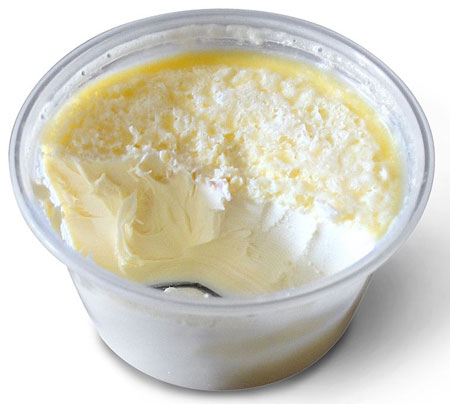
Clotted cream is not cream that has been whipped, but cooked. And when this cream cooks it develops a texture and richness that’s best described as something between the two greatest of dairy products: whipped cream and butter. Clotted cream has been described as having a "nutty, cooked milk" flavour, and a "rich sweet flavour" with a texture that is grainy, sometimes with oily globules on the crusted surface.
In the U.S., clotted cream would technically classify as butter because of its wonderfully high fat content — to be considered clotted cream it has to meet the minimum fat content of 55 percent though more commonly rests along the rich number of 64 percent. For comparison, the fat content of single cream is only 18 percent. In fact, scones are served in Great Britain with clotted cream in place of butter. Clotted cream goes well with just about any scone: plain scones, fruit scones, chocolate scones.
In Devon, the clouting of cream goes back to the Tavistock Abbey estates in the early part of the fourteenth century. Because they had no churns to make butter, they scalded their milk. The resulting clotted cream was stirred and then made into butter. During the sixteenth and seventeenth centuries in Cornwall, clotted cream and butter became the best ways to preserve milk. Later, in British dairies, farmers’ wives would set out a bowl of cream to “settle” for several hours. They would then scald it and let it simmer overnight on their kitchen ranges. As it cooled the next day, the thick, yellow cream was skimmed off and layered into a bowl. Countries other than England also enjoy clotted cream. In Serbia it’s called kajmak, in Turkey it’s kaymak, and in India it’s malai. Clotted cream is often described as having a nutty flavor, which is achieved by cooking the cream without boiling it.
Recipe for Mock Clotted Cream
Homemade Clotted Cream
from http://theviewfromgreatisland.com/
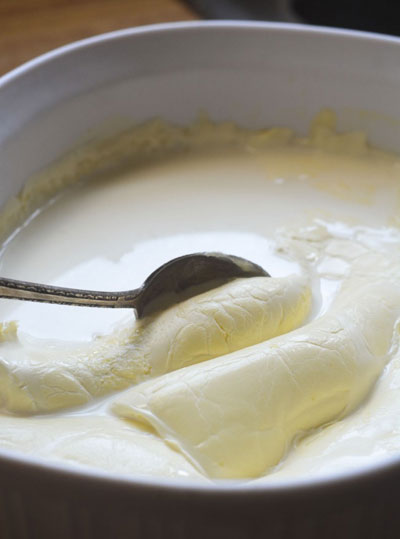
This luxurious and hard to find staple of afternoon tea can be made easily right in your own kitchen! The only catch is that you can’t use ultra-pasteurized cream, which is cream that’s been processed for a longer shelf life. Many stores only sell ultra-pasteurized cream, so you have to search a bit for regular cream.
Use the cream that is leftover after skimming off the clotted cream to make scones to go with the clotted cream. Recipes for Irish Scones and Oatmeal Raisin Scones.
2 pints heavy cream (not ultrapasteurized)
a heavy casserole dish
Set your oven to 180F.
Pour the cream into the casserole dish. It should come up about 1-3 inches on the side.
Set the dish, uncovered, in the oven and leave undisturbed for 12 hours. Be sure to leave the oven on the whole time. You can do this overnight.
Remove the dish from the oven and set to cool. Then cover and refrigerate.
The next morning scoop the thickened cream off the top into a jar or jars. Mix well. Cover and put back in the refrigerator. You can use the leftover cream for baking.
Spread the clotted cream on freshly baked scones.
Comment from viewer:
"Your recipe is intriguing! I am going to try this although my oven doesn’t have a setting below 200F- it just says “warm” so I’ll try making it on “warm’ for the 12 hours. I learned to make clotted cream a bit differently from a friend while I was visiting her in England. In a low sided saute pan- (NOT a sauce pan- it is much easier to scoop out in a saute pan and you have more surface area for the cream to “clot”) pour in a pint of cream and put the burner on a very low setting. When a skin forms on the top- gently scoop it off and collect in a jar. Continue to do this until the cream is gone. The clotted cream will seem partially congealed with watery appearing cream around it but no worries! Just mix it back in with the clotted cream and when finished- refrigerate. It will thicken up in the fridge.
I have made clotted cream this way for years and it has always come out wonderful. The whole process takes me about 30 minutes and there is no leftover cream."
