Crumpets
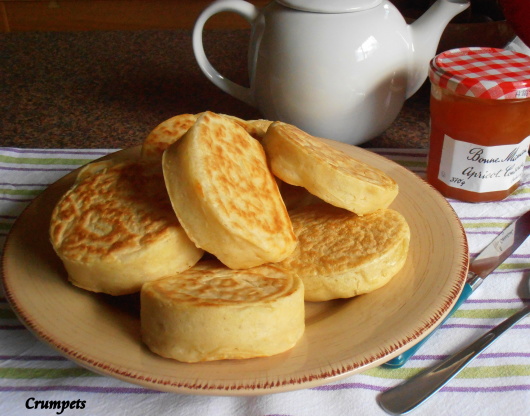
Crumpets may have been an Anglo-Saxon invention. An early reference to them comes from English Bible translator John Wycliffe in 1382 when he mentions the 'crompid cake'. The early crumpets were hard pancakes cooked on a griddle, rather than the soft and spongy crumpets of the Victorian era, which were made with yeast. The crumpet-makers of the English Midlands and London developed the characteristic holes by adding extra baking powder to the yeast dough. The term itself may refer to a crumpled or curled-up cake, or have Celtic origins relating to the Breton krampouezh / Cornish krampoeth meaning a "thin, flat cake" and the Welsh crempog or crempot, a type of pancake.
English crumpets are generally circular roughly 8 cm (3") in diameter and 2 cm (0.8") thick. Their shape comes from being restrained in the pan/griddle by a shallow ring. They have a characteristic flat top with many small pores and a chewy and spongy texture. They may be cooked until ready to eat warm from the pan, but are frequently left slightly undercooked so that they may be cooled and stored before being eaten freshly toasted. They are often eaten with a spread of butter or some alternative spread on the top of them, such as jam.
Crumpets, pikelets, Scotch pancakes and English muffins: all traditional British tea-time treats but what's the difference? That's a good question!
They're all cooked on a griddle or bakestone (a heavy-based frying-pan can be used as an alternative) but crumpets and muffins are both yeast-based.
To make crumpets, you need egg rings (available from kitchen or hardware shops) or, if you can get them, special crumpet rings, and they need to be well-greased.
More about crumpets: crumpets are flattened round breads which are cooked on a griddle or in a skillet. They are closely associated with English society and culture, and are sometimes confused with English muffins. Although the crumpet and the English muffin share some characteristics, the two foods are in fact very different. Classic crumpets have a smooth round bottom, and a top riddled with small holes. They are served fresh from the griddle or toasted, and can be topped with cheese, bacon, honey, jam or clotted cream - although butter is the traditional crumpet topping.
Crumpets are never split, unlike English muffins, and they have a slightly spongy texture which absorbs butter remarkably well. The concept of toasting crumpets over a fire is often associated with companionable rainy days in British fiction. For people who are still confused about the differences between crumpets and English muffins, remember that crumpets have a holey top, they are not split, and they are far less "bready" than English muffins tend to be. It is believed that the English muffin may have been invented by someone who was trying to replicate the crumpet, which explains the commonalities between the two.
The recipes for English muffins and crumpets are also very different, with crumpets being made from batter and English muffins being made from a dough. Because crumpets are made from a batter, they must be cooked in metal rings called crumpet rings or they will lose their shape.
Crumpets
450 g strong plain flour, sifted (1lb)
1⁄2 teaspoon salt
1 teaspoon sugar
2 teaspoons fast-rising active dry yeast (1x7g sachet)
300 ml warm milk (1/2 pint)
300 ml warm water (1/2 pint)
1⁄2 teaspoon bicarbonate of soda
vegetable oil
Note - you will need 4 crumpet rings, or egg rings or 7.5cm (3in) plain pastry cutters, greased.
Place the flour and salt into a large bowl and stir in the sugar and yeast making a well in the centre. Pour in the warm milk and water and mix to give quite a thick batter. Beat well until completely combined and cover with a tea towel or cling film.
Leave in a warm place to rise for about an hour until it's a light, spongy texture. Stir well to knock out any air, add the bicarbonate of soda and pour into a large jug - mix well and allow to stand for a further 30 minutes.
Heat a non-stick frying pan, or a greased griddle, over a very low heat with a drop of oil or butter. Wipe the pan with kitchen paper to remove excess oil/butter. Sit the greased crumpet rings in the pan and leave to heat up for a couple of minutes.
Pour in enough mixture to fill the rings just over halfway up the sides. Leave to cook until lots of small holes appear on the surface and the batter has just dried out. This will take about 8-10 minutes.
Remove the rings and turn over the crumpets to cook for a further minute or two on the other side. Sit the first batch of crumpets on a wire rack whilst continuing to cook the remaining crumpets.
Serve the crumpets warm, generously buttered. If you are making crumpets in advance, then reheat them by toasting lightly on both sides before serving. (Prep time includes rising time for the yeast dough.).
Yield 18 crumpets
