Creole Rice Calas (rice doughnuts)
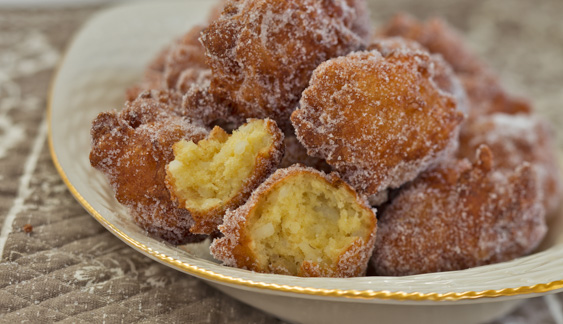
Picture is from Anson Mills. Their recipe uses sugar to coat
the calas instead of the ususal powdered sugar.
Calas (/kəˈlɑː/) are dumplings composed primarily of cooked rice, yeast, sugar, eggs, and flour; the resulting batter is deep-fried. It is traditionally a breakfast dish, served with coffee or cafe au lait, and has a mention in most Creole cuisine cookbooks. Calas are also referred to as Creole rice fritters or rice doughnuts.
The origin of calas is most often credited to slaves who came from rice-growing regions of Africa. A 1653 French recipe, beignets de riz, lends support to a French origin as well. The name "calas" is said to have come from the Nupe word kara ("fried cake"). According to The Dictionary of American Food & Drink, the word calas was first printed in 1880.
Creole street vendors, typically women, sold the fresh hot calas in New Orleans' French Quarter, with the cry, "Bel calas tout chauds!" (Creole for "Beautiful calas, still hot"). These vendors, called "calas women", would sell their pastries in the early morning from covered baskets or bowls carried upon their heads.
Writers in the first decade of the 20th century refer to the increasing rarity of calas as street food. Though not widely sold, calas continued to be made at home using leftover rice, and was a typical breakfast food in early 20th-century New Orleans.
After World War II, while the beignet remained popular, the calas became more and more obscure. From a breakfast food it evolved into a Mardi Gras and First Communion treat among Louisiana Creole families. It could be specially requested at some restaurants.[10] Through the efforts of food preservationists, interest in calas was revived and it began to appear on the menus of some restaurants.
In early recipes for calas, rice was boiled and cooled, then yeast added to make a sponge that was allowed to proof overnight. From this a batter was made by adding eggs, sugar and a little flour for binding. Rice flour was preferable but difficult to obtain, according to Eustis. A dash of salt might be included, and a grating of nutmeg was a typical addition. The batter was dropped by spoonfuls into deep, boiling lard and fried until browned. Modern recipes reflect the changes in available ingredients, cooking practices, and taste. Baking powder is sometimes used in place of yeast; vegetable oil is substituted for lard; savory variations have been developed.
The recipe from the Gumbo Page is a modern version. The recipe from Anson Mills uses yeast. Cane syrup seems to be popular for drizzling on top when serving.
Creole Rice Calas: Fried rice cakes
from https://www.gumbopages.com/
This recipe comes to us courtesy of my old high school classmate Louis Poché, of Loyola University and a member of the old NEW-ORLEANS Mailing List, who sent it to me years ago:
"CALAS! CALAS, TOUT CHAUD!" as the Creole women used to shout when they sold them in the French Quarter.
"What are calas? (or, "I've got all this leftover rice, NOW WHAT DO I DO?") Calas are fried balls of rice and dough that are eaten covered with powdered sugar, not unlike rice-filled beignets.
"The way it has been told to me is that long ago, on cold mornings in New Orleans, women would walk the streets of the French Quarter selling these warm fried cakes for breakfast.
"Here's a recipe from La Bouche Creole (Pelican Press, 1981):
6 tablespoons flour
3 heaping tablespoons sugar
2 teaspoons baking powder
1/4 teaspoon salt
1/4 teaspoon vanilla
2 cups cooked rice [and cooled so the grains remain separate]
2 eggs
Pinch of nutmeg
Cooking oil
Powdered Sugar
Mix together the flour, sugar, baking powder, salt, and vanilla.
Thoroughly mix the rice and eggs together in a separate bowl. Add the dry ingredients to the rice and egg mixture. When thoroughly mixed, drop by spoonfuls into the hot deep fat (about 360 degrees F) and fry until brown. Drain on paper towel. Sprinkle with powdered sugar and serve while hot.
"Other variations are to serve with honey or (my favorite) Steen's Cane Syrup instead of the powdered sugar.
"Serve with a cup of coffee
Calas (Rice Beignets)
from https://ansonmills.com/
If crullers are Dutch, beignets French, and Berliners German, calas are most certainly Creole. But beyond what one expects to discover in a donut recipe (yeast, flour, butter, and eggs), calas contain cooked rice. The tradition of calas and their distinguishing ingredient landed in Louisiana on a slave boat from Ghana before Louisiana was even part of the United States!
Like rice bread and other fading Southern rice-fed specialties, calas have struggled to remain in the cultural memory of their region. Yet after making them, we wonder why: this is one tasty little donut! Under their scratchy sugar cloak, calas have a fine, moist crumb and melting texture interrupted by the odd soft rice kernel. The magic of the rice in this formula, however, is not so much its textural contribution, but the unexpectedly enticing fermentation flavors the rice and yeast get up to in their time alone together, flavors that move throughout the batter when all elements are in place.
And calas are easy to make! No rolling or cutting required—just shove batter off a spoon into hot fat and a couple minutes later, the calas are done.
2.5 ounces (1/3 cup) Anson Mills Carolina Gold Rice [uncooked]
1 1/2 cups whole milk
1/2 teaspoon fine sea salt
1 ounce (2 tablespoons) unsalted European-style butter, cut into 2 or 3 pieces, room temperature
1 1/2 tablespoons hot tap water
3/4 teaspoon instant yeast
1 tablespoon sugar, plus more for coating the beignets
2 large eggs
1/8 teaspoon ground nutmeg
1 teaspoon vanilla extract
4.5 ounces (1 cup) Anson Mills Fine Cloth Bolted Pastry Flour
Peanut oil for frying
The night before you plan to make the calas, turn the rice into a small bowl, add water to cover by about 1 inch, and let it soak it overnight in the refrigerator.
Drain the rice. In a small saucepan, bring the milk and 1/4 teaspoon of the salt to a simmer over medium-high heat. Add the rice, stir well, and allow the mixture to return to a simmer. Turn down the heat to maintain a gentle but persistent bubbling, partially cover the pot, and cook, stirring occasionally, until the rice is tender, 15 to 17 minutes; stir more frequently near the end of cooking to ensure that the rice on the bottom of the pot does not scorch. The cooked rice will be thick and creamy and resemble rice pudding.
Off heat, vigorously stir the cooked rice with a spoon, breaking up the grains until the mixture resembles small-curd cottage cheese, and then stir in the butter until melted and fully incorporated. Transfer the rice to a medium mixing bowl and let cool for 5 minutes.
Meanwhile, put the hot tap water in a small bowl, sprinkle the yeast over the top, and let stand until the yeast dissolves. Stir the dissolved yeast and the sugar into the rice. Cover the bowl and let the mixture rise at room temperature until doubled in volume, about 1 hour.
Beat the eggs in a small bowl, and then stir them into the rice mixture along with the nutmeg, vanilla, and remaining 1/4 teaspoon salt. Add the flour and stir lightly with a rubber spatula to incorporate. Cover and let the batter rise at room temperature until once again doubled in volume, about 1 hour.
When the batter has almost doubled in volume, scoop about 1/2 cup of sugar into a small bowl for coating the calas. Set a wire rack on a rimmed baking sheet and line the rack with a triple thickness of paper toweling.
Pour oil to a depth of about 1 1/4 inches into a medium heavy-bottomed saucepan and heat over medium-high heat until the oil registers 365 to 370 degrees on an instant-read or deep-fry thermometer. (Alternatively, if you have a Fry Daddy, feel free to use it.) Using a soupspoon, scoop up a generous tablespoon or so of batter and use a second soupspoon to push the batter off the spoon into the hot oil (don’t let the batter create a splash!).
Repeat this process to fry four or five calas at a time, but do not overcrowd the pot. Fry the calas, turning them occasionally, until deeply browned on all sides, about 3 minutes total. Using a wire skimmer, transfer the calas to the prepared wire rack. Allow the oil to come back up to temperature before adding more batter.
While you fry the next batch, toss the previous batch in the sugar until coated on all sides. Let cool slightly and serve.
