Brotzeit (Bread Time)
from https://www.craftbeering.com/
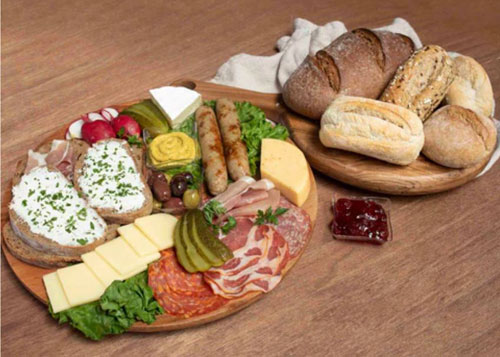
Brotzeit translates to bread time from German and quite literally so: brot=bread, zeit=time. It is a snack type meal consisting of fresh bread, a variety of cold toppings and accompaniments and traditionally – beer, the other bread of Bavaria. It originated as a hearty snack eaten by farmers, shepards and field workers alike during their short breaks from doing demanding physical work.
Today Brotzeit is an established part of the cultural heritage of Bavaria and can be enjoyed at any time of the day – between breakfast and lunch, mid-afternoon, early evening etc. If it lasts a bit longer or is very susbtantial the next meal is simply skipped.
The Brotzeitplatte is typically presented on a wood board with all the ingredients arranged on top. This is in keeping with tradition – farmers and field workers didn’t snack from porcelain plates. The bread can be presented separately in a basket next to the other ingredients or directly on the platter. Butter is served with or near the bread.
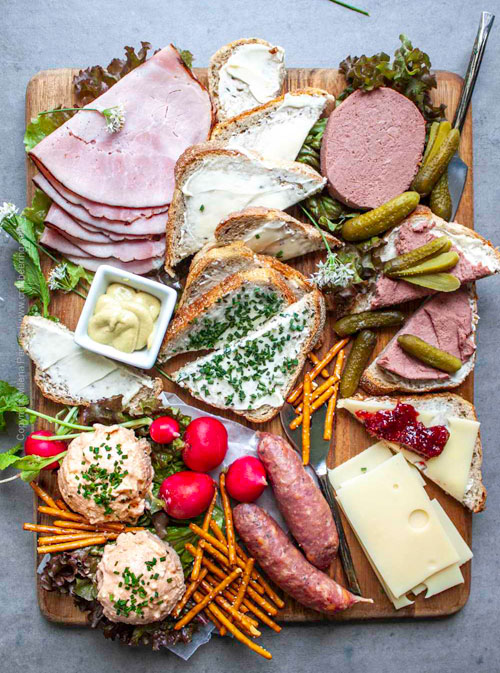
Brotzeit Platter
Typical Ingredients for the Brotzeit Platter
- Bread. Traditional bread choices are Farmer’s bread (a rye sourdough), and Bavarian pretzels. Brotchen (bread rolls) and bread sticks are more modern additions. The crackers would be rye bread (like the German-style pumpernickel). Farmer’s dark rye bread (a type of sourdough) is a classic, not to mention it has an incredible pairing affinity for German lagers.
- Meat/sausage. Cold meats such as smoked Black Forest ham or salami slices, precooked bratwurst (veal or veal & pork) and a variety of other types.
- Lyoner (with olives and peppers) – Lyoner is the equivalent of Bologna in Germany and the loaf with olives and peppers is a popular variation. Our favorites are Lyoner with garlic and this one. So well suited for rye bread and Schwarzbier (a type of beer).
- Leberwurst – This is a well known spreadable liver sausage. Good on top of all sorts of crackers and bread.
- Schwarzwald ham (Schwarzwälder Schinken) – We could not leave out the emblematic ham of the state of Baden-Württemberg in the south-west of Germany. Schwarzwald is a large forested region in the state, it literally means Black Forest, hence the popular US name, Black Forest ham. Schwarzwald ham is lightly smoked with beech wood chips. It is delicate, with very tasteful hints of smoke and partners beautifully with the Schwarzbier (a type of beer).
- Cheese. Typically Emmental (type of Swiss cheese), Bavarian Blauschimmelkäse, Limburger, Butterkäse, Camembert, Bavarian Bergkäse.
- Butterkäse – Buttery in consistency and appearance, it is a dream to spread over toast, rye bread or even nut crackers. With a mild flavor (similar to that of young Gouda) Butterkäse (‘butter cheese’) is the quintessential German cheese. It is semi-soft and made of cow’s milk, aged for only a brief period of time.
- Limburger – A semi-soft cow’s milk cheese, aged for 2-3 months. It has a characteristic smell (similar to Raclette cheese) due to the bacteria used to ferment it (same one for both cheeses, Brevibacterium). Today it is almost exclusively made in Germany, but its origins are from an area known as the old Duchy of Limburg in Belgium. In the US, it is produced in Wisconsin. Germans love to spread it over rye bread, with a red onion garnish and pair it with lagers (or coffee when the rye bread and Limburger cheese are eaten for breakfast, which is very often).
- Salads. Not what you expect! These hearty preparations of sausage or cheese are perfect with bread. The most popular examples are Wurstsalat and Limburger cheese salad.
- Dips/spreads/eggs. Obatzda, ham schmalz, apple and onion schmalz, quark dip, sweet Bavarian mustard, beer mustard, leberwurst, various savory butter spreads flavored with herbs, garlic, tomato etc. As much as the Bavarians love smoked trout and dips using it such as this one, fish is not included on Brotzeit platters. Hard boiled eggs or pickled eggs are also popular. A very easy platter to prepare could be centered around the piquant beer cheese dip Obatzda. Soft Bavarain pretzels are a perfect companion for it.
- Veggies & herbs. Onions, radishes, Bavarian beer radish (lovingly called Radi and with a spicy attitude!), tomato (technically a fruit), cucumber or pickles, lettuce, chives, parsley. The pickled dill gurken, German and whole grain mustard, tomato slices and parsley are a must for a German meat and cheese board. They go with the territory. Red onions go with Limburger and Leberwurst and arugula seems to be a wildly popular green in Germany (based on our experience).
- Butterbrot translates to butter(ed) bread from German. It is a simple open-faced sandwhich – a slice of bread, generously buttered and topped with savory or sweet ingredients. It is often enjoyed during Brotzeit although not exclusively, it can be a part of breakfast, lunch or accompany a cup of tea or coffee.
Radieschenbrot (radish bead) is an open-faced sandwich made by spreading cream cheese on farmer`s bread and topped with thin sliced radishes and chopped green onion.
The origins of the buttered bread sandwich can be traced back to 1339 when in Bremen it was offered as an alternative to poridge. It slowly reached other parts of Germany and by the fifteenth century was accepted in Bavaria and was considered a healthy food to give to children. In the seventeenth century adding cheese slices to the Butterbrot became popular, followed by a variety of other toppings.
Today Butterbrot is declining in popularity but is still a widely enjoyed snack option in Germany, despite the availability of fast food and the nationwide trend to eat warm lunches over cold sandwiches.
Types of Butterbrot German Sandwiches
- Meat topped. All sorts of cold cuts from ham to wursts. Leberwurst is a delicious alternative (garnish with cucumber slices or gurken). Mett (raw minced pork) is also very popular in the Mettbrötchen (German raw pork sandwich).
- Cheese topped. Sliced or spreadable cheeses both work.
- Egg or veggie/herb topped. Hard boiled, scrambled or poached eggs and herbs like parsley and chives.
- Jam or chocolate topped. A favorite for breakfast – anything from strawberry jam to Nutella works here.
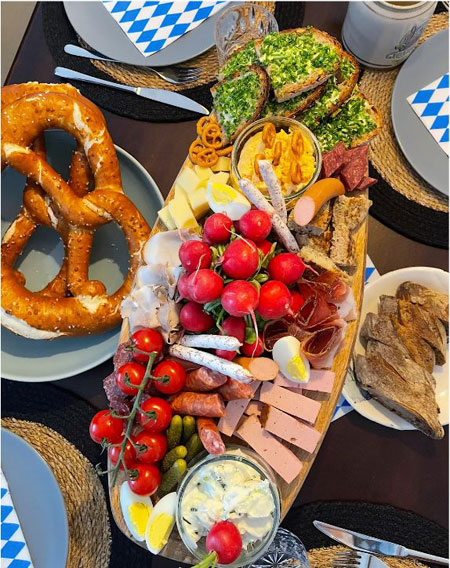
Radishes and tomatoes are popular on a Brotzeit Platter
Origin of the Beer Garden
The origins of contemporary beer gardens are in the Free State of Bavaria (Freistaat Bayern), where the biergarten culture evolved into a phenomenon envied and replicated all over the world. Back in the 1600’s beer brewing was restricted to the cold months of the year (October through March) due to the fire dangers posed by the extremely hot brewing kettles in hot weather. In those days without refrigeration the restriction meant that during summer when people craved cold, fresh beer the most, it was not available.
By way of solution to the flat, warm beer problem resourceful Bavarian brewers built cellars which they filled with blocks of ice sourced during the cold winters. They planted chestnut trees on top of these underground cellars to provide thick shade and thus the beer was granted cold storage all summer long. The chestnut trees doubled as inviting spots to sit under while enjoying a beer, a snack and a pleasant conversation – the beer garden was born.
In 1812 Maximilian I of Bavaria issued a proclamation allowing beer brewers to serve beer stored in their own cellars and bread during the summer months, but not any other kind of food. This layed the foundations of the custom of bringing one’s own food to the biergarten – something simple that could be enjoyed with bread (i.e. a Brotzeit platter or toppings for Butterbrot). To this day, the laws regulating beer gardens in Bavaria affirm that one thing that distinguishes a biergarten from an outdoor restaurant that serves beer is the fact that patrons can consume food they have brought along, free of charge.
