Elisen gingerbread with marzipan and rum
from https://www.schuhbeck.de/
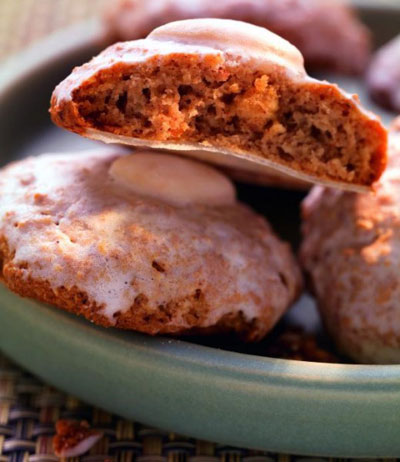
Every year again. Why buy gingerbread when it's easy to go home and even taste it festive? With my specification succeeds. And you are welcome to call this Elisen-Schuhbeck gingerbread. (Google translation)
This recipe comes from the comments one viewer posted for a Lebkucken recipe at Serious Eats. The poster provided a link to his website.
Translated dough ingredients for the americans:
Ingredients for 20 pieces:
1/2 tsp. ammonium carbonate (also known hartshorn)
1 tbsp rum
40g tightly packed chopped candied orange rind
30g tightly packed chopped candied lemon rind
200g ground almonds
50g ground hazelnuts
40g flour
1 tsp Lebkuchen-Spice (the mix in this recipe - Lebkucken recipe at Serious Eats - sounds reasonable, see below)
Salt
4 egg whites
190g sugar
130g marzipan* (more sugar and egg whites than almond paste has in US)
*In the UK and Germany, and I believe the rest of Europe, almond paste and marzipan are the same. In the US marzipan contains more sugar than almond paste, so you could use rolled-out marzipan on the outside of a cake with no real problem, but for mixing into a cake, you would want to use almond paste. Poster does a lot of baking in Germany and uses marzipan--the poster has never seen almond paste there.
Spice Mix:
2 teaspoons (4.2g) ground cinnamon
1 teaspoon (2.1g) ground powdered ginger
1/2 teaspoon (1g) ground nutmeg
1/2 teaspoon (1g) ground cloves
1/2 teaspoon (1g) ground allspice
1/4 teaspoon (0.5g) ground cardamom
1/2 teaspoon (2.8g) kosher salt
1. One day before, dissolve the ammonium carbonate in the rum.
2. Finely chop orange and lemon peel, combine it with the nuts, almonds, flour, spices and a little salt in a large bowl.
3. Beat egg whites, slowly adding the sugar, until it’s creamy but kinda stiff
4. Grate the marzipan on a cheese grater and stir it together with a little of the beaten eggwhites, add the dissolved ammonium carbonate.
5. Fold marzipan mixture and beaten egg whites alternatingly into the stuff from step (2).
To bake, preheat the oven to about 340°F. The instructions in the original recipe for individual round cookies should work if you flatten the balls of dough out, as this stuff doesn’t really flow. See translated instructions below. The recipe at https://www.schuhbeck.de/ uses wafers to place the dough on.
If Making Individual Round Cookies: Chill dough until quite firm, about 4 hours. Working in 2 batches, line 2 large cookie sheets with brown parchment. Dip a 1 3/4-inch ice cream scoop (2 level tablespoons) into water, shake off excess water, and scoop level scoops of dough. Roll into balls and place 2 inches apart. Bake in the lower and middle thirds of the oven, shifting pans from top to bottom and front to back halfway through, until a toothpick inserted in center of cookies comes out clean, about 18 minutes. Slide parchment onto a wire rack to let cookies cool slightly while you bake the remaining cookies.
You might have to bake them a bit longer (or make smaller lebkuchen). Also, pressing a single almond or hazelnut into the cookie before baking gives a nice look. The dough will be difficult to handle, so using water to wet your fingers while working is necessary.
For glazing, my favourite is to brush them with melted dark chocolate after cooling. [If you wish to coat the cookies with chocolate, the Elisenlebkuchen should be fully cooled. You can turn the undecorated cookies upside down and dip them evenly into the melted chocolate; let cool right-side up on a rack until set.]
A simple, very thin layer of sugar icing also is delicous. [If you wish to coat the cookies with a sugar glaze, they must still be hot. After taking the cookies out of the oven, immediately brush each Elisenlebkuchen with a thin layer of the hot glaze.]
Glaze from Serious Eats:
3 cups confectioners' sugar (13 ounces; 375g)
1 tablespoon (15mL) kirsch, Grand Marnier, or rum (or pure vanilla extract)
3 to 4 tablespoons warm water (1.5 to 2 ounces; 45 to 60mL)In a medium bowl, whisk confectioners' sugar with kirsch and add enough water to make a thin but spreadable glaze. Spread glaze on just-warm cake or cookies and let cool completely.
Google translation of Instructions:
The day before for the dough, dissolve the staghorn salt in the rum. Chop the orange peel and the lemon as fine as possible and mix with the almonds, the nuts, the flour, the gingerbread spice and a pinch of salt in a bowl.
Beat the egg whites in a bowl to a creamy snow, gradually adding the sugar.
Grate the marzipan on the grater and stir in a bowl with a little egg whites until smooth. Stir in the dissolved staghorn salt. Take the marzipan alternately with the egg whites under the almond-nut mixture.
Lay out two baking trays with baking paper. Spread the gingerbread mass dome-shaped on the wafers and place on the metal sheets. Garnish with almonds or nuts. Let the gingerbreads rest in a dry place for 24 hours. Note: the wafers are oblaten (thin Communion-like wafers first used by monks in the 15th century so the cookies wouldn't stick to the baking sheets).
Preheat the oven to 170 ° C the next day. Bake the gingerbread in the oven on the middle rack for about 30 minutes.
Meanwhile, for the glaze, stir the egg whites with the icing sugar and the lemon juice in a small bowl until smooth. Take the gingerbread out of the oven, allow it to cool slightly and then apply the glaze while still warm. The Elisenlebkuchen keep cool and dry for 3 to 4 weeks.
