Schnitzel
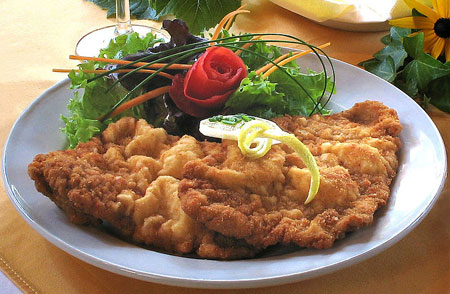 Schnitzel is a traditional Austrian dish and is a popular part of Viennese and Austrian cuisine, consisting of a thin slice of meat coated in breadcrumbs and fried. In Austria the dish, called Wiener Schnitzel (Viennese Schnitzel), is traditionally served with a lemon slice, lingonberry jam and either potato salad or potatoes with parsley and butter.
While the traditional Wiener Schnitzel is made of veal, it is now sometimes made of pork. In the case it is made of pork, it is often called Schnitzel Wiener Art (Germany) or Wiener Schnitzel vom Schwein (Austria) to differentiate it from the original. There are also regional versions of Schnitzel, such as "Salzburger Schnitzel", which is stuffed with mushrooms, bacon, onions, and other various herbs.
A Schnitzel in Germany is a cutlet without bones. Only the version coated in breadcrumbs is called Wiener Schnitzel, and even this is often referred to as simply Schnitzel. When made of prime quality meat, a Schnitzel is mostly served pure, perhaps with some salt and a slice of lemon. Other than that it may be served with a sauce.
In the U.S., Wiener Schnitzel is most commonly found at German-style restaurants. These restaurants usually use the term Wiener Schnitzel to refer to the dish made with veal cutlet, and may also serve other "Schnitzels" made with other meats.
America's Test Kitchen uses 2 cups vegetable oil for frying the Schnitzel: "The two cups of oil may seem like a lot—but they’re necessary to achieve a wrinkled texture on the finished cutlets. When properly cooked, the cutlets absorb very little oil. To ensure ample cooking space, a large Dutch oven is essential."
Wiener Schnitzel
from http://germanfood.about.com
4 veal cutlets (traditional) pounded to 1/4 inch thickness (about 5 oz. each) (you may use chicken or pork, as well)
1/4 c. flour (all purpose or brown rice)
1/4 tsp. salt
1/2 c. bread crumbs
2 eggs
Oil or lard for frying (lard is traditional)
Lemon slices, for serving
Tips:
To pound meat thin you may want to place the cutlet between sheets of plastic wrap for easier washing up. Use a heavy, flat-surface pan to pound if you don’t have a meat mallet.
Pound the meat evenly to 1/4 inch thickness for best results.
Do not press the bread crumbs into the meat. The crust should not adhere completely, but form a loose shell around the schnitzel.
Make sure the breaded meat “swims” in fat. Contrary to instinct, the breading will take on less oil than if the meat is sticking to the pan. Also, the breadcrumb topping has a chance to puff up a little, and your clean up is easier!
Preparation:
Set up 3 shallow dishes. Place the flour and 1/2 teaspoon salt in one and breadcrumbs in another. Beat eggs well and place in the third dish.
Heat at least 1/4 inch of oil in the pan to 350°F.
Working one at a time, dredge cutlets first in flour until the surface is completely dry. Dip in egg to coat, allow the excess to drip off for a few seconds and then roll quickly in the breadcrumbs until coated. Do not press breadcrumbs into the meat. Place meat immediately in the pan with the hot oil. Do not crowd the pan. Cook the schnitzel in batches, if necessary.
Fry the schnitzel for 3-4 minutes on one side. You may want to swish them around a little with your fork to make sure they are not sticking to the pan. Turn them over once and fry until both sides are golden brown. Remove from pan, allow the oil to drain off, place on a plate with lemon slices and serve.
Good with Wiener Schnitzel: french fries, potato salad or potatoes with parsley and butter, and cucumber salad.
Serves 4
