Springerle
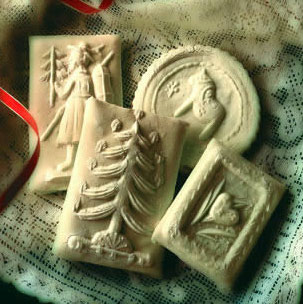
Springerle rolling pins have been used in Austria and Bavaria for centuries to create Christmas cookies. The original carvings were of biblical scenes; eventually, secular scenes evolved. One could even have a springerle carved to depict marriages, births and other important events. The name springerle means "little jumper" or "little knight".
The major ingredients are eggs, white (wheat) flour, and very fine or powdered sugar. The biscuits are traditionally anise-flavored, although the anise is not usually mixed into the dough; instead it is dusted onto the baking sheets so that the biscuit sits on top of the crushed anise seeds.
They are also unusual in that they may use hartshorn (ammonium carbonate, or baker's ammonia) as a leavening agent, though many recipes omit it in favour of modern leavening agents. Very cold dough is rolled thin and pressed into a mold, or impressed by a specialized, carved rolling pin. The dough is unmolded and then left to dry for about 24 hours to preserve the designs before being baked at a low temperature on greased, anise-dusted baking sheets. See Grandma Fickelscherer's Hartshorn Cookies, a cut-out cookie using hartshorn.
The leavening causes the biscuit to at least double in height during baking. This "pop-up" effect may be the source of the name in German, and produces the characteristic "foot" along the edges, below the molded surface - in other words, the cookies raise and the design stands up from the plate. Thanks to the firmness that the dough gets through the drying, the lower portion of the Springerle rises when baked and creates the so-called "little feet".
How to make a perfect "foot" on your German Springerle Cookies: First, dry your springerle on a towel or place them on the parchment lined baking sheet for a full 24 hours to make sure the pretty patterns on the top do not bake out, however do not lay down the anise seeds just yet. Next, take the cookies off of the baking sheet and put them on a plate or kitchen towel. Get a small kitchen wash cloth or a couple of paper towels and get them wet. Make sure to wring out the excess water, but no too much. You want it wet but not soaking. Put this on plate. Then take the anise seeds and scatter them on the parchment lined cookie sheets. With dry hands (it's very important not to get the edges wet) take a cookie and tap the bottom twice on the wet cloth or paper towel. Now place it on the seeded baking sheet. Thats it! The moisture will cause the bottom to expand at a different rate.
Another recipe says to: In a cup, mix 1 tsp caster sugar with 1 tsp water and paint the bottom of each of the biscuits with the sugar water - avoid spillage as it will ruin the surface of the biscuits.
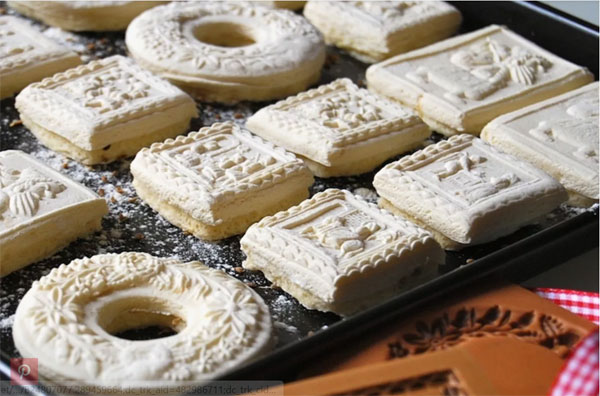
The baked biscuits are hard, and are packed away to ripen for two or three weeks (often with an apple). During this time, they become tender. Springerle are normally baked a few weeks before Christmas as they need to be stored for 2-3 weeks in order that they soften.
Traditional German cookies with a delicate anise flavor, stamped with special cookie stamps for a lovely bas-relief appearance. Real works of art, these are a hard cookie suitable for shipping and dunking in your tea or coffee. Perfect Springerle are soft on the inside and slightly crisp on the outside.
Also see Authentic German Springerle, which discusses how to make good, traditional springerle as well as providing a recipe.
Mom's Recipe slightly modified
4 eggs
1 pound powdered sugar, sifted (3 3/4 cups) - Mom's recipe used 2 cups (about 1#) of regular sugar, powdered sugar should make them more tender
4 drops anise oil
4 1/2 cups cake flour
2 1/2 teaspoons baking powder (not in Mom's recipe)
1/4 teaspoon salt (not in Mom's recipe)
Crushed anise seeds
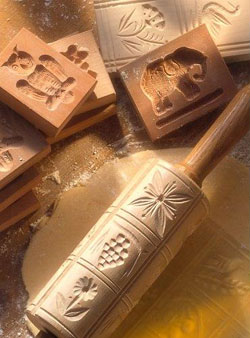
Springerle Rolling Pin and Molds
Beat the eggs with an electric mixer until thick, about 10 minutes. Gradually add in the sugar, beating well between additions, then 15 minutes more. Add the anise oil. Sift together the flour, baking powder and salt. Fold in the dry ingredients.
Cover tightly and chill 4-5 hours. Divide the dough into fourths. Roll 1/2" thick, dust lightly with flour and press with springerle mold or rolling pin to create design*. Cut the individual cookies apart with a cutter wheel. Sprinkle greased sheets with anise seed and place cookies on top. Cover with a towel and let stand in a cool place to dry overnight. This helps to keep the design intact.
Brush the excess flour from the cookies and bake at the very bottom of the oven at 300 F for 25 to 30 minutes (Mom's recipe says put in 375° F oven to set shape, but immediately reduce to 300° F for 15 minutes.) The picture should stay quite white and the bottom should be slightly brown.
Mellow in tins for two weeks. Put an apple piece in to soften before using. Traditionally eaten by dunking in tea or coffee.
Makes about 60
Note: *Springerle, also known as Eierzucker, are shaped with special wooden molds used to stamp designs into the cookies. They can also come in the form of a roller. These items can be found by visiting specialty food stores or gift shops specializing in Swiss and German keepsakes. If you cannot find a springerle board, just cut the cookies in squares or cut them with cookie cutters, or use the other popular cookie stamps that are available.
