Traditional Easter Babka Recipe - Polish Babka Wielkanocna
By Barbara Rolek, About.com Guide, http://easteuropeanfood.about.com/
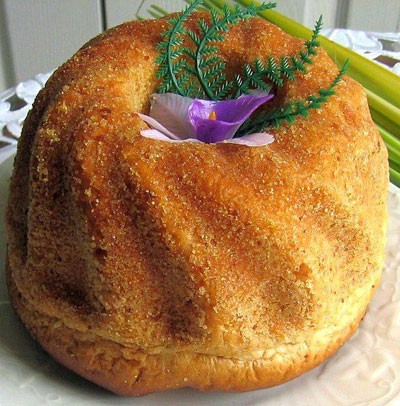
This Polish Easter babka celebrates the return of the egg to the diet after the strictures of the Lenten fast. A mere 15 egg yolks are featured in this traditional recipe! The high yolk count makes the dough very rich and cake-like. Some modern or easier versions may use fewer (e.g., 4 to 6) or substitute whole eggs, but a "traditional" recipe will generally use 10+ yolks.
Babka is an indispensable component of a Polish Easter feast and is featured in other cuisines, including Ukrainian where it takes a tall shape similar to a Russian Kulich.
Babka is the general term for a bundt cake in Poland. Any type of cake baked in a bundt cake pan would be babka, for example, chocolate pound cake baked in a bundt pan would be chocolate babka (babka czekoladowa) and you should not confuse it with popular in the US Jewish chocolate babka which would be called ‘strucla’ in Poland.
1 cup milk
3 1/3 cups all-purpose flour
2 packages active dry yeast
1/4 cup lukewarm water
2/3 cup sugar
2 teaspoons salt
15 large egg yolks
1 teaspoon vanilla
1/4 teaspoon almond extract (optional)
1/2 cup melted butter
3/4 cup candied citrus rind (optional)
1/2 cup chopped almonds (optional)
1/3 cup light or dark raisins
1. Scald milk and pour into a large bowl or stand mixer bowl fitted with the paddle attachment. Add 3/4 cup of the flour, mixing well. Cool.
2. Dissolve yeast in lukewarm water 5 minutes. Add 1 tablespoon of the sugar and let stand 5 minutes. Add to cooled milk mixture, combining well. Cover and let rise until doubled.
3. In a separate large bowl, combine salt and egg yolks and beat until thick and lemon-colored, about 5 minutes. Add remaining sugar and extracts, mixing well. Combine egg mixture with risen milk mixture, beating thoroughly.
4. Add remaining flour and, using a wooden spoon, beat vigorously for 10 minutes or 7 minutes by machine with the paddle attachment. Add butter and continue to beat an additional 7-10 minutes. Beat in candied rind, almonds and raisins. Dough will be sticky. Scrape down sides, cover with greased plastic wrap and let rise until doubled in the same bowl. Punch down dough and let rise again until doubled.
5. Generously coat a 12-inch fluted babka pan or tube pan, or turk's head mold (turban mold) with cooking spray. Punch down dough and, using slightly dampened hands, transfer to prepared pan. Cover and let rise 1 hour or until dough fills the pan. Heat oven to 350 degrees.
6. Bake about 50 minutes or until instant-read thermometer registers 190 degrees or toothpick comes out clean. Cool in pan 10 minutes and invert onto rack to cool completely. Leave plain or dust with confectioners' sugar, if desired.
Anjali writes:
"This is an incredibly sticky dough, is it OK to add more flour?" AND "Is there a traditional topping to this bread? A glaze would bring this bread to perfection, as it's a little less sweet than others I have had."Anjali brings up good points. Don't add more flour. That's what keeps this cross between a cake and a bread light. Use slightly dampened hands to deal with the sticky dough when transferring it from the bowl to the pans, etc. It will never become "unsticky." As to the second question, it's perfectly OK to dust a babka with confectioners' sugar or drizzle on a glaze. It's just not traditional and I was going for that. This is a no-knead recipe, because the dough is beaten with the paddle attachment of a stand mixer or with a wooden spoon by hand.
Yield: 1 (12-inch) Polish Easter Babka
Rum Syrup – from a different recipe and not sure if it would work
1 cup water
7 ounces / 200 g superfine sugar
Zest and juice of 1 lemon
1/4 cup dark rum
To make the rum syrup: Boil 1 cup water with superfine sugar, lemon zest and lemon juice. When sugar is completely dissolved, remove from heat and stir in the rum. Poke holes all over the cake with a toothpick and saturate the cake with the rum syrup. Decorate with jelly beans or other candy Easter eggs.
