Chinese Cuisine Regional Cuisines
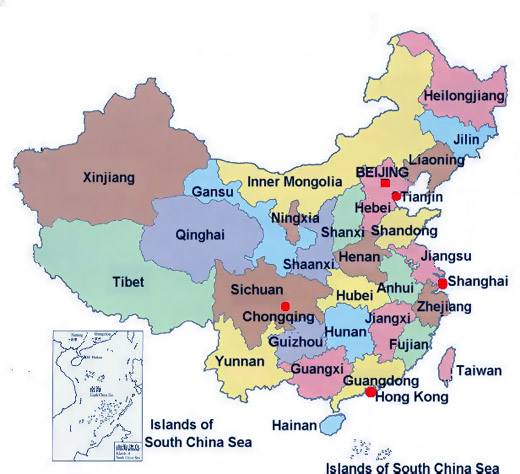
Since many Chinese emigrants to America came from Canton, it was commonly assumed that Cantonese cooking represented the sum total of Chinese cuisine. More recently, spicy Szechuan food has caught on in the west. However, China actually has at least four distinct styles of regional cuisine (many experts would break this down further into eight or nine), based loosely on geographical area.
- Northern or Beijing (Peking) Cuisine - includes Beijing, the capital of the People's Republic of China, and the provinces of Hunan, Shantung, Hopei, Honon, Shansi, Shensi and Inner Mongolia. (Beijing is the modern name for Peking).
- Eastern or Shanghai Cuisine - includes the provinces of Kiangsu, Chekiang, Anhwei and Fukien.
- Western or Szechuan Cuisine - includes the provinces of Szechuan, Hunan and Yunnan. Chengdu, is the capital of Szechuan province.
- Southern or Cantonese cuisine - includes the provinces of Guangdong (Canton) and Jangxi. (Guangzhou city is also known as Canton city and is the capital of Guangdong)
http://www.chinahighlights.com/travelguide/chinese-food/eight-cuisine.htm
Southern or Cantonese Cuisine
The enduring popularity of southern or Cantonese cuisine comes from the subtle use of sauces and the diversity of ingredients and cooking methods. Cantonese chefs specialize in stir-frying, steaming, and roasting a wide variety of meats, poultry, and seafood. Roasted and barbecued meats are hot sellers at restaurants and meat shops, since most Chinese kitchens do not have ovens. We also have the Cantonese to thank for dim sum, literally meaning "touch your heart" - the custom of feasting on a varied assortment of pastries and dumplings that originated in China's teahouses.
Staple Foods:
Fresh fish and shellfish, rice, tropical fruit such as mangoes and lychees, and a wide array of vegetables are readily available. Rice is the staple crop; sweet potatoes (yam), taro and wheat are also cultivated. While water chestnuts are used throughout China, they are more popular in the south.
In addition to seafood, the Cantonese diet includes beef chicken and pork (while western versions often have little in common with the original, Sweet and Sour Pork is an authentic Cantonese dish).
Seasonings and Spices:
No Cantonese kitchen would be complete without a bottle of oyster sauce, made from boiling oysters and seasonings. (Vegetarian cooks can use a vegetarian version made with mushrooms). Chinese fermented black beans (also called salted black beans) and shrimp paste also figure prominently in Cantonese cooking. Hoisin sauce, made by mixing soybean paste with spices, is used as well.
Cooking Methods:
At home, steaming and stir-frying are the two primary Cantonese cooking techniques. Given the emphasis on freshness in Cantonese cuisine, it's not surprising that steaming is popular, as this is the least intrusive cooking technique, and the healthiest. As for stir-frying, the Cantonese are the acknowledged experts. Cantonese cooks believe every stir-fry must exude a taste and aroma that comes from having "wok hay" or "wok breath."
Besides stir-frying and steaming, Cantonese cuisine is also famous for its roast meats such as pork and duck. Char siu bao, or steamed buns filled with roast pork, is a popular Cantonese dim sum treat.
Popular Regional Dishes:
Beef with Oyster Sauce is a typical Cantonese dish, as are Fried Rice and Steamed Chicken. Steamed sea bass, stir-fried garoupa, and Lobster Cantonese are all well-known Cantonese dishes. Shark's fin soup is a local delicacy. Curry chicken, made by simmering chicken, curry powder and vegetables in coconut milk, shows the influence of Southeast Asian cuisine on Chinese cooking. Vegetable dishes reflect the wide variety and seasonality of what is available.
Northern China or Beijing (Peking) Cuisine
In China's northern regions, where the climate of hot, dry summers and freezing cold winters would be all too familiar to many North Americans, people opt for more solid, nourishing fare. Instead of rice, wheat is the staple grain in the north, and noodles made from wheat flour constitute the fan portion of many meals. Steamed dumplings and pancakes are also popular. Mutton is frequently consumed, and is the chief ingredient in Mongolian Hot Pot. Another favorite is Mu Shu Pork. This dish, with its strong flavors of leeks, onions, and garlic, wrapped in steamed pancakes, is characteristic of northern-style cooking.
One of China's most interesting regional cuisines, Beijing or northern Chinese cuisine reflects a variety of influences. It has been shaped by chefs at the Imperial Court, Mongol invaders in the 14th century, the cuisine of eastern Shangdong province, and a harsh climate elsewhere.
Imperial Court Cuisine:
With the exception of periods when foreign conquest forced the Chinese to move it southward, China's capital has always been in the north. The Imperial Court attracted talented chefs from throughout China, bringing with them other regional culinary influences. Court chefs specialized in delicately flavored dishes, many featuring exotic ingredients such as shark's fin and bear's paw. Over time, the cuisine of the noble classes became very cosmopolitan, displaying Szechuan and Shanghai influences.
Shangdong Province:
The area of northern China with the most temperate climate, Shandong province has had a major impact on northern Chinese cuisine. Shandong borders the eastern Yellow Sea, and seafood dishes are very popular. Shandong cuisine is famous for its use of garlic, leeks and spring onions, both raw and cooked.
Everyday Fare :
Outside of Shangdong, common people have historically been limited to hardy foods that can survive in a climate of hot, dry summers and freezing cold winters. Wheat is the staple grain in the north - wheat-based noodles or pancakes make up the fan (starch) portion of many meals. Rice, the staple grain in the south, has traditionally been considered a luxury in the north. Hardy vegetables such as leeks, garlic, and spring onions are consumed frequently, often seasoned with pungent sauces such as bean sauce.
Lamb is popular due to the influence of the Mongolians, who conquered China in the 13th century AD, making Beijing their capital. Beef is eaten more frequently in northern China than in the south.
Is there a Northern Chinese Cuisine? :
All of these outside influences have led some to claim that there is no true Peking or northern Chinese cuisine. Others argue that it encompasses the best of China's numerous regional cooking styles.
Western or Szechuan Cuisine
Next to Cantonese cooking, the cuisine most familiar to us originated in China's largest province, Szechuan in the west. Over time, chefs in the landlocked, mountain-ringed province developed a cuisine distinct from other Chinese cooking styles, but heavily influenced by the foreigners journeying along China's famous "Silk Route." Buddhist missionaries introduced them to the incendiary spicing that characterizes Indian cuisine, and which chefs replicated by making liberal use of Szechuan pepper. (Szechuan peppercorn is one of the ingredients in five spice powder). In the 16th century, Spanish traders introduced chilies to the region. Like their northern neighbors, Szechuan cooks prefer pungently flavored vegetables such as garlic and onions.
Suggest going out for Szechuan cuisine, and many people immediately envision platters of hot, spicy food - the kind that has you gulping down copious amounts of water all evening in an attempt to soothe your burning tastebuds. People are often surprised to discover that at least of one-third of the recipes that make up Szechuan cuisine are not spicy at all. That is not to say that Szechuan's reputation for producing "mouthburners" is undeserved. But, along with fiery classics such as "Hot and Numbing Fish" and "Kung Pao Chicken," Szechuan is the home of "Tea Smoked Duck" - a fascinating dish made by smoking a duck over tea leaves.
Moreover, the chili peppers that have made Szechuan cooking famous are a relatively recent addition. It was Christopher Columbus who brought chili peppers back with him from his travels (on behalf of the Spanish crown) in what he mistakenly took to be the Orient, and which we now know was somewhere in the Bahamas.
It is unclear precisely how chili peppers were introduced to Szechuan, in any event, today chili peppers are an indispensable feature of Chinese regional cuisine. Dried peppers are frequently used in Szechuan dishes, while cooks favor fresh peppers in the neighboring province of Hunan.
However, this does not mean that Szechuan cooks had no way of producing heat prior to Columbus' transatlantic voyage. Szechuan pepper is another important ingredient in Szechuan cooking. Also known as pepper flower, Chinese pepper, and fagara, Szechuan pepper is not a pepper at all. Instead, the reddish-brown fruit - one of the ingredients in five spice powder - is a berry that comes from the prickly ash tree. While not as hot as chili pepper, it does have a unique flavor, and is famous for its numbing effect on the tongue.
Szechuan dishes often contain many flavors, such as sweet, sour, bitter, hot, salty, aromatic, and fragrant. Hot foods like red chili stimulate the palate, making it more sensitive to all these flavors. In addition, they cleanse the palate in preparation for the next dish. Still, it's interesting to note that highly seasoned foods are primarily a feature of Szechuan home cooking - peppery hot dishes are never served at formal banquets.
Foods featured in Szechuan cooking
Chili peppers, Szechuan pepper, garlic, salt, and dried and pickled ingredients such as Szechuan preserved vegetable. Beef, lamb, and pork, although the Szechuanese eat less pork than neighboring Hunan, which is famous for its ham.
Cooking methods: Szechuan cooks employ a variety of cooking methods, from stir-frying to roasting and simmering. Twice Cooked Pork, where the pork is first boiled and then stir-fried, is a classic regional dish.
Hunan cooking, also called Xiang cuisine, is rooted in Szechuan cuisine
Hunan means “south of the lake” and the region is nicknamed “the land of fish.” With the Dongting, a true natural basin, and the rivers which flow into it, fishermen here find a seemingly-inexhaustible catch. It is agriculture, however, that is the province’s primary occupation. Changsha, the capital, is famous for its orange groves.
The basics of Hunan cooking can be found in the culinary style of Szechuan. However, poultry here takes on a unique flavor since it is cooked in a special earthenware pot. Steamed or fried noodles or breads are often served instead of rice. Braising is a cooking technique that is central to Hunan cuisine. The slow-simmered stew, called wei, will tenderize virtually any cut of meat, while flavoring it with mandarin peels, sweet peppers and a large amount of pepper and chilies.
Hunan’s salted foods are famous, particularly carp, meat and poultry which are initially marinated in salt, sugar, pepper and wine for 6 or 7 hours. They are then brushed off and hung for 12 hours before being smoked over a walnut shell fire.
Traditional Hunan cooking includes game, swallows, bear’s claws, turtle and snails. Many recipes call for walnuts, chestnuts, peanuts and large amounts of sesame seed.
While many dishes are typically regional, others can be found from one end of China to the other, with each area imparting its own particular flavors to a recipe. For example, sweet and sour pork is made with just sugar and rice vinegar in the north; in the east a little ketchup is added; while the Cantonese, always favoring abundance, top the dish with pickled vegetables and fruit. On the other hand, if you ask for sweet and sour pork in a Szechuan or Hunan restaurant you will be told politely that it’s not on the menu - such sweet foods are foreign to that region’s tradition.
Eastern or Shanghai Cuisine
The cuisine in Eastern China provides a compelling case for breaking the four regional styles down further. Both rice and wheat are grown here - rice in the subtropical climate to the south, wheat in the colder northern area that includes Shanghai. Cooks in the northern regions rely on noodles and bread made from wheat flour to provide sustenance in the cold winter months. Congee - a rice gruel similar to porridge and eaten for breakfast throughout China - originated in the south-eastern province of Fukien. Nonetheless, there are a few features that characterize all eastern cooking, such as the liberal use of sugar to sweeten dishes. Eastern China is also famous for "red-cooking" - a process whereby meat is slowly simmered in dark soy sauce, imparting a reddish tinge to the final product.
Shanghai is unique, for as a major port on the Huangpu, it was connected to the outside world, benefiting from an international contact unknown to other parts of China until fairly recently. The trading posts here first saw the British come by in 1845, the French in 1849, and the Americans in 1854. Even today it is still said that in Shanghai you can find a little of everything. This is a fertile region: rice, wheat, pork, fish, seafood from the Yellow Sea and freshwater hairy crab are staples of this rich cuisine, that is both sweet and spicy. The region also produces corn, barley, peanuts and sweet potatoes, though the most common vegetable is white cabbage, often called Chinese cabbage, which is used in soups, braised or fried.
The central cooking method of the region is called hung-shao, a slow-cooked process in which ingredients are simmered in rice wine, covered and left to steam. Anyone passing the region of Soochow-wuhsi should never pass up a chance to try the pork with rock sugar, prepared by this long-cooked method. The city of Hang-chou is renowned for its fried rice, and Chin-hua for its delicious ham. Black vinegar from Zhejiang and rice wine from Shaoxing are often added to flavor the typical regional sauce based on soya and sugar.
Staple Foods
Rice - Rice is a major staple food for people from rice farming areas in southern China. It is most commonly eaten in the form of steamed rice. Rice is also used to produce beers, wines and vinegars.
Noodles - Chinese noodles come dry or fresh in a variety of sizes, shapes and textures and are often served in soups or fried as toppings. Some varieties, such as Shou Mian (寿面, literally noodles of longevity), are symbolic of long life and good health according to Chinese tradition.
Soybeans - Tofu, made of soybeans, is another popular product that supplies protein.
Wheat - In wheat farming areas in Northern China, people largely rely on flour based food such as noodles, breads, dumplings and steamed buns.
Vegetables - Some common vegetables used in Chinese cuisine include bok choy (Chinese cabbage), Chinese Spinach (dao-mieu), On Choy, Yu Choy, and gailan (guy-lahn).
Food Preparation and Service
In most dishes in Chinese cuisine, food is prepared in bite-sized pieces (e.g. vegetable, meat, doufu), ready for direct picking up and eating. Traditionally, Chinese culture considered using knives and forks at the table barbaric due to fact that these implements are regarded as weapons. It was also considered ungracious to have guests work at cutting their own food.
Fish are usually cooked and served whole, with diners directly pulling pieces from the fish with chopsticks to eat, unlike in some other cuisines where they are first filleted. This is because it is desired for fish to be served as fresh as possible, and more importantly, whole fish culturally signifies wholeness of things as it has a proper beginning (head) with an end (tail). It is common in many restaurant settings for the server to use a pair of spoons to divide the fish into servings at the table. Chicken is another meat popular in Chinese meals. While the chicken is cut into pieces, and similar to serving fish every single piece of the chicken is served including gizzards and head in order to signify completeness.
In a Chinese meal, each individual diner is given his or her own bowl of rice while the accompanying dishes are served in communal plates (or bowls) that are shared by everyone sitting at the table. In the Chinese meal, each diner picks food out of the communal plates on a bite-by-bite basis with their chopsticks. This is in contrast to western meals where it is customary to dole out individual servings of the dishes at the beginning of the meal.
Many non-Chinese are uncomfortable with allowing a person's individual utensils (which might have traces of saliva) to touch the communal plates; for this hygienic reason, additional serving spoons or chopsticks ("公筷", lit. common/public/shared chopsticks) may be made available. In areas with increased Western influence, such as Hong Kong, diners are provided individually with a heavy metal spoon for this purpose. The food selected is often eaten together with some rice either in one bite or in alternation.
Seasonings
When comes to sauces, China is home to soy sauce, which is made from fermented soya beans and wheat. Oyster sauce, transparent rice vinegar, Chinkiang black rice vinegar, fish sauce and fermented tofu (furu) are also widely used. A number of sauces are based on fermented soybeans, including Hoisin sauce, ground bean sauce and yellow bean sauce. Spices and seasonings such as fresh root ginger, garlic, spring onion, white pepper, sesame oil are widely used in many regional cuisines. Sichuan peppercorns, star anise, cinnamon, fennel, cloves. To provide extra flavors to dishes, many Chinese cuisines also contain dried Chinese mushrooms, dried baby shrimps, dried tangerine peel, dried Sichuan chillies as well.
Beverages Served with Meals
In traditional Chinese culture, cold beverages are believed to be harmful to digestion of hot food, so items like ice-cold water or soft drinks are traditionally not served at meal-time. Besides soup, if any other beverages are served, they would most likely be hot tea or hot water. Tea is believed to help in the digestion of greasy foods. Despite this tradition, nowadays beer and soft drinks are popular accompaniment with meals. A popular combo in many small restaurants in parts of China is hot pot served with cold beer, a combination known as "冷淡杯" (Pinyin: leng3 dan4 bei1, literally: cold and bland cup, despite being strongly flavored), which is the very opposite of what traditional wisdom would admonish. Ideas from Chinese herbology, such as the four natures, influence the food combinations favored in traditional Chinese meals.
Desserts
Chinese desserts are sweet foods and dishes that are served with tea, along with meals or at the end of meals in Chinese cuisine. Bings are baked wheat flour based confections, and include moon cake Red bean paste pancake and sun cakes. Chinese candies and sweets, called táng are usually made with cane sugar, malt sugar, honey, nuts and fruit. Gao or Guo are rice based snacks that are typically steamed and may be made from glutinous or normal rice. Ice cream is commonly available throughout China. Another cold dessert is called baobing, which is shaved ice with sweet syrup. Chinese jellies are known collectively in the language as ices. Many jelly desserts are traditionally set with agar and are flavored with fruits, though gelatin based jellies are also common in contemporary desserts. Chinese dessert soups typically consist of sweet and usually hot soups and custards.
American Chinese Cuisine
American Chinese cuisine refers to the style of food served by Chinese restaurants in the United States. This type of cooking typically caters to Western tastes, and differs significantly from the cuisine of China.
In the 19th century, Chinese restaurateurs developed American Chinese cuisine when they modified their food for American tastes. First catering to railroad workers, they opened restaurants in towns where Chinese food was completely unknown. These restaurant workers adapted to using local ingredients and catered to their customer's tastes. Dishes on the menu were often given numbers, and often a roll and butter was offered on the side. In the process, chefs would invent numerous dishes such as chop suey and General Tso's Chicken. As a result, they developed a style of Chinese food not found in China. Restaurants (along with Chinese laundries which have since nearly vanished) provided an ethnic niche for small businesses at a time when Chinese were often excluded from most jobs in the wage economy by discrimination or lack of language fluency. For most of those who run such restaurants, wages tend to be low, and hours long as much of the labor is provided by immigrants or family members, but part of the attraction of Chinese restaurants is the quality and low cost of the food. In modern times, some Asian professionals invest their savings into running restaurants.
American Chinese food typically treats vegetables as garnish while cuisines of China emphasize vegetables. This can be seen in the use of carrots and tomatoes. Native Chinese cuisine makes frequent use of Asian leafy vegetables like bok choy and kai-lan and puts a greater emphasis on fresh meat and live seafood. As a result, American Chinese food is usually less pungent than authentic cuisine.
American Chinese food tends to be cooked very quickly with a great deal of oil and salt. Many dishes are quickly and easily prepared, and require inexpensive ingredients. Stir-frying, pan-frying, and deep-frying tend to be the most common cooking techniques which are all easily done using a wok. The food also has a reputation for high levels of MSG to enhance the flavor. Market forces and customer demand have encouraged many restaurants to offer "MSG Free" or "No MSG" menus.
Chinese American Dishes (descriptions)
