Hot Chinese Mustard
from http://chinesefood.about.com/
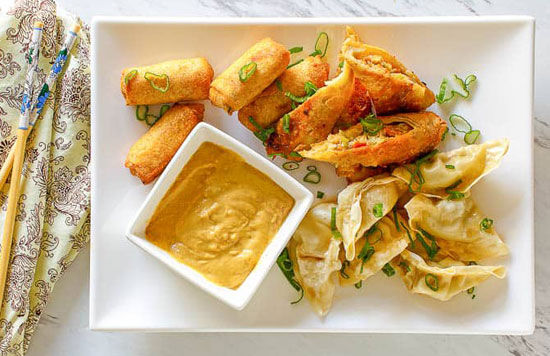
Many Chinese appetizers are accompanied by Chinese hot mustard, a condiment that will provide a real bite. It is the mustard that Chinese take-out restaurant gives you in those little packets. You'll definitely feel the sinus-clearing heat with just a touch of this potent spice. You'll find this mustard served at Chinese restaurants both in the U.S., China, and Taiwan.
Chinese hot mustard can be bought premade or made fresh for each use by mixing a dry mustard powder with water, causing a chemical reaction that produces a sharp, spicy taste. Some recipes call for the addition of cooking or vegetable oil, which reduces the effect somewhat; sesame oil and rice vinegar may also be added.
Hot mustard's raw bite goes well with most Chinese appetizers and is the perfect accompaniment for egg rolls and spring rolls. It is also an ideal condiment for Chinese shrimp balls and deep-fried wontons, any appetizer which is deep-fried which mustard would compliment.
You may be surprised to learn what gives China's most popular table condiment its strong bite, especially considering its seemingly simple preparation. The answer lies in the chemical properties of mustard seeds. Mustard seeds come from the mustard plant, a member of the cabbage family, and contain two sulfur compounds—myrosin and sinigrin—as well as an enzyme, myrosinase. When the seeds are broken and water is added, the enzyme breaks down the sulfur compounds. The result is the sharp tasting oil that gives mustard its pungency.
If you can't find Chinese mustard powder, you can use English Colman's dry mustard powder as a perfectly acceptable substitute; it is made by blending the flavorful brown seeds with the less pungent white mustard seeds. In 1866, Colman perfected the technique of grinding mustard seeds into a fine powder without creating the heat which brings out the oil. The oil must not be exposed or the flavor evaporates with the oil.
Chinese Hot Mustard vs. Prepared Mustards
You may wonder how regular mustards are not just as spicy as Chinese hot mustard. In the case of prepared mustards, the enzyme reaction is toned down by using additives such as flour. The actual flavor of prepared mustard will depend on a number of factors, including the type of seeds used, how they are processed, and what spices are added. The brown mustard seeds used in Chinese hot mustard are stronger than the black and white mustard seeds used in some other types of mustard. By comparison, Dijon mustard is made with strong brown or black mustard seeds, verjuice (the juice of unripened grapes) and/or white wine or wine vinegar, cloves, cinnamon, and other seasonings.
Chinese Hot Mustard is one of those condiments you might not think of making yourself, but it’s quick and easy to prepare at home with mustard powder and water. That intense heat can be preserved to some point either by refrigerating the mustard at its peak, or adding a little vinegar to stabilize it, but this mustard is so quick and easy to put together; just equal parts mustard powder and cold water. I'd recommend making as much as you need when you need it and forget about trying to store it.
Hot Chinese Mustard
from http://chinesefood.about.com/
1/4 c. dry ground mustard from brown mustard seeds
2 - 4 Tbsp. cold water
Put dry mustard in cup or small bowl. Gradually add cold water, stirring until thoroughly mixed. Let sit for about an hour. After about 15 minutes, the reaction will fully develop. Just remember that after the mustard reaches its peak strength at this point, it slowly begins to decline.
If you want hot mustard that's not quite as strong, adding a salad or cooking oil (1/8 teaspoon) to the mustard powder and water tones down the process somewhat, as does adding boiling water, but it also changes the taste.
Use immediately, or transfer the mustard to a small jar, cover, and place in the refrigerator. If you're not using it immediately, adding an acid such as vinegar or rice wine will stop the reaction and prevent the mustard from losing its sharp edge.
Make only the amount needed at a time, for it dries on standing.
Serve with egg rolls, sliced pork, shrimp or cubes of cheese and ham. Flat beer may be used in place of water.
Hot Chinese Mustard Sauce
Recipe courtesy Emeril Lagasse
Use as a dipping sauce, such as with Crab Rangoon or Egg Rolls.
1/4 cup Chinese mustard powder
1/4 cup rice wine vinegar
1 tablespoon water
1 teaspoon dark sesame oil
1/2 lime, juiced
1 tablespoon honey
1 tablespoon grated ginger
3/4 cup peanut oil
Whisk together mustard, vinegar, water, sesame oil, lime juice, honey, and ginger. While whisking, drizzle in the peanut oil.
Chinese Hot Mustard
from https://thewoksoflife.com/
Chinese mustard is pungent, spicy and strong in taste, and it’ll wake your taste buds up immediately with its horseradish-like heat. As you’re making this recipe, keep in mind that it can be adjusted entirely to your taste, and adding some rice vinegar will definitely tone down the spiciness, making your mustard slightly more mellow.
For this recipe, we used an English dry mustard powder, which is more than fine to make a good Chinese hot mustard.
1 tablespoon mustard powder (an English dry mustard powder is fine)
⅛ teaspoon salt
⅛ teaspoon white pepper
1½ teaspoon hot water
½ teaspoon vegetable oil
½ teaspoon rice vinegar optional
Mix the dry ingredients together in a small bowl until evenly combined. Add water and stir well until a liquid paste forms and all dry ingredients are absorbed. Next, add oil and vinegar and stir well until evenly combined.
Let your Chinese hot mustard rest for 10 minutes covered, and re-stir to ensure the dry ingredients have fully absorbed. At this point, taste your Chinese Hot Mustard and adjust it to your own preferences.
Tips: Add a little more water or oil if you like a thinner in consistency. Add more vinegar if you like it a tad tart. Omit the vinegar altogether if you like it spicier, since vinegar makes your mustard a bit mellower in flavor. Add more white pepper and/or mustard powder if you like it spicier.
4 servings
