How to Shape Chinese Dumplings
No matter what shape you are making, please make sure the dumpling is well sealed, especially if you are going to boil them in water. Otherwise, you would end up with broken wrappers and leaking filling.
After the dough has rested, it's divided, portioned, and rolled into 3" circles. A French pastry pin works well for this; it allows you to make thinner edges on the circles, which results in more delicate and thinner pleats. The dough gets thicker from the pleats and you don’t want to end up with really thick edges.
To make homemade dumpling wrappers, see:
Cold Water Dumpling Wrappers
Hot Water Dumpling Wrappers
All of these methods for how to fold a Chinese dumpling start with the same first two steps.
- To prepare a dumpling for folding: Dip your finger in a bit of fresh water and moisten the outer edges of half the dumpling wrapper (in a semi-circle). This will help seal the dumpling.
- Place a tablespoon of filling in the middle.
One more quick tip is to keep the wrappers under a damp paper towel, as they tend to dry out quickly, which makes sealing them more difficult. If that happens, wrap them in a damp paper towel and put them in a sealed plastic bag for a couple hours to soften back up.
You can cover the shaped dumplings with a an inverted bowl or rimmed baking sheet so they don't dry out while you shape the rest, or put them on a parchment-lined baking sheet in the freezer, if you're making enough to freeze them for later.
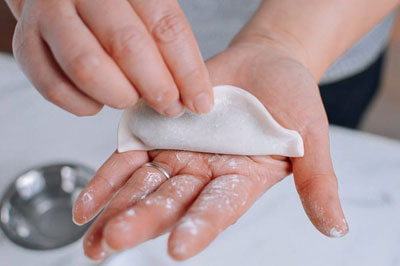
Half moon
The most common look of a Chinese dumpling and the simplest method to fold is the ‘half-moon’ shape. With the wrapper in your off hand, place 2 teaspoons of filling in the center. Bring the edges of the circle up to meet above the filling and pinch the dumpling closed. Thoroughly press the edges together so you get an airtight seal.
Use the palm of your hand to flatten the bottom of the dumpling, so it sits upright.
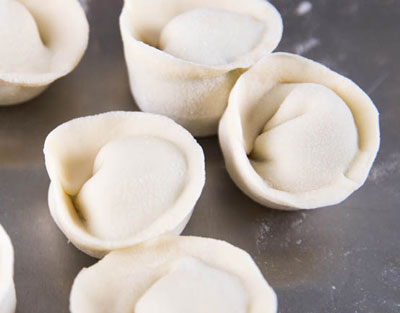
Rosebud
If you want to make them a little fancier, simply bring the ends of the half moon dumpling together, placing one over the other, wet, and pinch to seal; now you have a rosebud shape.
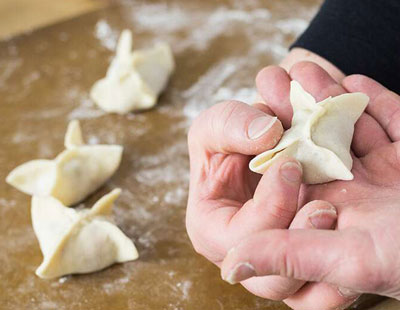
Square dumplings
Put the wrapper in your off hand, place the filling in the center, then pinch the opposite edges together just in the center.
Now bring the open edges to the center, and pinch where the edges meet each other, creating four seams in a cross shape.
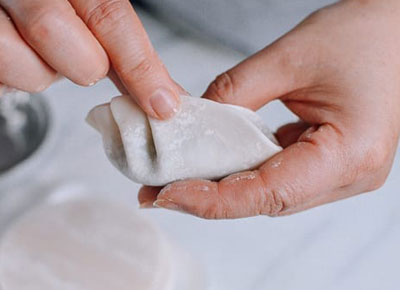
One Directional Pleated crescent
This is the shape we think of most often when it comes to shaping Asian dumplings. Some versions have pleats in two directions, each pointed toward the center (see Bi-directional Pleated crescent below). This version is pointed in one direction only.
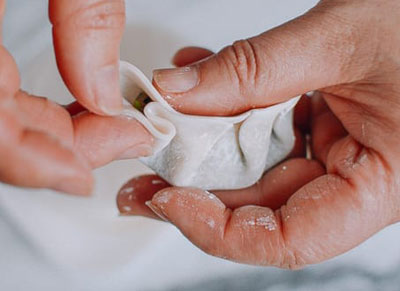
With the wrapper and filling in one hand, gather the dough from the opposite side and fold it into a pleat. It helps to moisten the edge of the dumpling to which you're gathering and pressing the dough.
Bi-directional Pleated crescent
First, start out with a small amount of filling (it's easier to make than you'd think) and place it in the center of your wrapper. Dab water all the way around the outside edge of the wrapper—this will make sure the dumpling's properly sealed later on.
Use your fingers to lightly pinch the two sides of the wrapper together at the center point of the dumpling's seam.
While holding your thumb and index finger against the seam you just pinched, use the index and middle fingers of your other hand to fold a small portion of the top dumpling skin towards the center seam. This is your first pleat. Note that you're only using one side of the skin to make this pleat (if you flip the dumpling over, it should be smooth).
Continue this process, working away from the center seam, until you have three evenly spaced pleats on one side of your dumpling. If you're having trouble getting the pleats to stick to the seam, just add a dab of water.
Now it's time to pleat the rest of the dumpling. Switch hands and hold the center seam with the opposite hand, then use the other hand to pleat the rest of the top dumpling skin against itself. (Sometimes the filling will try to escape. Don't panic—just push it back into your dumpling and keep pleating.) The pleating will cause the dumpling
Once you've completed all six pleats, you'll want to reinforce the seam with water and some gentle pinching to make sure all of the pleats stay, um, pleated during the cooking process.
Dumpling Shape
Description
Dumpling Shape
Description
