Red Cooked Pork (Hong Shao Rou)
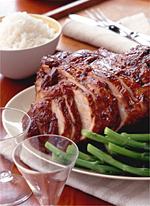
This Chinese method of slow cooking turns a rich piece of meat into flavorful morsels that simply fall off the bone. "Red-cooked" refers to the dark, burnished color of the meat after it's braised in the aromatic cooking broth. Red cooking is popular throughout most of northern, eastern, and southeastern China.
You can make the pork the day before serving. If you do, allow the pork to cool overnight in the broth which ensures its succulence. The flavorful broth that results from cooking the pork is known in Chinese cuisine as a master sauce — save any that's left over in the freezer. It can be re-used several times; just add more water, soy sauce and/or spices as needed. Over time, the sauce becomes even richer, with a fuller flavor.
In the old ways of chinese cooking, before refreigation became popular, the sauce was kept warm throughout the day and night in a Dragon urn. This dragon urn is 3 feet in diameter and 5 feet in height. Meat was hung on a hook and braised inside the urn. Below the urn is charcoal burning at low heat. This master sauce is more precious than gold or silver. Before the cook dies, he leaves his dying wish to his children that they are NOT allowed to sell this sauce away as it carries with it wealth for the family and it will always put food on the table for generations to come. Today, there still are chefs who say their master sauce is 10 years old.
Also see Asian-Glazed Pork Shoulder by Ming Tsai.
1 whole bone-in pork shoulder roast (7 pounds), trimmed of skin
and excess fat
1 piece (2 inches long) fresh ginger, peeled and thinly sliced
3 garlic cloves, crushed with flat side of chef's knife
2 strips (3" by 1" each) fresh orange peel
1 cinnamon stick (3 inches long)
1 whole star anise [or less, this amount was way too strong for me - that's all I could taste]
1/4 teaspoon crushed red pepper
1/2 cup packed brown sugar
1/4 cup dry sherry or water
1/3 cup soy sauce
1/3 cup seasoned rice vinegar
4 1/2 cups water
cornstarch
1 tablespoon brown sugar
- Heat 8-quart Dutch oven over medium-high heat until hot. Add pork and cook until browned on all sides, about 15 minutes. Transfer pork to plate.
- Reduce heat to medium. Add ginger slices, garlic, orange peel, cinnamon stick, star anise, and crushed red pepper, and cook 5 minutes, stirring. Add 1/2 cup brown sugar and cook 10 minutes longer, stirring frequently. Add sherry or water, stirring to loosen brown bits; cook 2 minutes.
- Preheat oven to 375 degrees F. Stir soy sauce, rice vinegar, and water into mixture in Dutch oven. Add pork and heat to boiling over high heat. Cover Dutch oven; place in preheated oven and bake 2 hours 30 minutes, turning meat over once during cooking, until meat is fork-tender.
- Remove Dutch oven from oven. Transfer meat to platter; cover and keep warm.
- Meanwhile, skim fat from cooking broth. Strain broth through fine mesh sieve into large glass measuring cup to measure yield of broth. Pour broth back into Dutch oven.
- In cup, with small wire whisk or fork, mix cornstarch (use 1 1/2 teaspoons cornstarch for each 1 cup cooking broth) with 1/2 cup cold water until blended. Slowly whisk cornstarch mixture into broth in Dutch oven. Heat broth over medium high heat until mixture boils and thickens slightly, stirring occasionally. Boil 1 minute.
- Ladle 1 cup broth into 1-quart saucepan; stir in remaining 1 tablespoon brown sugar. Heat to boiling over medium-high heat; boil 15 minutes or until broth is thick and syrupy. With pastry brush, brush syrup over pork.
To serve, pour broth into gravy boat. Slice pork or, with 2 forks, shred pork coarsely. Good served with Steamed White Rice and Green Beans w/ Water Chestnuts.
Other Chinese dishes that you can use leftover Red Cooked Pork in are Pork Fried Rice, Egg Rolls and Won Ton Soup. The pork could also be wrapped in Mandarin Pancakes as done with Peking Duck or Crispy Aromatic Duck.
