Filipino Adobo Chicken
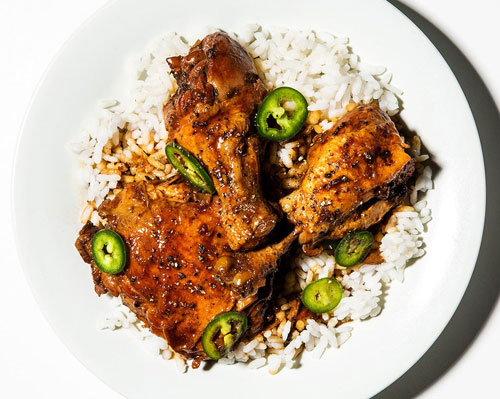
In Filipino cuisine, adobo refers to a common cooking process indigenous to the Philippines. When the Spanish invaded the Philippines in the late 16th century, they found an indigenous cooking process that involved stewing with vinegar. They referred to this method as "adobo". Over time, dishes prepared in this manner came to be known by this name as well. The first written record of adobo dates from 1613, and can be found in the dictionary Vocabulario de la Lengua Tagala, compiled by the Spanish Franciscan missionary Pedro de San Buenaventura, where it is referred as adobo de los naturales (adobo of the native peoples).
The method of cooking pork and chicken in vinegar as a way to preserve the meat probably dates back to the pre-Hispanic times. Like many peoples and cultures living in warmer climates, Filipino natives developed various methods to help them preserve food. Adobo used the acidity of vinegar and the high sodium content of salt to create an undesirable environment for bacteria to develop. It is the Chinese traders who visited the country and introduced soy sauce to Filipinos, which quickly replaced the salt present in the original marinade.
Adobo, which is more of a method of preparation, is often prepared with chicken but can also be made with pork, seafood or even vegetables. Those raw ingredients are marinated what is called adobo sauce: a mixture of vinegar, soy sauce, garlic and peppercorns, before being browned in oil, and simmered in the marinade. The word comes from the Spanish word adobar which actually means “marinade,” or “sauce”.
There are more than 7,100 islands in the Philippines, a nation slightly larger than the state of Arizona, and if you could devote your life to traveling through them asking questions about food, you would discover a different recipe for adobo on each one. It is the national dish, many Filipinos say: protein braised in vinegar until pungent and rich, sweet and sour and salty at once, sometimes crisped at the edges in high heat, always served with the remaining sauce. Its excellence derives from the balance of its flavors, in the alchemy of the process. Cooking softens the acidity of the vinegar, which then combines with the flavor of the meat to enhance it.
What adobo recipes do share in common is the use of soy sauce and vinegar to create the characteristic salty and tangy flavor that melds so well with the characteristic steamed white rice that it is served with. The most important ingredient of Filipino adobo is vinegar. Coconut vinegar, rice vinegar, or cane vinegar are traditionally used, although white wine or cider vinegar are now often used.
In the Philippines, the dish was traditionally cooked in small clay pots called palayok or kulon. Nowadays, metal pots or woks (kawali) are used instead. If you like your chicken a little crispy, after the chicken has stewed, pan fry it on both sides to crisp the skin and don't fully immerse it in the liquid afterwards. You can also add a little hoisin sauce as a glaze on the chicken before pan frying it, so that the sugar in the hoisin sauce caramelizes and adds another layer of flavor.
FMM: Brian & I made this dish using a different recipe than the one on the below left and were not impressed. At that point, I said we should try the recipe with coconut milk on the right or add more vinegar. The chicken did not taste vinegary, a complaint by some reviewers. We used rice vinegar. (The recipe was courtesy of Corinne Domingo, foodnetwork.com, and used 1/2 white vinegar and 1/2 soy sauce). Since then I've seen recipes that use twice as much vinegar as soy sauce. I also replaced the recipe with one from Bon Appetit.
Filipino Adobo Chicken
from https://www.bonappetit.com/
Adobo is typically served with white rice.
1 head of garlic
2 green chiles (such as serrano or jalapeño), divided
4 bone-in, skin-on chicken thighs and 4 drumsticks, or 4 whole chicken legs
1 tablespoon vegetable oil
¾ cup distilled white vinegar
¾ cup soy sauce (not low sodium)
5 dried bay leaves
1 tablespoon light or dark brown sugar
Freshly ground black pepper
1 cup uncooked white rice, preferably short grain
Without separating or peeling the cloves, cut entire head of garlic in half through the “equator” (it’s fine if some cloves become detached). Thinly slice 1 green chile, removing seeds if desired for less heat.
If you got whole chicken legs (if not, go to the next step), cover surface of cutting board with a double layer of plastic wrap and place legs skin side up on top (this is to protect your board from any possible contamination; if you have a cutting board that you use for raw meat, use that). You’re going to split the legs into thighs and drumsticks. Working one leg at at time, wiggle drumstick so you can see the joint connecting the thigh and drumstick. Slice down with your knife crosswise between the two, aiming for the joint, until you hit bone. Grasp leg with thigh in one hand and drumstick in the other and break the joint, then cut the rest of the way through with your knife. Repeat with remaining legs.
Heat 1 Tbsp. vegetable oil in a large Dutch oven over medium. Add chicken skin side down and cook, lifting pieces with tongs once or twice toward the end to let hot fat flow underneath, until fat is rendered and skin is crisp and golden brown, 7–10 minutes. Transfer skin side up to a plate. Because drumsticks are covered entirely in skin, you can brown both sides, but it’s not necessary.
Add ¾ cup vinegar, ¾ cup soy sauce, 1 Tbsp. brown sugar, 5 bay leaves, and reserved garlic and sliced chile to Dutch oven. Bring to a simmer, then reduce heat to low, stirring to dissolve sugar. Season generously with pepper.
Return chicken to pot skin side up. Cover and cook chicken very gently, adjusting heat to maintain a bare simmer and turning pieces once, until meat is very tender and pulling away from bone (but not so tender that it’s falling apart), 35–40 minutes.
While chicken is simmering, cook 1 cup rice in medium pot according to package directions.
Transfer chicken to a clean plate. Increase heat to medium-high and boil braising liquid, shaking pot often, until liquid has formed a rich sauce thick enough to coat the back of a spoon, about 5 minutes. Remove pot from heat and return chicken to pot, turning to coat in sauce.
Serve chicken and sauce over rice. Thinly slice remaining chile and scatter over, then season with more pepper.
4 servings
Filipino Adobo Chicken
Adapted from Amy Besa and Romy Dorotan, Purple Yam restaurant, Brooklyn
1 cup coconut milk
¼ cup soy sauce
1½ cup rice vinegar
12 garlic cloves, peeled
3 whole bird’s-eye chilies or other fiery chili
3 bay leaves
1½ teaspoons freshly ground black pepper
3 to 4 pounds chicken thighs.
1. Combine all of the marinade ingredients in a large, nonreactive bowl or resealable plastic freezer bag. Add the chicken and turn to coat. Refrigerate overnight or for at least 2 hours.
2. Place chicken and marinade in a large lidded pot or Dutch oven over high heat and bring to a boil. Immediately reduce heat to a simmer and cook, stirring occasionally, until the chicken is cooked through and tender, around 30 minutes.
3. Heat broiler. Transfer chicken pieces to a large bowl, raise heat under the pot to medium-high, and reduce the sauce until it achieves almost the consistency of cream, about 10 minutes. Remove bay leaves and chilies.
4. Place chicken pieces on a roasting pan and place under broiler for 5 to 7 minutes, until they begin to caramelize. Remove, turn chicken, baste with sauce and repeat, 3 to 5 minutes more. Return chicken to sauce and cook for a few minutes more, then place on a platter and drizzle heavily with sauce.
Serve with steamed rice and some steamed or sautéed greens, such as baby bok choy.
Serves four.
