 |
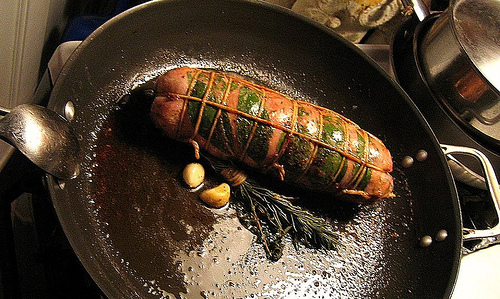
Ballotine of Rabbit with Swiss Chard
and Mustard Seed:
Boneless rabbit stuffed with a forcemeat of rabbit (trimmings from the forelegs, liver, heart, kidney) pork, lardo (cured fatback), swiss chard and mustard seeds with the loins inlaid lengthwise. The rabbit was deboned (bones used for the bombine base) in the same method as in for porchetta; the ribs and spine removed in one piece from the underside as to give a rectangular meat canvas. Forcemeat is mixed, seasoned, wrapped in the meat and chilled to give it a firm shape. Once chilled and firm, bay leaves and thyme are placed on caul fat and the roulade is wrapped, whereupon it can be cooked and offered as either a cold galantine or hot ballotine. |
What is a Ballotine?
French in origin, ballotine refers to boned meat that has been rolled into a round shape and filled with a stuffing of ingredients that enhance the flavor of the meat being prepared. Beef, pork, veal, turkey, chicken, and fish are common meats that are boned, cut and formed, or pounded into thin, flexible pieces that are rolled and tied to keep the filling secure as it cooks inside the meat. As an example, Ballotine de poulet would be poultry stuffed with a filling.
Stuffings
Frequently, the stuffing is comprised of additional meat from the same animal, sometimes called forcemeat, or of other meat products like pâté. Other common stuffings may include a mousse prepared with herbs, ground meat such as sausage mixed with spices, or complimentary meats such as bacon, pork, pancetta, ham, and veal that are cooked within other meats. A different take on the ballotine is Beef Wellington, which is covered with foie gras, pastry crust, and then baked. Beef Wellington is not a standard ballotine because of its pastry shell.
Fish ballotine may be stuffed with a variety of herbs and spices, in addition to various sauces. It’s also quite common to see fish ballotine stuffed with types of shellfish like chopped crab, lobster meat, oysters or scallops. In many cases, the whole fish is used, but is carefully boned prior to preparing the ballotine.
More likely you will see recipes for chicken or duck ballotine, which may be partially stuffed with forcemeat, usually from the legs and thighs, combined with cream sauces, spices, or other meats like pancetta.
Serving Ballotine
Serving the ballotine is certainly a way of impressing guests. Ballotine is typically sliced in horizontal slices that display the stuffed interior. Chefs enjoy going for contrast so that the meat of the exterior looks different than its interior. In presentation, a person may receive one or more slices of the ballotine, perhaps topped with luscious cream sauce or gravy.
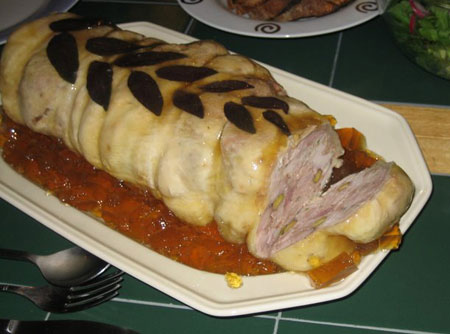 |
Chicken Galantine Chicken Galantine is one of those slightly obscure dishes that have survived from the courtly cooking of the middle-ages (Galantine orignally referred to dishes immersed in a galangal sauce -galangal is a root herb). A distant relative of the whole ‘eggs stuffed into quail, inside a chicken, stuffed into a turkey, inside a roasted boar’ conundrum served at royal tables to impress visitors. Today this usually means a chicken stuffed with forcemeat and various other surprises, the simmered and served cold in aspic. |
Galantine
Almost always served warm, a Ballotine may be confused with galantine which is similarly rolled and stuffed, but is served cold rather than warm. Galantine is traditionally prepared and wrapped within a cheese cloth or baking paper covering. It is then poached in a base stock, refrigerated and served cold by slicing off pieces of the rolled meat, providing a different flavor entirely. It served with decorative aspic made from the stock, either cold or room temperature.
Since deboning poultry is thought of as difficult and time-consuming, this is a rather elaborate dish, which is often lavishly decorated.
Galantine comes from the Old French word for chicken “géline” or “galine” as it was originally made from chickens, though some maintain the word has its origins from the Gothic root “gal” meaning jelly, for the gelatinous stock. Towards the end of the 17th century it came to include other types of poultry, the remarkable Russian Doll Roast making use of 17 birds stuffed within one another being a remarkable example.
