Christmas Foods of Provence
Forget roast turkey with all the trimmings and mince pies: Provence has its own distinctive, very different but equally delicious eating traditions at Christmas.
The Great Supper
The major meal takes place on Chistmas Eve and is the Gros Souper, or Great Supper. For it, the table is cermoniously laid with three white tablecloths, one on top of the other, garnished with three candles and three saucers of wheat of Saint Barbara, representing the Holy Trinity.
The first part, eaten before Midnight Mass, consists of seven very plain dishes, symbolising the seven sorrows of the Virgin Mary (some stories link it to the seven wounds of Christ). They're all presented on the table at once, in the form of a buffet. No meat is on the table, but there is likely to be fish such as salt cod, shellfish, snails and vegetables such as cauliflower, cabbage, artichoke and celery, often with an aïoli (garlic mayonnaise sauce). Seven separate wines are served as an accompaniment.
An extra place should be set: le couvert du pauvre. It's either for a beggar who might come to the door or for the souls of dead ancestors. For the same reason, the table should be left uncleared overnight in order for the latter to partake of the feast.
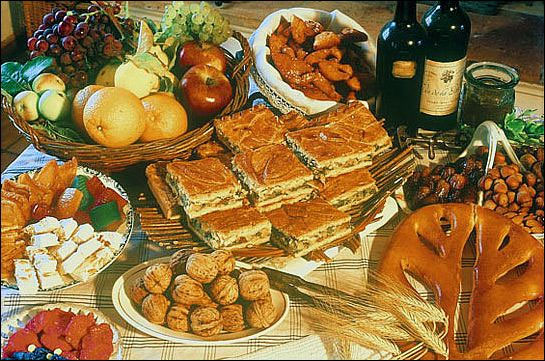
The 13 Desserts
This is followed by the 13 Desserts, served after Midnight Mass and signifying the 13 participants at the Last Supper. Here too, the exact components can vary, but they generally fall into three categories: mendiants (mendicants), fruit and local sweetmeats.
There are always four mendiants, symbolising the religious orders which have taken a vow of poverty: dried figs (Franciscans), almonds (Carmelites), raisins (Dominicans) and walnuts or hazelnuts (Augustines). The colours of the nuts or dried fruit correspond to the colours of the habits of the monks or nuns.
Also key are the two nougats, black and white, symbolising, some say, good and evil. The fruit can encompass all sorts of fresh fruit such as apples, oranges, mandarines, bananas, pears and so forth.
The local specialities will vary too, of course, but might feature calissons d'Aix, quince paste and/or dates stuffed with marzipan, often dyed a lurid shade of pink or green.
An essential component is the pompe a l'huile (in the bottom right-hand corner of the picture). It's a sweet bread made of olive oil and flavoured with orange flower water and citrus zest. It should be torn apart when served (in the same way that Christ broke the bread) and not cut with a knife, at the risk of incurring bad luck during the coming year.
This part of the meal is accompanied by sweet wine. Even families who skip the rigours of the Gros Souper include a variant of the 13 Desserts in their Christmas celebrations and many food shops and supermarkets sell ready-made presentation baskets of these dried fruits and sweetmeats.
The Christmas Log - Bûche de Noël
An edible version of the Christmas log, or bûche de Noël, will be on display in all self-respecting French pâtisseries throughout the festive season. It's usually a Swiss Roll-like confection, a sponge-based cake lined with chocolate buttercream and coated with chocolate striated to resemble the bark of a log.
The Brioche des Rois
In theory the brioche des rois- the kings' cake - is meant to be eaten at la fête des rois (Epiphany, 6 January), but in practice it will be glowing away temptingly in the windows of pâtisseries from early December. This is the Southern counterpart of the galette des rois, a puff-pastry torte with frangipan filling sold in Northern France. The Mediterranean version is altogether much nicer, and certainly much prettier: a rich but light brioche flavoured with candied peel and topped with a multi-coloured array of preserved fruit and glistening sugar glaze.
Both galettes and brioches contain a favour or fève: a broad bean or small porcelain figure. Whoever gets it in his or her slice at the ceremonial cutting of the cake is declared king or queen for the day - and has to pay for the brioche the following year.
Navettes
Candlemas (Chandeleur) on 2 February is the occasion for yet more sweetmeats: this time navettes, long thin biscuits flavoured with orange water and intended to resemble the boat, or navette, that brought Lazarus, Mary Magdelene and other saints to Saintes-Maries-de-la-Mer in Provence. Made without yeast or baking powder, these biscuits are best eaten straight from the oven, but you can freshen them up by reheating them gently.
