All-Butter Croissant Dough
from https://www.foodandwine.com/
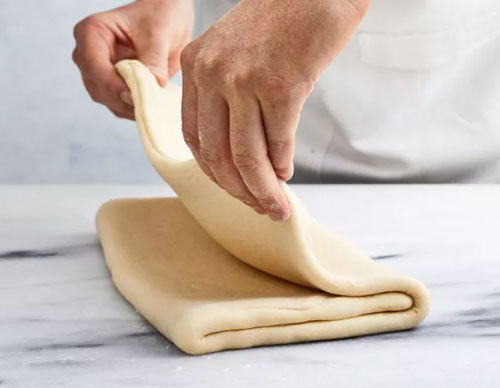
Golden, buttery, and impossibly flaky croissants depend on quality ingredients, good technique, and plenty of patience — and are oh so worth it. For bakery-perfect croissants with distinct, crispy layers, the key is keeping the dough, and the butter block that’s encased within layers of dough, nice and cold.
Croissants are made of yeasted laminated dough, which makes a base recipe that you can use for flaky layers in many other baked goods. It can also be used as a substitute for puff pastry. Both doughs are laminated, meaning they are made with many layers of butter. Puff pastry dough does differ from croissant dough, though, in that croissant dough contains yeast, but puff pastry does not contain yeast. The yeast in croissants give them a lighter and softer texture than that of puff pastry. Additionally, the milk and sugar in croissant dough that is not present in puff pastry creates a richer dough with better flavor. Puff pastry is flakier and more crumbly than croissants.
The butter block (Step 2) can be made ahead, wrapped tightly in plastic wrap and refrigerated for up to two weeks. Let stand at room temperature until pliable, about 10 minutes, before starting lamination.
4 cups all-purpose flour (about 17 ounces), plus more as needed
1/4 cup plus 1 teaspoon granulated sugar, divided
2 1/2 teaspoons fine sea salt
2/3 cup warm water (100°F to 110°F)
1 tablespoon active dry yeast (from 2 [1/4-ounce] envelopes)
1 1/2 cups plus 3 tablespoons cold unsalted European-style butter* (such as Échiré) (13 1/2 ounces), divided
1/2 cup whole milk
*European butter contains more butterfat and less water, so it's more pliable than standard butter. As you roll out your dough, the butter block stays relatively flexible, allowing for smooth, even layers that remain fully enclosed in the yeasted dough instead of crumbling and breaking.
Step 1 Create the Dough: Stir together flour, 1/4 cup sugar, and salt in a medium bowl; set aside. Stir together 2/3 cup warm water, yeast, and remaining 1 teaspoon sugar in the bowl of a stand mixer fitted with a dough hook. Let stand until foamy, about 5 minutes. Meanwhile, place 3 tablespoons butter in a microwavable bowl, loosely cover with a paper towel, and microwave on high until melted, about 30 seconds. (Keep remaining butter refrigerated.) Add melted butter and milk to yeast mixture. With mixer running on low speed, gradually add flour mixture to yeast mixture, beating until dry ingredients are incorporated, about 6 minutes. Increase speed to medium-low and beat until dough is smooth, elastic, and tacky, about 8 minutes. Shape dough into a ball; flatten slightly. Place dough on a lightly floured large plate; wrap tightly in plastic wrap. Refrigerate at least 2 hours or up to 8 hours or overnight for more flavor.
[It’s best to start the dough in the mixer and mix only until the dough comes together. Next, take the dough out onto a floured surface and knead by hand until the dough is soft. Let ferment at room temperature for 30 minutes. This will activate the fermentation process.
Complete Step 2 on Day 1.]
Step 2 Ready the Butter Block: Place remaining 1 1/2 cups cold butter between two sheets of parchment paper; let stand at room temperature 10 minutes. Using a rolling pin, pound butter to flatten and soften slightly. Removing and replacing parchment as needed, use a bench scraper and a rolling pin to shape butter into a 7 1/2-inch square block of even thickness. Refrigerate between sheets of parchment paper at least 15 minutes.
Step 3 Add the Butter Block to the Dough: Unwrap chilled dough and transfer to a lightly floured surface. If need be, lightly flour top of dough. Roll into a 12-inch square; brush off any excess flour. Remove and discard top sheet of parchment paper from butter block. Using bottom sheet of parchment paper as handles and turning butter block 45 degrees, flip butter onto middle of dough square. (Butter will be in a diamond shape, leaving corners of dough square exposed.) Remove and discard parchment paper. Using a rolling pin and starting at edge of butter block, roll each dough corner away from the center until it is 8 inches long (about 1/16-inch thick), flouring as needed. Brush off excess flour. Fold one elongated dough corner up and over butter block, stretching gently into a square to fully cover butter. Repeat with remaining dough corners, creating four layers of thinly stretched dough covering butter block.
Step 4: Lightly flour work surface if needed. Try to add as little flour as possible. Press rolling pin across dough to create trenches, evenly dispersing butter. Roll dough into a smooth 24- x 12-inch rectangle. Starting with one short side, fold dough into thirds, like a letter. Transfer to a lightly floured baking sheet. Cover tightly with plastic wrap and refrigerate until firm, about 45 minutes. Repeat rolling, folding, and chilling process two times. Proceed with making Classic Croissants or other pastry.
Number of layers: In the beginning, there are a total of 3 layers (a layer of butter sandwiched in between 2 layers of dough. With each fold, the number of layers is multiplied by 3. At n = 1, there are 9 layers, at n = 2, there are 27 layers, at n = 3, there are 81 layers. Note: Too many folds yields a tight structure due to the layers getting compressed into one another. What happens is the butter gets pressed so incredibly thin that it doesn’t have quite enough moisture to create the steam that typically makes the dough layers separate and puff.
Note: When cutting croissant dough, do not press down with a knife and seal the edge of the dough; slice the dough and make clean cuts instead so that the layers of dough and butter are visible.
Tips:
- The temperature of the dough and the temperature of the butter folded inside the dough should be cold, but not so cold that the butter breaks into pieces when you roll it out.
- The gluten in the flour should be relaxed. The more you fight against rolling out the dough, the longer it will take (which causes the dough to become too warm), and the tougher the croissant will be.
- Dough Is tearing: If you witness any kinds of tearing of the dough and butter peaking through, STOP and put it back in the fridge for another hour.
- Making the best authentic French croissants requires a one and a half to three day process. This is because you are letting time and long fermentation add the most amazing natural sweet flavor.
- Work ahead: You can make the main dough the day before, then let it rest overnight and continue the next day. This comes in handy when wanting to make fresh pastries for breakfast the next morning!
Pastries Made with Croissant Dough:
- Classic Croissants (recipe makes 12 croissants)
- Pain au Chocolat (Chocolate Croissants) - chocolate strips are place on strips of croissant dough, the strips are rolled up, brushed with an egg wash and baked.
- Pain aux Raisins - Raisins and almond cream (frangipane) filling is spread on the rolled-out dough, the dough rolled up and sliced (like making cinnamon rolls), brushed with an egg wash, then baked.
- Cinnamon sugar, and perhaps raisins, can also be sprinkled on the rolled-out dough, the dough rolled up and sliced (like making cinnamon rolls), brushed with an egg wash, then baked.
- Popular today is rolling savory fillings inside the croissant before baking: ham & cheese, feta cheese and spinach, brie & jam. . .
