Financiers
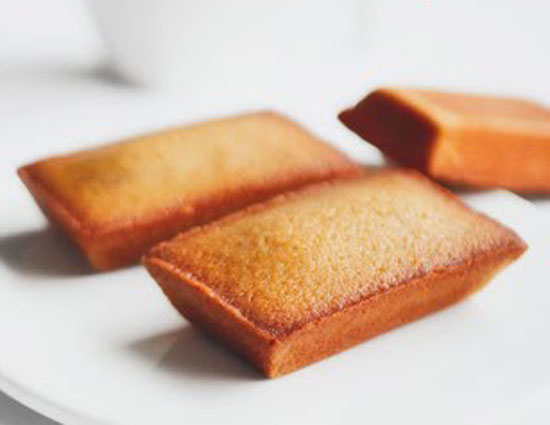
Financiers are rich, tiny cakes made with almond flour, brown butter, and egg whites. Usually baked in small molds, financiers are traditionally rectangular in shape, but they’re also often made in round molds, such as the ones in a mini-muffin pan. The perfect financier will have a springy texture, golden and crispy edges, while the center will remain moist and tender. When baked, financiers should rise to form a slightly dome-like shape.
Despite their fancy name and elegant appearance, financiers are super easy to make (if you can make muffins, you can make financiers!), and they’re extremely versatile: you can make them with any type of nut and garnish them with any fresh or roasted fruits, dried fruits or citrus zest, or even chocolate chips. What’s more, you can (and should) make financier batter in advance as it will keep in the fridge for a few days—all of which makes French financiers the ultimate stress-free dessert.
History
In Memorial de la Patisserie, published in 1890, Pierre Lacam wrote that the financier was created by a baker named Lasne, whose bakery on the Rue St.-Denis was near the Bourse, the financial center of Paris. Presumably the rich little cake was named for the rich financiers who frequented his bakery. The cake was baked in rectangular molds in the shape of gold bars.
Nick Malgieri, the director of the baking program at New York’s Institute for Culinary Education, said a similar cake, made with nuts, egg whites, and brown butter, existed even before that. It was made, he said, by nuns of the Order of the Visitation and was called a visitandine. Its possible thtat the baker Lasne simply altered the shape and the name of the cake to flatter his clientele.
The recipe has withstood the test of time, despite a lack of notice from cookbook authors. There is no mention of the financier in Le Cordon Bleu or La Varenne Pratique, two of the leading encyclopedic French cookbooks. Nor is it in Lindsey Shere’s Chez Panisse Desserts, or Rose Levy Beranbaum's comprehensive Cake Bible, The finnancier earns just a vague definition in some editions of Larousse Gastronomique.
Nut Flour
If you have raw nuts on hand, it’s best to toast them before grinding them to make financiers. This will make them more flavorful. The easiest way to grind nuts is to add them to a food processor along with the flour. This will ensure the nuts grind evenly and don’t turn to butter. Simply combine the nuts and flour and process until finely ground. Scrape down the sides of the bowl once or twice to make sure the nuts grind evenly.
Brown Butter
One central flavor component of classic French financiers is brown butter (beurre noisette, in French). Brown butter is made by melting butter in a saucepan, then letting it simmer for 5 to 7 minutes, until its water evaporates and milk solids caramelize. Brown butter is easy to make and incredibly aromatic. It gives financiers a truly special flavor.
Place the diced butter in a small stainless steel saucepan. A stainless steel saucepan makes the color of the butter more conspicuous, which will help you know when it’s ready to pull off the heat. Set over medium heat and stir until the butter is completely melted. Keep simmering over medium-low heat, swirling the pot from time to time. As the water evaporates, the butter will bubble up. This may prevent you from properly seeing what color the butter is, so, from time to time, simply lift the saucepan off the heat and gently swirl it for a few seconds until the bubbles recede, check whether the butter has started browning, then put it back on the heat if the butter is not ready.
Brown butter is ready when the milk solids at the bottom of the pot turn golden brown and the concoction gives off a deliciously nutty aroma. When it does, remove the butter from the heat, pour it in a small bowl, and let cool completely. (The whole process should take about 5 minutes.)
Sugar
Sugar is responsible for the financiers’ crackly exterior. Recipes contain more sugar than flour. As the cakes bake, the sugar caramelizes, turning pliable. Then, as the cakes cool, the sugar takes on a brittle structure, creating the delightfully crisp shell that is the hallmark of a good financier. Some recipes, such as Cook’s Illustrated, uses granulated sugar as opposed to confectioner’s. They say "Granulated sugar, which is coarse and doesn’t fully dissolve in the egg whites, gives these cakes a rustic, open crumb." You find confectioner’s sugar more often in recipes.
Flavorings
You can also easily add a layer of flavor by incorporating a generous amount of grated lemon or orange zest to financier batter. Use a Microplane to grate the citrus zest very finely. Add 2 tbsp (30 ml) of finely grated citrus zest to the financier batter for the best flavor (that’s about 2 lemons, or 1 orange). Other flavorings are vanilla, almond and other extracts, as well as rum and other liquors and liqueurs.
Toppings

Get creative with toppings: You can top financiers with an almost infinite array of ingredients and produce different results with a single batch of batter. For example, you could whip up a batch of classic French financier batter, scoop it into prepared cups, and top them with 3 or 4 different fruits (raspberries, blueberries, cherries, plums, and figs, for example) and easily create a stunning array of treats without breaking a sweat. Dried fruits and nuts also work as toppings. You could garnish with candied orange peel and dust with more confectioner’s sugar.
For Candied Orange Peel:
3 oranges
1 cup sugarShred long strips of orange peel
Place strips in medium saucepan, cover with cold water and bring to a boil over medium heat. Drain and repeat two more times with fresh water (this will get rid of the bitterness of the orange skin)
Place sugar in clean saucepan with 1 1/2 cups water. Stir to combine and bring to a boil over medium heat, stirring occasionally, until sugar dissolves, about 3 minutes.
Add citrus strips to boiling syrup, reduce heat and simmer until strips are translucent, about 12 minutes. Remove from heat, let strips cool in syrup at least one hour. Remove from syrup when ready to use.
Storage
One of the joys of freshly baked financiers is the contrast between the crunchy edges and the buttery rich interior. After 24 hours in an airtight container, the texture of French financiers loses that contrast—they become more uniformly tender in texture—but they do remain delicious. The fact that you can refrigerate financier batter for several days allows you to bake as many financiers as you need and enjoy them fresh, always.
To return French financiers to their freshly baked texture, reheat them in a 325°F (160°C) oven for 6 to 8 minutes, then let them cool to room temperature before serving.
Other Financier Recipes
Roasted Hazelnut Financiers
Coconut Financiers
Financiers
from https://www.pardonyourfrench.com/
FMM: These are excellent little treats made in mini muffin pans.Very nutty tasting with just a touch of sweetness.
1/3 cup + 2 tbsp (105g) unsalted butter, made into brown-butter
3/4 cup (90g) roasted almond flour
1/2 cup (62.5g) all-purpose flour
1 cup + 2 tbsp (145g) icing sugar
¼ tsp salt
4 egg whites (1/2 cup [125 g]), at room temperature
1/2 tsp vanilla extract
Pre-heat your oven to 350°F (180°C) with a rack in the middle. Grease a 12-cup muffin pan with butter and dust with flour (you will likely only use 8-9 cups).
Note: Financiers pans have loaf cavities that are 3.75 x 2.25 x 1.25 inch deep and make 18 mini loaves. You could also make financiers in mini cupcake pans. Mini cupcake pans hold about 1/3 the batter that a regular muffin pan holds. So this recipe would make about 24 - 27 mini financiers. (I got 11 from 1/2 recipe but I did fill the mini muffins cups a little more than 2/3 full. If you just divvy the batter equally between 12 mini cups, it should work out well.)
Step 1 - Make the brown-butter (“beurre-noisette”) (see instructions above) and set aside to let it cool slightly.
Step 2 - In a large mixing bowl, whisk together the ground roasted almond flour, icing sugar, flour and salt.
Step 3 – Whisk in the 4 egg whites and the vanilla extract. The batter will be fairly thick.
Step 4 – Switch to a spatula, and fold in the brown butter. Stop folding when just incorporated.
[Be sure to rest the batter before baking, preferably several hours. The flavors will meld together and the batter will firm up making it easier to transfer into the molds.]
Step 5 – Transfer the batter into the muffin pan – fill the cups up 2/3 of the way. You should have enough batter for 8 to 9 "cups". [Decorate with fruits, if desired.} Bake for 20-22 minutes [10 - 15 minutes for mini muffin pans], until financiers have a dome and a toothpick inserted in the middle of one comes out clean.
[Bake them until browned on top, and they feel just set in the center when you touch them. Be careful not to burn the financiers and dry them out. They must be very soft.]
Transfer onto a cooling rack, cool for 5 minutes and remove financiers from the pan.
Makes 8-9 Financiers (12-cup muffin pan)
