Almond Sponge Cake (Biscuit Joconde)
from
The Fundamental Techniques of Classic Pastry Arts by The French Culinary Institute with Judith Choate
Makes one 18-by-26-inch sheet cake (or 2 half-sheet pans)
Estimated time to complete: 1 hour
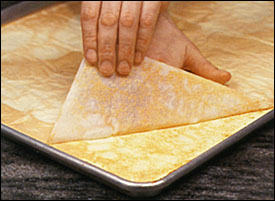 Butter for pan
185 grams (6-1/2 ounces) almond flour
85 grams (3 ounces) sugar
45 grams (1-1/2 ounces) all-purpose flour, sifted
5 large whole eggs, at room temperature
For the French meringue
125 grams (4-1/2 ounces) large egg whites, at room temperature
100 grams (3-1/2 ounces) sugar
18-inch by 26-inch sheet pan
Parchment paper
Standing electric mixer fitted with paddle and whip attachments
Rubber spatula
Medium mixing bowl
Wire rack
Prepare your mise en place (get all ingredients out and measured, ready to use).
Preheat the oven to 177 degrees C (350 degrees F).
Prepare a sheet pan with butter and parchment paper as directed on page 325 of the book. Set aside.
Combine the almond flour, sugar, and all-purpose flour in the bowl of a standing electric mixer fitted with the paddle attachment. Beat on low to just blend.
Add the eggs, one at a time, occasionally scraping down the sides of the bowl with a rubber spatula. It is important that as each egg is added, the mixture is beaten for a couple of minutes until it is completely emulsified. After all of the eggs have been added, beat for about 4 minutes to ensure that as much air as possible has been incorporated. Scrape the mixture from the electric mixer bowl into another clean bowl.
Wash the mixer bowl and return it to the stand. Fit the mixer with the whip attachment. Place the egg whites in the bowl and beat on low to aerate. Add the sugar, raise the speed to high, and beat for about 4 minutes, or until soft peaks form. Keep a close eye on the meringue; you can overmix it very quickly. If the egg whites do form dry, stiff peaks, discard the meringue and make a new one.
Remove the bowl from the mixer and, using the spatula, carefully fold the meringue into the batter. Work quickly and carefully so that the batter is not overworked, which will create a tough cake.
Gently spread the batter out in a thin layer in the parchment paper-lined pan and bake for about 7 minutes, or until the surface is an even golden brown and the center springs back when lightly touched.
Carefully invert the cake onto a wire rack. Peel off and discard the parchment paper and let cool.
Use as directed in a specific recipe (see Tips).
Tips
Biscuit is the French word for sponge or sandwich cake. This particular biscuit can be used to make decorations for two types of cold confections. It may be stacked, layered with jam, and sliced to decorate the outside of a cake (for instance, Miroir aux Fruits), or it may be made into a roll, filled with jelly, and used to decorate a Charlotte Royale. It can also be used as a component in layered cakes and petits fours such as Opera Cake.
Miroir aux Fruits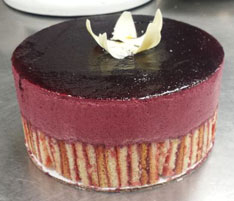 |
Miroir aux Fruits (translates as Fruit Mirror): This particular Miroir aux Fruits is made with a plain genoise base, almond sponge (joconde) layered with raspberry jam and used to line the bottom half of the mold, fruit mousse (raspberry cassis), and nappage (topping) that has been colored with fruit puree. |
Charlotte Royal 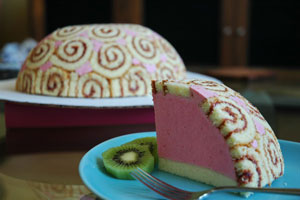 |
Charlotte Royal: A cold Charlotte made by lining a domed mold with small slices of jelly roll, packed tightly, then filled with a flavored Bavarian cream (bavarois) and topped with a round of sponge cake. Once chilled and set, the mold is inverted and glazed with apricot jam. This charlotte was invented by Antoine Câreme. Popular flavors are raspberry, lemon and chocolate. Bavarois or Bavarian cream: A dessert made from either a vanilla-flavoured egg custard or a fruit purée containing gelatine, let down with sugar syrup, combined when beginning to thicken, with whipped cream and sugar. Cooled in a mould, which is either oiled or lined with caramel, demoulded when fully set and decorated if required. Also called crème bavaroise. |
Opera Cake 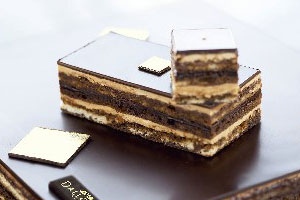 |
Opera Cake is a type of French cake. It is made with layers of almond sponge cake (known as Joconde in French) soaked in coffee syrup, layered with ganache and coffee buttercream, and covered in a chocolate glaze. According to Larousse Gastronomique "Opéra gateau is an elaborate almond sponge cake with a coffee and chocolate filling and icing." The cake was popularized by the French pâtisserie house Dalloyau. |
Great care must be taken when mixing the batter; if it is overworked, it will deflate and there will not be enough to cover the entire pan.
If the baked biscuit is crispy, place it in the refrigerator for about an hour and it will soften.
Evaluating Your Success
The batter should display no unmixed ingredients.
The baked biscuit should be a thin, even layer across the entire sheet pan.
The baked biscuit should be soft and pliable, with no dark or crispy sections.
Note: The world-famous painting Mona Lisa, Leonardo da Vinci's masterpiece, is thought to be the portrait of the wife of an Italian merchant, Francesco di Bartolomeo del Giocondo. It is, therefore, also known as La Gioconda (La Jaconde in French). Da Vinci visited France in 1516 or 1517 as the guest of King François I and then remained there for the rest of his life. The Mona Lisa was still in the artist's possession and was held in very high esteem by the French. The name of this cake, joconde, was given to indicate how highly regarded the cake was among pastry chefs.
