Classic French Napoleon (Mille-Feuille)
from http://www.confessionsofaconfectionista.com/
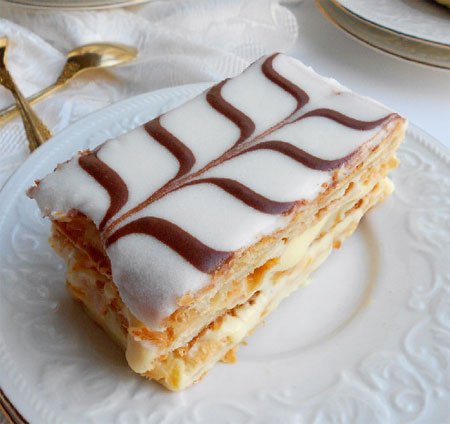
This recipe is for the popular French pastry, mille-feuille (pronounced meel foy). Also known as Napoleon, to us American folk. In Italy, it is referred to as "mille foglie". If you're interested in the more literal definition, mille feuille actually translates into "a thousand leaves", referring to the inumerable layers of the puff pastry used to make it.
The origin of the mille-feuille is unknown: some sources refer to François Pierre De La Varenne‘s 1651 invention, later improved by the legendary Marie-Antoine Carême, and some others mention the Italian city of Naples as birthplace of this dessert. The “Neapolitan” adjective was later mangled into “Napoleon“, a name that became widespread in the 1800’s with the Napoleonic wars. For this reason, the mille-feuille is also known as Napoleon in many countries.
Traditionally, the puff pastry is made by hand, using pounds of butter and lots of arm strength to continously fold and re-fold the dough, to create the many layers. That's where frozen puff pastry comes to play. The only part that you have to put some kind of effort into, is making the pastry cream, to ensure it comes out smooth and velvety. Make sure you let your pastry cream REALLY thicken; although it's just as delicious when it's oozing out of your puff pastry, it looks better when it can stay in place.
Napoleons are a versatile dessert, allowing for creativity with the filling and topping. You can alter the flavor of the pastry cream, or even opt for two different flavors if you are feeling ambitious. The filling can also be supplemented with fresh berries, chocolate chips, or a layer of raspberry jam. Sprinkle the glaze with chopped nuts, toffee bits, toasted coconut, or chocolate shavings.
One (17.3 oz) package puff pastry, thawed
For the pastry cream:
4 large egg yolks
1/4 cup cornstarch
2 cups whole milk
1/2 cup sugar
pinch of vanilla powder (or 2 teaspoons vanilla extract)
1/4 teaspoon salt
2 tablespoons butter, diced
For the icing/glaze:
1 cup powdered (confectioners) sugar
2 teaspoons corn syrup
2 tablespoons unsalted butter, melted
2 tablespoons milk, plus more as needed
1 tablespoon unsweeetend cocoa powder
First, prepare the pastry cream. In a medium-sized bowl, whisk together egg yolks and cornstarch until well-combined. Set aside. In a medium saucepan, heat milk, sugar, vanilla, and salt until simmering. Slowly add heated milk mixture to the egg yolks, 1/2 cup at a time, whisking constantly and vigorously to ensure the egg yolks do not curdle. Once the milk mixture has been completely incorporated into the egg mixture, return the mixture back to the saucepan. Cook over medium heat, whisking constantly, for an additional 2-3 minutes, or until mixture is thick and bubbly. Remove from heat and whisk in diced butter. Transfer pastry cream to a heat-proof bowl, cover with plastic wrap, and refrigerate for 2 hours, or overnight. (Make sure the plastic wrap is touching the surface of the pastry cream so it doesn't form a skin). The pastry cream can be prepared up to two days in advance.
Next, prepare the puff pastry. Cut a piece of parchment paper as large as the baking sheet you will be using. Lightly flour the parchment paper.
Place both sheets of thawed puff pastry on top of one another on the piece of parchment paper. Roll them out into a 12x12 inch square. Using a pizza wheel, cut the square into three 12x4 inch strips. Prick the strips all over their surface with a fork. Transfer the puff pastry strips, with the parchment paper, onto baking sheet and refrigerate for 30 minutes, or until firm.
Preheat oven to 425 degrees F. Bake the pastry strips for 10 minutes. Then, place a baking sheet directly on top of them and bake for an additional 6 minutes. (This step ensures that the pastry rectangles bake flat and do not puff up too much in the oven.) After that, remove the baking sheet and bake for 6 more minutes, or until pastry strips are golden brown. Transfer to a wire rack to cool completely.
Now, prepare the glaze. In a medium-sized bowl, whisk together powdered sugar, corn syrup, and melted butter. Add milk, 1 tablespoon at a time, until you reach a consistency that is pourable, but still thick. Transfer 1/4 of the glaze to a separate bowl and whisk in cocoa powder to create the chocolate glaze. Spoon the chocolate glaze into a piping bag fitted with a small round tip. Alternatively, you can use a Ziploc bag with the tip cut off.
Take one of the cooled pastry strips and flip it over. Pour white glaze over the surface of the strip, spreading it evenly with an offset spatula. Pipe lines of chocolate glaze lengthwise across the pastry strip. Drag a toothpick across the chocolate glaze to create a pattern - the pastry will be cut crosswise into six. First drag the toothpick to mark the center of the pastry, then drag two more lines on each half, again marking where the pastry will be cut. Then drag the toothpick in the opposite direction down the center of each pastry. The resulting pattern should look like the picture when cut.
Remove chilled pastry cream from fridge. Spread half of the pastry cream evenly over one puff pastry strip. Top with the second puff pastry strip, pressing gently to adhere. Spread the remaining pastry cream over this strip. Then, top with the glazed puff pastry strip.
Refrigerate for 1 hour to let it set before slicing and serving. Use a serrated knife to cut the pastry. The pastries are best eaten the day that they are assembled, however they will keep overnight, covered and refrigerated. The puff pastry will soften with refrigeration.
Recipe from Peanut Butter and Julie
Yield: 6 servings
