Nouvelle Cuisine
http://tangbro1.blogspot.com/2009_04_01_archive.html
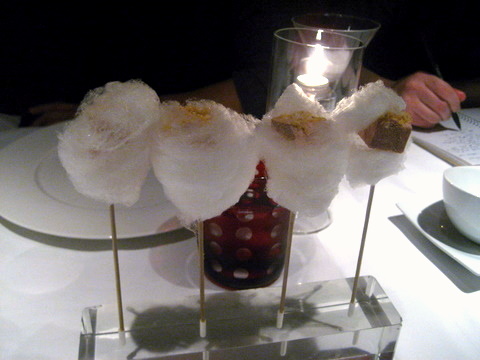 |
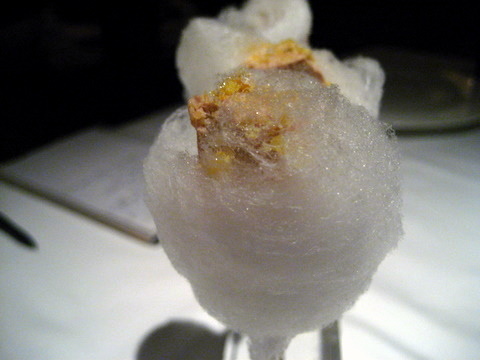
| Cotton Candy Fois Gras |
 |
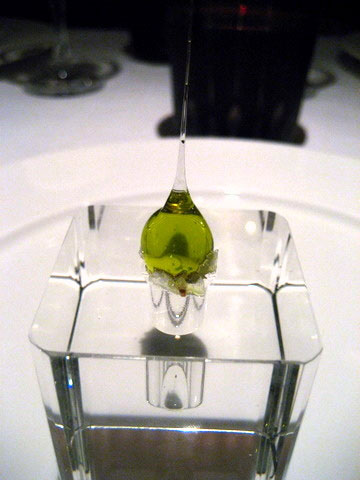 |
| Olive Oil Bonbon - sumac, Maldon sea salt Saam, Los Angeles, CA, has given me a new appreciation for the intricacies of olive oil. Here the olive oil was covered wtih a sugar shell topped. Biting through the hard exterior releases a rich heady flood of aromatic oil which is expertly accented by the salt and sumac. Saam offers a high-end 20-course menu in the same vein as Chef Andrés' Minibar. |
Haute cuisine is basically 'classic' French cooking. Lots of butter, cream, painstakingly reduced sauces, elaborate cooking methods and presentation, and expensive ingredients like foie gras, etc.
Nouvelle cuisine emphasized lighter, simpler preparations and more down-to-earth ingredients (fresh vegetables, simple steamed or roasts meats and fish, etc.). What you see in most high-end restaurants these days is closer to nouvelle cuisine.
The following was excerpted from Haute Cuisine: How the French Invented the Culinary Profession by Amy B. Trubek:
Wonderful fine dining establishments can be found in all the nations of Europe and in North America, but everywhere the menus are dominated by the French. Girardet in Switzerland, Le Manoir aux Quartre Saisons in England, Lutèce, Le Français, Le Chanticleer, and Restaurant Daniel in the United States, to name a few, are destinations for gourmets. Among the Maître Cuisiniers de France found in the United States are Georges Perrier of Le Bec-Fin, Daniel Boulud of Restaurant Daniel, Jean Joho of Everest, and Michael LeBorgne of the New England Culinary Institute. French chefs have dominated as the masters of culinary practice and as the primary instructors in the culinary knowledge necessary in fine dining restaurants, hotels, and clubs since their very inception.
Haute cuisine first appears in the stately châteaus and manors of the French aristocracy. Before the late 1700s homes were the only places where people could expect to sit down to be served a formal meal. Although prepared foods were available as early as the 1300s, it was found at town markets or at roadside stands that served itinerant travelers and pilgrims. Large elegant manors were the site of professional cuisine's precursors and the place where chefs were first employed to ply their craft, which consisted of complex preparations presented to the aristocratic consumer in elaborate multi-course feasts. The food produced by chefs was French Haute Cuisine, the cookery of the elites. Haute cuisines always have some relationship to an elite population.
Beginning in the Medieval period, "haute" cuisine was characterized by tremendous attention to the appearance of food, particularly in the case of the courtly feast. These feasts were major events and required the efforts of many people. Held in the great hall, they included musical and dramatic entertainment along with a sumptuous feast. Food, the mets in French, was often presented in the service of a larger pageant or drama called the entrements, in which roast beasts would make an entrance on a tower or candied fruits would arrive hanging from silver trees. Le Viandier of Taillevent, who was the master cook to Charles V, is an excellent source of information about the medieval haute cuisine. Le Viandier has three notable themes: the extensive use of spices to flavor the food; the separate preparation of the meats, fowl and fish from the sauce that accompany them; and the complex instructions for presentation. Flavor and color were important considerations. Cooks were interested in making dishes bright in color, and they often dyed sauces and covered roasts with gold and silver leaf. As early as the 1300s, spectacle and complexity characterize haute cuisine.
By the seventeenth century, chefs working in aristocratic kitchens began to experiment with the look, taste and feel of food. Such changes in culinary sensibility can be traced to to an overall shift in European cultural values toward the notion of civility; social class was indicated by social refinement. By 1651 La Varenne, considered a major figure in the move to such a new culinary sensibility writes in his cookbook, Le Cusinier Français, of his education in "the secrets of preparing foods delicately." In this book, preparations now considered basic to French haute cuisine - bouillon, liaisons, roux, farces - are provided. With his more systematic approach, La Varenne has been called "the founder of French classical cooking."
Almost a century later, the revision of haute cuisine to a more modern sensibility remained the preoccupation of many cookbook authors. in Les Dons de Comus ou L'Art de la Cuisine, first published in 1739, François Marin exhorts the reader to aim toward a more elegant style of preparation. The preface of the 1758 edition argues for a judicious use of spices. When discussing the shift in culinary sensibility, Marin makes a distinction between la cuisine ancienne and la cuisine moderne. La cuisine ancienne was the culinary fashion created by the French and exported from France until the early 1700s. Cuisine modern comes from the ancienne tradition, but is less complicated and uses more scientific principles.
In 1828, Carême wrote in a similar vein. His second edition of Le Cuisinier Parisien compares recipes of the cuisine ancienne and the cuisine moderne to show the "vast superiority" of the cuisine moderne because of its "simplicity, elegance, and sumptuousness." Carême was considered by many subsequent professional chefs to be a great culinary artist who began to simplify the vestiges of medieval pageantry in the courtly haute cuisine. His cookbook still contains elaborate galantines, drawings of various socles, or editable pedestals, along with basic recipes, however. These editable pedestals, usually elaborately carved or decorated, yet according to a "completely modern taste," were a vital part of the presentation of the dish and were placed in the middle of the table for all to see. His galantine of turkey rests on a socle carved with classical columns and botanical decorations and uses hâtelets (metal skewers) as a garnish, some skewered with truffles.
Despite the chefs' pronouncements of a culinary revolution, during both eras the preoccupation of haute cuisine remained the transformation of nature into culture. Thus, although the content of the cuisine underwent significant transformation, strategies for providing hauteness persisted. What changes as the eighteen century shifts to the nineteenth are the locations where the chefs ply their craft. By 1830, some chefs continue to cook in noble households, but more work in hotels, restaurants, and clubs. Many work not in France but in Britain, Italy , Germany and the United States. Thus the next link in the historical chain between France and professional cuisine can be found in the shift from the noble home to the public restaurant. By the nineteenth century, French haute cuisine had become identified with professional mastery throughout Europe as well as the United States.
The customer plays a primary role when French haute cuisine enters the public sphere; the benefits of patronage, especially the assurance of an audience, can no longer be assumed. Customers provide the financial fuel that keeps a restaurant or hotel in business. In the complex world of fine dining after it entered the public sphere and became an established part of urban life, chefs played a vital role in determining the taste and shape of the food, as well as the symbolic significance of fine food as a marker of hauteness. In this new milieu, the chef can influence the customer and make him want the galantine, establishing the desire. Food is a cultural symbol and is a means for creating social distinction. Everyday cooking, born out of necessity, produced in the domestic sphere, overlaps but does not link directly with the haute culinary discourse.
French chefs have an interesting but at times confusing tendency to herald change in haute culinary practices by calling the new cuisine "nouvelle," thus in effect renaming what was called "moderne" cuisine by its practitioners to "classique." By 1890 Carême's la cuisine moderne has become la cuisine classique, and by 1975 Escoffier's has become la cuisine classique in light of the nouvelle cuisine of a new generation of chefs such as Fernand Point and his disciples, including Paul Bocuse, Pierre Troisgros, and Michel Guérard.
--------------------------
Cuisine classique is a style of French cookery based on the works of Auguste Escoffier. These were simplifications and refinements of the early work of Antoine Carême, Jules Gouffé and Urbain François Dubois. It was practised in the grand restaurants and hotels of Europe and elsewhere for much of the 20th century. The major developments were to replace service à la française (serving all dishes at once) with service à la russe (serving meals in courses) and to develop a system of cookery, based on Escoffier's Le Guide Culinaire, which formalized the preparation of sauces and dishes. In its time, it was considered the pinnacle of haute cuisine, and was a style distinct from cuisine bourgeoise (cuisine for families with cooks), the working-class cuisine of bistros and homes, and cuisines of the French provinces.
Nouvelle cuisine, a French term meaning new cuisine, commonly refers to food that is a healthier, lighter alternative to haute cuisine or cuisine classique. It is generally perceived to concentrate on delicate dishes with simple yet elegant presentations. However, it is also customarily associated with certain chefs and cookbook authors dating back to the 1740s.
Haute cuisine generally refers to elaborately prepared food. Cuisine classique typically indicates French classic cuisine, often typified by dishes laden with heavy ingredients such as cream and butter that are served by course. Cuisine classique was popularized in the 20th century and replaced service a la francaise, which required all dishes to be served at once.
French dishes prepared by famous chefs Menon, Vincent La Chapelle and Francois Marin in the 1740s were the first ones referred to by this terminology. The legendary Auguste Escoffier, generally considered the impetus behind the development of modern French cuisine, often had the term applied to his creations in the 1880s and 1890s. In the next century, the term re-emerged almost every time a new French chef took center stage in the culinary world.
Acclaimed French chef Paul Bocus, along with other cooking masters, created the menu and prepared the food for the maiden flight of the Concorde airliner in 1969. Celebrated cookbook authors Henri Gault and Christian Millau used the term nouvelle cuisine to describe the dishes served on the historic voyage. They praised the menu’s sophisticated offerings and complimented the chefs on the simplicity and lightness of the ingredients they chose.
This observation spawned the term cuisine minceur, which translates to “thin cooking.” The term became somewhat synonymous with nouvelle cuisine. When the terminology became more common, its meaning began to more frequently refer to menu items that were less fattening than classic French cuisine.
Cookbook authors Gault and Millau are commonly credited with defining the ten traits that characterize genuine nouvelle cuisine. The preparation must be simple and require a minimal number of steps. Cooking times should be reduced to maintain the natural tastes of vegetables, meat, fish and poultry. Only the freshest possible ingredients should be used in this cuisine style.
Other qualifying traits for nouvelle cuisine include short menus and lighter food item choices. Strong marinades, for example, are normally replaced by lighter versions in this style. Heavy sauces made with dairy products and starches are traditionally replaced with light sauces created with lemon juice and fresh herbs in this type of cooking. More regional dishes using local ingredients also are typically preferred for nouvelle cuisine creations.
Unlike former cooking styles, nouvelle cuisine promotes the use of modern equipment and techniques. The style also requires the chef to consider the best dietary choices for diners in terms of fat, sodium and salt. Nouvelle cuisine also requires cooks to develop innovative pairings of foods.
from http://www.helium.com/items/913123-origins-of-classical-french-cuisine
Fine dining as the well to do would understand it is an over expensive, exotic meal where the staff bends to your every whim. This style of opulent overindulgence stems from the royalty of Europe. In the early 19th century Marie Antoin Careme ushered in the perfectly calculated conception of Grande Cuisine sometimes referred to as haute cuisine. This was a copious combination of Cuisine Bourgeoisie (Simple food) and the Grande cuisine. This style became the burgeoning culinary delight of the aristocratic class of Europe.
In the late19th century, Aguste Escoffier changed the world of gastronomy to a degree that may never be rivaled, Cuisine Classique. Like any culinarian before him he recreated, simplfied and perfected the concepts of the prodigious chefs before him. Escoffier was no exception to this rule, he fancied Marie Antion Careme as a genius. Most notably Escoffier created a classification of sauces we still use today. The mother sauces! These are hollandaise, tomato, espagnole, bchamel and veloute. These 5 sauces are the foundation to an astounding array of contemporary sauces.
Escoffier revolutionized the Savoy Hotel in London by taking his concept of simplicity to the people. Aguste originated the concept of tableside cooking. You may recognize the flaming cherries jubilee, or bananas foster as a more modern derivation of this concept. The idea was to make such an impression that the diner was literally experiencing the meal.
The mid 20th century brought Nouvelle Cuisine. This idea tended to be on the lighter side and infused more natural flavoring. The nouvelle movement sought to simplify classic overcomplicated recipes. A meal must be in harmony with all of the elements. In short, nouvelle cuisine was a return to the natural. It was important to let the central part the dish to be the main flavor. It was no longer reasonable to cover up all the wonderful food with sauces. Sauces became more of an element of the dish rather than the main component. Some of the more notable of the contributing Chefs of this genre are Francios Bise, Louis Outhier and Gaston Lenotre.
As high-quality ingredients became more available in America, young American chefs began to experiment-drawing upon traditional French techniques and concepts but feeling freer to decide what to incorporate into their own individual style. Chef Eric Ripert says, "Before Nouvelle Cuisine if I wanted to make a Hollandaise sauce with coriander, the chef would lose his mind. Today we have this freedom."
In the United States, there is a proliferation of schools specializing in the training of men and women in all areas of the culinary arts. It used to be that if you wanted to become a chef, you were expected to go to cooking school in France where you learned classic technique. But over the last decade, the culinary world has shifted to America. Famed chef Paul Bocuse thinks enough of American culinary talent to send his son Jerome to the Culinary Institute of American in Hyde Park, N.Y. "We are seeing what is going on now in the United States and now we have to be better in France," Bocuse states. Chefs might credit Bocuse more than any other culinary great as the man who made it possible for chefs to emerge from the kitchen and become stars. Along with Michelin chef Roger Verge and patissier Gaston Lenotre, he is a consultant to the Pavilion des Chefs de France in Disney World's Epcot Center in Orlando. Chef Daniel Boulud says, "Before coming to America twenty years ago, I had always assumed that the finest cooking, using the best ingredients, could be done only in France, where the tremendous variety of excellent ingredients-the meats and fowls, vegetables and herbs, fruits and cheeses, fish and crustaceans-had no other equal in the world. However, I am now convinced that the quality and variety of the American bounty is similar to that found in European markets and more diverse. In the last decade an abundance of superior foods such as high-quality fresh herbs, fruit, vegetables, and free-range poultry have become more generally available throughout the U.S. We're in touch with small farms from all over, as well as fishermen who'll FedEx in some of their day's catch." American chefs are no longer intimidated by European haute cuisine and are now among some of the most innovative and exciting talents in the field. French-born Chef Daniel Boulud, has responded to American influences with a culinary style that balances the best of both worlds. Born on a farm near Lyons, France and trained in classic French discipline and technique with Michelin chefs Georges Blanc, Roger Verge, and Michel Guerard, he is now teacher to two American-born chefs, Chinese-American Alex Lee, executive chef at Daniel and Italian-American Andrew Carmellini, executive chef at Café Boulud. "These two young Americans are greatly inspired by their culinary heritage and combine that with respect for French tradition and classic technique in dishes prepared in harmony with the bounty of the seasons. There has to be respect for quality; there is no compromise. That is what I teach everyone who comes into the kitchen," he remarks.
France's Alain Ducasse, the only six-Michelin star chef in the world-three in Paris, three in Monaco--recently brought his version of haute cuisine to New York, the city that calls itself the world's dining capital. But don't count on a table at the legendary chef's eponymous restaurant, tucked away in the Essex House hotel. Instantly, there was a six month waiting list with almost 3,000 names on it. New York's great French restaurant tradition began in the 19th century with Delmonico's and is descended through the 1940's Le Pavillon. The 90's saw an influx of French chefs to New York to open outposts of their French restaurants. In addition to the chefs who are working both sides of the Atlantic, there are chefs who have abandoned their highly rated restaurants or positions to open shop here. Like many of his peers who came of age in the Bocuse revolution, Pascal Oudin got the itch to come to America seeking fame and riches at the end of a plane ride to the United States. Oudin, who began his culinary apprenticeship at the age of 13 in Moulin, France, training in classic French discipline and technique, came to the States when he was 21 for a job in Williamsburg, Virginia. "Under the French system I would have to work as a sous chef until I was 35 years old. After only one year here, I became an executive chef, " he remarks. That open-mindedness, along with the differences between European and American ingredients, has inspired most of these newly arrived chefs to re-create their recipes. When Hubert Keller came to California in 1982 he could sense the scene would explode, "farmers came knocking at my door with produce and soon I would see that same exotic product in the supermarket." Keller says, "I definitely left my heart in San Franciso."
For generations, bistros have been the culinary soul of France, no-frills neighborhood spots where regulars drop in for local gossip and a reassuringly familiar meal. Even as Americans embrace French haute cuisine, the appeal of the classic bistro, for a taste of France's past, is undiminished. There is a boom in bistros that serve traditional cuisine and a new generation of French restaurateurs are nailing the word bistro over their doors. Hubert Keller explains, "The whole French idea is "in" again-cafes, bistros, brasseries. The climate is right for bistro food. There's a new young clientele who have traveled to France and experienced the uncomplicated, non-intimidating flavorful foods of the French bistro. They have responded well to authentically executed bistros here. They know right away when it's not authentic-you can't do things half-way." Keller is making plans to open an as yet unnamed bistro in San Franciso. Bistro menu-makers today are taking old standbys and transforming them into stand outs. Back to basics is the call to arms with pot-au-feu, cassoulet, and simple roasted chicken. Passion, it seems, drives all of these chefs, and it seems clear that the style of French cuisine continues to evolve as we head into the new century.
In the late 20th century the culinary revolution in America was coming into its own on the world scene. In the past several centuries you can see that the main influence of gastronomy was largely French or European. This wonderful movement called New American Cuisine was conceived and perfected by Alice Waters (who is still alive today). There was collaboration between local restaurants and the farmers to bring original and fresh food to the table. The concept of frozen and packed food product was being rejected in favor of unique and fresh local produce and meat products. The incorporation of the many different ethnic cuisine and cooking techniques acted as a catalyst to bring forth this new American Cuisine. American chefs where now creating a style of our own. California farmers, wine makers and ranchers were and are providing exceptional products that rival European products thus allowing American chefs to design our culture and cuisine.
