Sables (French Butter Cookies)
from "America's Test Kitchen," Season 10
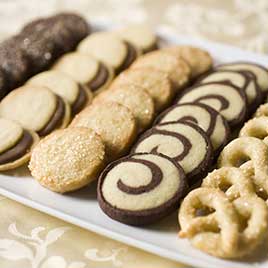
Sandwich Sables, Sables with course sugar topping,
Black and White Spiral Sables, Vanilla Pretzel Sables
Pronounced [SAH-blay]. "During the holidays, these French butter cookies offer sophistication and style. That is, if you can capture their elusive sandy texture (sablé is French for sandy), which separates them from sturdy American butter cookies. Also, Sable cookies include eggs, which distinguish them from shortbread. Eggs add a rich flavor and delicate texture.
Most of the sablé recipes we came across had only slight differences in ingredient proportions—but they all baked up without the delicate crumbliness that defines this cookie. To create the hallmark sandy texture of sablés—light, with an inviting granular quality similar to shortbread—we would have to do some detective work.
We started with a basic recipe using the typical method of creaming butter and sugar, then adding egg and flour. We then chilled, sliced, and baked the dough—but these cookies were missing the delicate crumbliness that defines sablés. We needed to decrease the liquid in the dough so there would be less moisture to dissolve the sugar particles. Cutting back on butter helped, as did the inclusion of a hard-cooked egg yolk, an addition we came across in our research. Adding the mashed yolk during creaming eliminated moisture and perfected the texture of the cookies. Brushing the cookies with a beaten egg white and sprinkling them with coarse sugar before baking added a delicate crunch and an attractive sparkle."
Note: Turbinado sugar is commonly sold as Sugar in the Raw. Demerara sugar, sanding (decorating sugar, or another coarse sugar can be substituted. Make sure the cookie dough is well chilled and firm so that it can be uniformly sliced. After the dough has been wrapped in parchment, it can be double-wrapped in plastic and frozen for up to 2 weeks.
Variations:
- Dip part of the baked cookie in chocolate. Sprinkle with chopped nuts if desired.
- Another turbinado sugar variation: Brush the log of dough with the egg white mixture and roll in the sugar, then slice. This adds sparkle to the edges instead of the top.
- You can add nuts or dried fruit to the dough, but be sure to chop them small enough that they do not interfere with slicing the cookies 1/4-inch thick. The dough can be a bit crumbly, but can be pressed back together again.
1 large egg
10 tablespoons (1 1/4 sticks) unsalted butter, softened
1/3 cup plus 1 tablespoon granulated sugar (2 3/4 ounces)
1/4 teaspoon table salt
1 teaspoon vanilla extract
1 1/2 cups unbleached all-purpose flour (7 1/2 ounces)
Chocolate Variation: In place of 1 1/2 cups flour, use 1 1/3 c. all-purpose flour and 1/4 c. cocoa
For finishing the cookies:
1 teaspoon large egg white, lightly beaten with 1 teaspoon swater
4 teaspoons turbinado sugar (see note above)
Place egg in small saucepan, cover with 1 inch water, and bring to boil over high heat. Remove pan from heat, cover, and let sit 10 minutes. Meanwhile, fill small bowl with ice water. Using slotted spoon, transfer egg to ice water and let stand 5 minutes. Crack egg and peel shell. Separate yolk from white; discard white. Press yolk through fine-mesh strainer into small bowl.
In bowl of stand mixer fitted with paddle attachment, beat butter, granulated sugar, salt, and cooked egg yolk on medium speed until light and fluffy, about 4 minutes, scraping down sides of bowl and beater with rubber spatula as needed. Turn mixer to low, add vanilla, and mix until incorporated. Stop mixer; add flour and mix on low speed until just combined, about 30 seconds. [Do not overmix.] Using rubber spatula, press dough into cohesive mass.
Divide dough in half; roll each piece into log about 6 inches long and 1 3/4 inches in diameter. Wrap each log in 12-inch square of parchment paper and twist ends to seal and firmly compact dough into tight cylinder. Chill until firm, about 1 hour.
[For Chocolate Vanilla Spiral Cookies, make both a vanilla dough and a chocolate dough. Divide each dough in half. Roll out each half between parchment paper to an 8 by 6-inch rectangle, 1/4 inch thick. You should have two vanilla rectangles and two chocolate rectangles. Briefly chill the dough until firm enough to handle but still malleable. Place one vanilla dough on top of one chocolate dough. [For a tidy finish, trim the vanilla dough 1/2 centimetre shorter on the long side furthest away from you. This way the chocolate dough will encircle the entire cookie.] Roll the dough between parchment paper to a 9 by 6-inch rectangle. If the dough is too firm, let it rest until malleable. Starting at the long end, roll the dough into a tight log. This step can be tricky so do it slowly; using parchment paper to roll the dough is very helpful. Repeat with the remaining vanilla and chocolate rectangles. Wrap the log in parchment paper and chill for one hour, or put log in a resealable plastic bag and freeze for up to one month. Repeat with the other two halves of dough.
Tip: You could use 1/2 vanilla dough to make vanilla cookies, 1/2 to make the chocolate cookies, and half of each to make the spiral cookies. This way you will have 3 types of cookies. Or you could freeze some of the doughs to bake at a later time.]
Adjust oven racks to upper-middle and lower-middle positions and heat oven to 350 degrees. Line 2 rimmed baking sheets with parchment paper. Using chef’s knife, slice dough into 1/4-inch-thick rounds, rotating dough so that it won’t become misshapen from weight of knife. Place cookies 1 inch apart on baking sheets. Using pastry brush, gently brush cookies with egg white mixture and sprinkle evenly with turbinado sugar.
Bake until centers of cookies are pale golden brown with edges slightly darker than centers, 13 - 15 minutes, rotating baking sheets front to back and top to bottom halfway through baking. Cool cookies on baking sheet 5 minutes; using thin metal spatula, transfer cookies to wire rack and cool to room temperature. Store cooled cookies between sheets of parchment paper in airtight container for up to 1 week.
Makes about 40 cookies
