Indian Etiquette
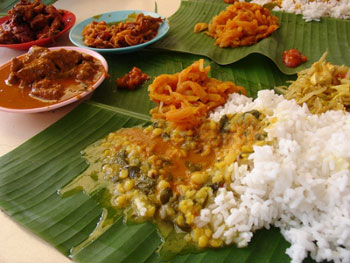 Several customs are associated with the manner of food consumption. Traditionally, meals are eaten while seated either on the floor or on very low stools or cushions. Food is most often eaten without cutlery, using instead the fingers of the right hand. However, these traditional ways of dining are being influenced by eating styles from other parts of the world. Eating with your hands is considered important in Indian etiquette because a person eating with his hands knows the exact temperature of food before the morsel hits his mouth thus preventing blisters in mouth due to consumption of hot food.
Traditional serving styles vary from region to region in India. A universal aspect of presentation is the thali, a large plate with samplings of different regional dishes accompanied by raita, breads such as naan, puri, or roti, and rice.
In South India, a cleaned banana leaf is often used as a hygienic, visually interesting and environmentally friendly, alternative to plates.
In India, eating is all about maximizing the flavour and texture of the food. At meal times, a variety of dishes are served with each item eaten a little at a time in different combinations.
What an Indian Meal Consists Of
Before you start eating, it helps to have an understanding of the different foods that an Indian meal consists of, and the order in which they’re eaten. In a traditional Indian meal you’ll usually find:
- Indian bread (chappathi, roti, or naan)
- Side dishes (salad, papad, and pickles)
- Main dishes of vegetables and/or meat
- Dal (a watery lentil dish)
- Rice
The bread is eaten first with some of the vegetable or meat dishes. The remaining vegetables or meat are then eaten along with the rice and dal. The purpose of the side dishes is to add different flavors and texture to the food, so you should have a small portion of any one of these after each bite of the main dishes. The most important thing is to sample each different dish separately, to allow its individual characteristics to be appreciated. For example, the papad should be eaten by itself and not dipped in anything, so as to experience its crispy texture.
