Irish Soda Bread
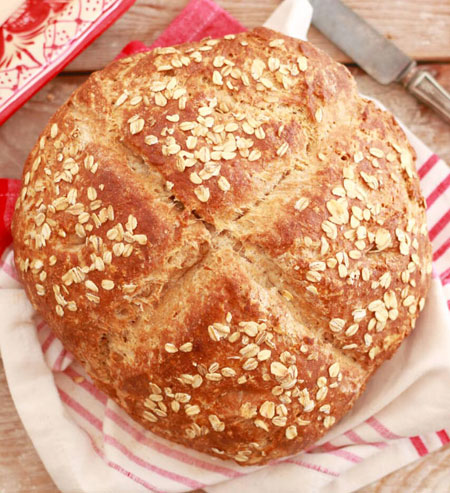 Soda bread dates back to approximately 1840, when bicarbonate of soda was introduced to Ireland. Soda bread is a type of quick bread in which baking soda is used for leavening rather than the more common yeast. Irish flour is very soft and is difficult for baking yeast-leavened breads, hence the development of a bread using baking soda as in this Irish Soda Bread Recipe.
The ingredients of traditional soda bread are flour, bread soda, salt, and buttermilk. Other ingredients can be added such as raisins, egg or various forms of nuts. The egg promotes a more cake-like texture. The buttermilk in the dough contains lactic acid, which reacts with the baking soda to form tiny bubbles of carbon dioxide.
In Ireland, the flour is typically made from soft wheat; so soda bread is best made with a cake or pastry flour (made from soft wheat), which has lower levels of gluten than a bread flour. Various forms of soda bread are popular throughout Ireland. Soda breads are made using either wholemeal or white flour. In Northern Ireland the wholemeal variety is known as "wheaten bread" and normally sweetened, while the term "soda bread" is restricted to the white savoury form. Tea and brown bread with pork sausages or brown bread and orange marmalade are commonly eaten for breakfast.
The two major shapes are the loaf and the "griddle cake," or farl in Northern Ireland. Soda bread would traditionally be baked on a hot cast-iron griddle over an open peat fire. This griddled soda bread would be shaped into a round, with an indentation marking the quarters; each quarter when broken off, hot and warm is called a farl. The loaf form takes a more rounded, taller shape and has a cross cut in the top to allow the bread to expand. The griddle cake or farl, is a more flattened type of bread so it can cook more evenly on the griddle.
Today, the bread is baked in the oven with consistent results; a light hand when mixing is still important though. See Scone and Soda Bread Tips
Also see: A Little Irish Cookbook's recipe
Irish Soda Bread (sweetened with orange zest and currants)
Walnut Oatmeal Sweet Irish Soda Bread
Mum's Traditional Irish Soda Bread Recipe (Brown Bread)
from https://www.biggerbolderbaking.com/
I have not made this recipe.
1 3/4 cups (265g/ 9oz) whole wheat flour (fine or coarsely ground)
1 3/4 cups (265g/9oz) all-purpose flour
1 teaspoon salt
1 teaspoon baking soda
2 tablespoons (30g/1oz) butter (cold)
1 egg
1 2/3 cups (13floz/370ml) buttermilk*
1 tablespoons oats
*For every Cup of Buttermilk needed, you can mix 1 cup of regular milk with 2 tablespoons of Lemon juice or white vinegar. Mix and let it stand for a minimum of 30 minutes before using.
Preheat the oven to 425°F (215°C).
Mix together the flours, salt, and baking soda in a large bowl. Add the butter and rub it into the flour mixture with your fingertips until it resembles bread crumbs.
In a separate jug, whisk the egg and buttermilk together (see note on how to make Buttermilk below)
Make a well in the center of the dry ingredients and pour the liquid, 3/4 at once, into the flour mixture.
Using an open hand bring the flour and liquid together to a loose dough [do not mix your hand, it will get covered with a sticky mess]. The dough should be quite soft, but not too sticky. You will know then if it needs more of the liquids. (Flour in different places reacts differently to added liquid).
[In her video she says you are not kneading the dough, just bringing it together until it cleans the bowl. Her dough was very shaggy; not smooth at all. You are making a quick bread, not yeast bread.]
Turn onto a floured work surface and gently bring the dough together into a round, about 1 1/2 inches (4cm) thick (8 inches by 8 inches).
[Again you are not kneading and the dough looks very rough and shaggy.]
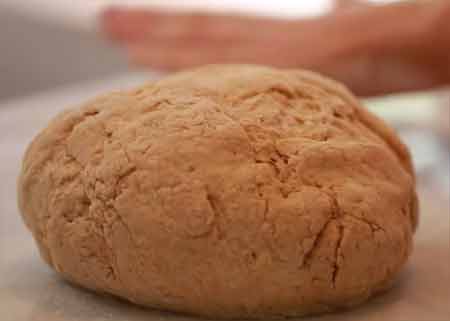
Place on a baking sheet dusted well with flour.
Score the bread by blessing it with a deep cross on top [about 1/2- to 3/4-inch]. Poke a hole in the 4 corners of the bread to release the fairies and stop them from cursing your beautiful bread.
Glaze the bread with the leftover bit of buttermilk in your jug and dust the top with rolled oats.
Bake for 15 minutes, then turn down the oven to 400°F (200°C) and bake for 30 minutes more. When done, the loaf will sound slightly hollow when tapped on the bottom. Remove from the baking sheet and place on a wire rack to cool.
[The bread is ready when the center of the X has lost the wet, shiny look of raw dough. You can also insert a cake tester or skewer — it should come out clean.]
Makes 1 loaf - servings 8
*Brown Bread (Irish Whole Wheat Soda Bread)
from
David Lebovitz
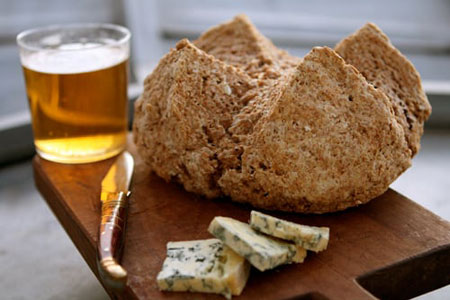
None of the brown breads, Irish soda breads, and scones I had in Ireland bore any resemblance whatsoever to their American counterparts. Soda breads were plain. At most, I saw a few raisins lurking in a scone or two.
I was fortunate that when I was at the Longueville House, chef/owner William O’Callaghan shared his Wholemeal Brown Bread recipe with me. I’d never heard of ‘cream flour’, which is regular all-purpose flour (although ‘cream’ flour sounds a little more interesting, doesn’t it?) and his original recipe calls for using both wheat germ and bran, 60 grams each.
This is not a refined bread, but meant to be rough, coarse, and earthy. Don’t worry too much if it doesn’t look picture-perfect; once slashed and baked in the oven, it’ll surprise you with how impressive it looks when baked. I also added a touch of molasses to augment the hearty flavor of the wheat, although true soda bread is apparently unsweetened.
I used T110 flour, which in France, is a light whole wheat flour. Which is wholemeal flour in Ireland, and similar to whole wheat pastry flour in the United States. Still, the loaf was a bit heavy. So I think next time I’m going to cut the amount of wheat germ or bran in half, or leave it out completely, to lighten things up a bit.
I also think the large loaf, while a necessity if you’re running an inn and feeding a lot of people, was pretty big for just me, so I would make two smaller loaves and reduce the baking time to compensate. Irish soda bread should be served the same day it’s made; any extra can be frozen.
FMM: I would make just 1/4 the recipe to make 1 small loaf for just me, see measurements in ( ) at the end of the ingredients. I also think I would like currants, raisins or walnuts added - about 1/3 cup for 1/4 recipe and a little more molasses. See Walnut Oatmeal Irish Soda Bread which adds walnuts and uses brown sugar.
I made 1/4 the recipe, weighed the flours, bran and wheat germ, and the loaf was plenty big for one person, about 4 servings. It was definitely rustic due to the whole wheat flour and and quite course due to the wheat bran in it, which I liked because it had a different texture. The crumb was fairly soft, the crust crunchy, and it tended to crumble when pulling it apart. It was quite good with butter and honey, better than butter alone; I ate it on the side with corned beef, red potatoes and carrots. I added 1/3 cup raisins and 1 Tbsp. molasses and you could not really taste the molasses. I think I would make this once in a while for breakfast with with raisins and more molasses, or maybe toasted walnuts and honey.
2 1/4 cups (250g) whole wheat flour (62.5g)
2 3/4 cups (120g) wheat bran or wheat germ, or a combination (30g or 15g each/1/3 cup?)
4 cups (500g) all-purpose flour (125g)
1 1/2 teaspoons baking soda (1/2 tsp.)
1 teaspoon salt (1/2 tsp.)
2 ounces (60g) butter, salted or unsalted (4 Tbsp./ 1/2 stick)
2 1/2 cups (600ml) buttermilk* (5/8 cup)
2 teaspoons molasses (1 Tbsp. - could not taste with this amount)
[1/3 cup raisins, currants, or walnuts for 1/4 recipe]
[Note on whole wheat flour, which is made from the entire grain: A kernel of wheat is made of bran 14%, endosperm 83%, and germ 2.5%.]
Put the rack in the middle of the oven and preheat the oven to 350ºF (180ºC.) [most are baked at a higher temp]. Line a sturdy baking sheet with parchment paper or a silicone baking mat and put it on the oven rack.
Mix the whole wheat flour and wheat bran and/or germ in a large bowl.
Sift in the white flour mixed with the baking soda and salt. Stir the flours together, to combine.
Cut the butter into little bits and rub them into small pieces with the flour mixture using your fingers, until as small as possible. [Once the butter is mixed in, add the raisins, if using.]
[Mix the buttermilk and molasses.] Stir in the buttermilk and molasses until the dough is uniformly damp. Turn out onto a lightly floured countertop and knead not-too-vigorously, until the dough forms a smooth ball. (If making two, divide the dough into two equal-sized pieces and roll each separately.)
[Note: This is a quick bread; do not knead or overmix. You are just mixing the flour and buttermilk until they come together. This is a very rustic loaf. Overmixing will make the bread tough. The mixing technique is just like making baking powder biscuits.]
Use a sharp serrated knife to slice a cross deeply into the top of the bread, about 1-inch (3cm) deep. Place the brown bread loaf on the hot baking sheet, being mindful that the baking pan is hot.
Bake for 45 minutes, or until the loaf is firm on top and when you tap the bottom, feels hollow. (If baking smaller loaves, I would begin to check them for doneness after 25 minutes.) [The bread from 1/4 recipe took about 45 minutes.]
Remove from oven and cool on wire rack for one hour.
Notes *For those who can’t get buttermilk, mix 1 part plain whole-milk yogurt with 1 part low-fat or regular milk and let stand for five minutes before using.
