Chicken Saltimbocca
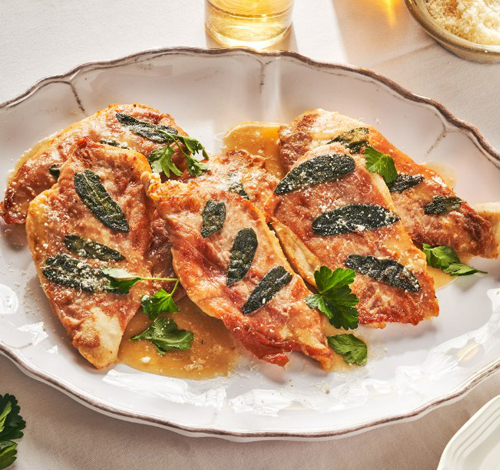
Saltimbocca is a Mediterranean dish which originated in Italy and is made of veal, chicken or pork, lined or topped with prosciutto and sage; marinated in wine, oil or saltwater depending on the region or one's own taste. This dish is also occasionally topped with capers depending on individual taste. The result is a very rich, flavorful dish which can be eaten as an appetizer or an entree.
In Italian, saltimbocca means “to jump in the mouth,” which is supposed to be a reference to the fact that the dish is so good that it literally jumps into the diner's mouth.
The most famous version of this dish is Saltimbocca alla Romana (saltimbocca, Roman-style) which consists of veal, prosciutto or ham, and sage, rolled-up and cooked in Marsala and butter.
Mario Batali's recipe below folds prosciutto and fresh sage leaves inside chicken cutlets before breading with flour and pan-frying. A mushroom, Marsala wine and chicken broth sauce is then made from the fond, and fresh sage is deep-fried for a different and interesting garnish.
Using a different technique, the Serious Eats recipe presses the prosciutto and sage leaves into the cutlets, then dusts them with flour and pan-fries. The dish is finished with dry white wine and chicken broth sauce.
Chicken Saltimbocca w/ Fried Sage (Saltimbocca di Pollo)
Recipe copyright 2000, Mario Batali
This dish was very good, especially the deep-fried sage.
1 cup all purpose flour
Salt and pepper
4 (8-ounce) chicken breasts
4 large slices prosciutto (can substitute thinly sliced ham)
4 large fresh sage leaves, plus 20 smaller leaves (or more, the fried sage is wonderful)
2 cups olive oil (for frying sage leaves) - you can use less by using a very small pot, the oil doesn't need to be that deep
4 tablespoons extra-virgin olive oil
4 shallots, thinly sliced
1/2 pound oyster mushrooms, sliced into 1/4-inch pieces
1 cup Marsala wine
1/2 cup chicken stock
2 tablespoons butter
1 bunch Italian parsley, chopped to yield 1/4 cup
Season the flour with salt and pepper.
With a meat mallet, pound the chicken breasts to 1/4-inch thickness. Season each breast with salt and pepper and lay 1 large sage leaf on each breast. Lay 1 slice prosciutto over each piece and fold in half like a book. Secure the two sides with a toothpick and dredge each breast in the seasoned flour.
In a small heavy-bottomed pot with high sides, heat the 2 cups olive oil to 375 degrees. Make sure that you have a slotted spoon or spider close by. Working in a few batches, fry the smaller sage leaves in the oil, removing with the slotted spoon after 30 seconds. Season with salt, set on a plate lined with paper towels to drain, and set aside.
In a 12 to 14-inch saute pan, heat the remaining olive oil until smoking. Add the chicken and saute until golden brown on both sides. Add the shallots and mushrooms and cook until the mushrooms have sweated, about 5 to 6 minutes. Add the Marsala and chicken stock and cook over high heat until reduced by half. Swirl the butter into the pan, add the parsley and serve on 4 warmed dinner plates, topped with the fried sage leaves.
Serve with Grilled Romaine drizzled with a little lemon juice. It is also good served over linguine or spaghetti; be sure to add plenty of Marsala wine and chicken stock to make a sauce in a proportion of 2 parts Marsala to 1 part chicken stock.
4 servings
One-Pan Italian Chicken Dish
from https://www.seriouseats.com/
Chicken saltimbocca tastes like something you'd order at a candlelit trattoria, but it comes together in under an hour—crisp, saucy, and packed with bold, savory flavors. Salty prosciutto, sharp lemon, fragrant sage—each bite of the chicken and its silky pan sauce lingers.
In Rome, saltimbocca is a classic secondi, traditionally made with thin slices of veal topped with sage and prosciutto, secured with toothpicks, and quickly sautéed in butter or olive oil. A splash of white wine deglazes the pan, creating a simple yet assertive sauce. Over time, the dish has traveled and evolved, especially in American kitchens, where chicken is often used as a more accessible and affordable substitute for veal.
Serve it with something simple, such as roasted potatoes or garlicky greens, and don't forget to pass a few lemon wedges at the table.
2 medium boneless, skinless chicken breasts (about 6 to 8 ounces each; 170 to 227 g each) (see notes)
1 teaspoon (3 g) Diamond Crystal kosher salt; for table salt, use half as much by volume
1/2 teaspoon freshly ground black pepper
16 large fresh sage leaves (4 g), divided
4 thin slices prosciutto (about 1 1/2 ounces; 43 g total)
3 tablespoons (45 ml) extra-virgin olive oil
1/2 cup, plus 1 tablespoon all-purpose flour (about 2 1/2 ounces; 71 g), divided
2 tablespoons unsalted butter (28 g)
1/3 cup (80 ml) dry white wine
1 cup (240 ml) homemade chicken stock or store-bought low-sodium chicken broth
2 teaspoons (10 ml) fresh lemon juice from 1 lemon
Lemon wedges, for serving
Working with one chicken breast at a time, place chicken breast on a cutting board. Hold it in place with the palm of your non-cutting hand, and use a sharp knife to slice chicken horizontally into two even cutlets. Repeat process with remaining chicken breast. Cover each breast half with plastic wrap, and use a meat mallet or rolling pin to pound to 1/2-inch thickness.
Season chicken on both sides with kosher salt and pepper. Allow it to sit at room temperature for 15 minutes. Place 2 sage leaves on each breast and top each breast with a slice of prosciutto, pressing to adhere. Trim prosciutto edges so that they don't overhang from the chicken, if needed.
Line a small plate with paper towels. In a large stainless steel, cast iron, or carbon steel skillet, heat 2 tablespoons oil over medium heat until shimmering. Add remaining 8 sage leaves, cook, basting occasionally, until bubbles subside and sage leaves become crisp, 30 to 60 seconds. Using a slotted spoon, transfer leaves to prepared plate. Set skillet aside (do not wipe out).
Frying sage leaves before searing the chicken infuses the oil with earthy, aromatic flavor.
In a shallow dish, such as a pie plate, place 1/2 cup (2 1/4 ounces; 64 g) flour. Heat oil in reserved skillet over medium-high heat until shimmering. Working with two chicken pieces at a time, lightly dredge chicken in flour, and shake off excess. Place chicken in hot oil, prosciutto-side down, and cook, undisturbed, until almost cooked through, lightly browned, and chicken edges turn white, about 3 minutes.
Starting with the ham-side flat against the hot pan ensures even contact from the get-go, helping it adhere to the chicken's flat surface and brown uniformly before the chicken begins to contract and curl.
Flip chicken, and cook until lightly browned on second side and an instant-read thermometer inserted into thickest part of chicken registers 160°F (71°C), about 2 minutes. Transfer chicken to a large plate; repeat with remaining 1 tablespoon of oil and 2 chicken pieces. (Do not wipe out skillet).
Add butter to drippings in skillet, and melt over medium-high heat. Whisk in remaining 1 tablespoon flour; cook, whisking constantly, until mixture is smooth and color darkens to deep blond, 30 to 60 seconds. Whisk in wine and simmer, stirring occasionally and scrapping bottom of skillet to loosen any browned bits, until reduced by half, about 1 minute. Add stock and lemon juice; cook over medium heat, stirring occasionally, until mixture thickens enough to coat the back of a spoon, 4 to 5 minutes. Remove from heat.
Divide chicken among four plates; spoon sauce evenly over chicken. Top with crispy sage, and serve with lemon wedges.
Chicken saltimbocca is best eaten right away, but can be safely stored in an airtight container in the refrigerator for up to 4 days.
Make-Ahead and Storage: The chicken can be prepared with the sage leaves and prosciutto through step 1 up to 1 day in advance, then dredged and cooked just before serving.
Serves 2 to 4
