Cannoli
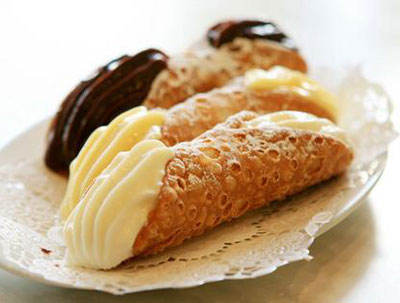
Cannoli are one of Italy's best-loved pastries. The singular is cannolo, meaning "little tube", with the etymology stemming from the Latin "canna", or reed.
Originating in Sicily, these treats start as an oval of pastry wrapped around a wooden dowel or metal tube then deep fried before being filled with ricotta or custard. A sprinkling of icing sugar is usually the final touch, though variations include nuts, chocolate and candied fruits.
The versions with which Americans are most familiar tend to involve variations on the original concept. This is possibly due to adaptations made by Italians who emigrated to the U.S. in the early 1900s and discovered limited availability of certain ingredients. The cannoli sold in Italian-American bakeries today usually still contain ricotta, but mascarpone is a less common alternative. Sometimes the filling is a simple custard of sugar, milk, and cornstarch. In either case, the cream is often flavored with vanilla or orange flower water and a light amount of cinnamon. Chopped pistachios, semi-sweet chocolate bits, and candied citrus peel or cherries are often still included, dotting the open ends of the pastry.
Chocolate Chip–Orange Cannoli
(Cannoli di Ricotta)
Epicurious | November 2008 by Mario Batali
To make this classic dessert, it is essential to have metal cannoli tubes.
There are several secrets to perfect, crisp cannoli:
1). You need the right proportion of filling to shell. In America, cannoli are often too large, with too much filling. These are tiny and delicate, perfect for eating in just a couple of bites.
2). Use high-quality ingredients. Sheep's-milk ricotta is the most traditional, but good fresh cow's-milk ricotta will work fine as well. Be sure to drain it for an hour to avoid watering down the filling. Good-quality candied orange peel is important as well. If you can't find any that's fresh and plump, substitute freshly grated orange zest.
3). Most importantly, don't fill the shells until you're ready to serve them. Both the filling and the shells can be made one day ahead, but to avoid soggy shells, don't pipe the filling into them until the last minute.
If you don't have a pastry bag, a one-gallon freezer bag with the end snipped off can be used to pipe the filling.
Shells:
1 1/2 cups all-purpose flour
1 tablespoon sugar
1 teaspoon unsweetened cocoa powder
1/2 teaspoon ground cinnamon
2 tablespoons chilled unsalted butter, cut into cubes
8 tablespoons limoncillo or other lemon or orange liqueur
Filling:
1 pound (2 cups) fresh sheep's- or cow's-milk ricotta, drained 1 hour in cheesecloth-lined sieve
3/4 cup superfine sugar
1/3 cup miniature chocolate chips
4 tablespoons candied orange peel, chopped, or finely grated zest of 2 oranges
1 teaspoon vanilla extract
To fry and serve:
About 8 cups vegetable oil
1 egg white, lightly beaten
Confectioners' sugar for dusting (optional)
Special equipment: deep-fat thermometer, 4-inch diameter round cookie cutter, 6 (roughly 5 5/8-by-5/8-inch) metal cannoli tubes
Make dough
In medium bowl, whisk together flour, sugar, cocoa, and cinnamon. Using fingertips or pastry blender, blend in butter just until mixture resembles coarse meal. (Alternatively, pulse in food processor.) Drizzle limoncillo over mixture and gently stir with fork until incorporated.
Turn out dough onto sheet of plastic wrap. (Dough will still look somewhat dry and crumbly.) Gather together into ball, wrap in plastic, and refrigerate 45 minutes to 1 hour.
Make filling
In medium mixing bowl, stir together ricotta, sugar, chocolate chips, orange peel, and vanilla. Spoon mixture into pastry bag fitted with 1/2-inch round tip and refrigerate until ready to use. (Filling can be made up to 1 day ahead and refrigerated, covered.)
Form, fry, and fill shells
Cut dough into 4 even pieces. On lightly floured surface, roll out 1 piece to 1/8-inch thick. Using floured cookie cutter, cut out 2 to 3 rounds from dough. Transfer rounds to baking sheet and keep covered with plastic wrap. Roll out remaining dough and cut rounds in same manner, then gather scraps, roll out, and cut again.
Fill heavy 4-quart pot with oil to depth of 3 inches. Heat over moderate heat until thermometer registers 375°F.
Meanwhile, brush bottom edge of 1 dough round with egg white. Wrap dough around 1 cannoli tube with egg white–brushed end overlapping other end and gently press edges together to seal. Make 5 more shells in same manner. (Keep remaining rounds covered with plastic.)
Working in 2 batches, fry formed shells in hot oil until deep golden brown, about 1 minute. Transfer to paper towel–lined plate to drain and cool 5 minutes. Stand tubes upright and tap gently against countertop to loosen shells. Twist molds to remove shells.
Wrap remaining dough around tubes and fry in same manner. (Shells may be made 1 day ahead and stored at room temperature, unfilled and uncovered.)
When ready to serve, pipe filling into 1 end of cannoli shell, filling shell halfway, then pipe into other end. Repeat to fill remaining shells. Dust with confectioner's sugar and serve immediately.
Makes 12 cannoli
Cannoli
Recipe courtesy Emeril Lagasse
Several reviewers complained about a runny filling and suggest straining the ricotta in cheesecloth overnight. Otherwise they were very happy with the results.
Cannoli Shells:
1 1/2 cups all-purpose flour
1 tablespoon sugar
1/8 teaspoon salt
1/2 cup dry Marsala or other dry red wine
2 beaten egg whites
Vegetable oil, for frying
Cannoli molds (tubes for shaping shells during frying)
Cannoli Filling:
1/2 cup heavy cream
1 pound ricotta
1/2 cup powdered sugar
2 teaspoons nut-flavored liqueur
1/4 cup finely chopped candied fruit
1/2 cup melted semi-sweet chocolate
1/4 cup chopped pistachios
Into a bowl sift together the flour, sugar, and salt. With your fingers, work the wine gradually into the dry ingredients to form a stiff dough. Form into a ball, wrap in plastic and let rest at room temperature for 1 hour.
On a lightly floured surface, roll out the dough to 1/8-inch thickness. With a cutter, cut out rounds 5-inches in diameter. In batches, as necessary, wrap each round onto a cannoli mold, sealing the edges with egg white.
In a deep saute pan, heat the oil to 350 degrees F.
Fry the cannoli in batches until just golden brown and crisp, about 2 minutes. Drain on paper towels, let cool, then gently slip the molds from the cannolis. (Note: Shells can be made 3 days in advance and kept at room temperature in an airtight container.)
In a mixing bowl whip the cream. Fold in the ricotta with a rubber spatula, working until creamy. Fold in the sugar, nut liqueur, and candied fruit.
Place 1 cannoli shell on a flat surface. Working from either end, fill the cannoli with the ricotta filling (using a pastry bag, if desired), pressing gently to ensure that the middle is filled. Dip both ends in the melted chocolate, then into the pistachios, and place on a waxed paper lined baking sheet. Repeat with the remaining cannoli, and serve.
Makes 12 - 15
