Sfogliatella
Recipe courtesy Alex Guarnaschelli
Alex begins her recipe by saying, "I could not have made this recipe without the help and tutelage of the Sessa family that runs Ferrara's Bakery here in Manhattan. I grew up eating this pastry at their store and it has been a part of my dessert favorites ever since the first time I ate it. I can remember the first time I bit into this pastry, standing on Grand Street, I felt as if my life had changed. So good. It is difficult to make but really rewarding." In her show, Alex used whole candied oranges and lemons that she bought from an Italian food shop. See Fruit Confits.
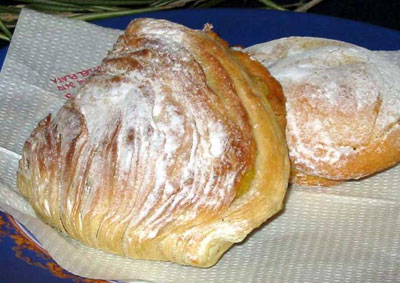 In Italian cuisine, Sfogliatelle (pronounced sfole-ya-'tell-ah) are filled pastries that are shaped like shells or cones. The word "sfogliatelle" means "many leaves/layers," and this describes the dessert fairly well, as the texture resembles leaves stacked on each other. Sfogliatelle are created by rolling out dough very thin and slathering it with shortening (or, more authentically, strutto - rendered pork fat). The dough is then carefully rolled up (like a jelly roll), which creates the many layers. It is then cut into thin discs. The center of the disc (which looks like a roll of ribbon) is pushed out to make room for a pocket of filling. The filling is usually orange-flavored ricotta. Sometimes, other fillings, such as almond paste, can also be used for a different taste. A common additive is citron. The dough is sealed around the filling, and the pastries are then baked in a special way to make them crispy on the outside and to give them their characteristic ridges as the layers of dough separate.
In Naples, sfogliatelle is sometimes called "sfogliatella riccia" ("curly") to distinguish it from "sfogliatelle frolla", a less refined pastry which uses a shortcrust dough that does not form the more labor intensive authentic sfogliatelle dough's characteristic layers. Italian-American bakeries, especially in the New York City area, created a cousin pastry to the sfogliatelle in the 1900's called a "lobster tail." The pastry has the same outside as a sfogliatelle, but instead of the ricotta filling, there is a french cream, similar to that of a whip cream inside.
Then there is Sfogliatella Santarosa. Slightly larger than a traditional sfogliatella, it is filled instead with a crema pasticcera and garnished with a bit of crema di amarene (sour black cherry). This creamy pastry holds the key to how the sfogliatella as we know it today was born. As it turns out, this luxurious and rich dessert was created in a monastery. If we go back to the 1600s, to the Monastery of Santa Rosa tucked high up in the mountains in the small village of Conca dei Marini on the Amalfi Coast, we find a story of a nun working away in the kitchen one day. By chance she created a pastry that became well-known in the surrounding community as la Santarosa, named after the monastery. The cloistered nuns retained this special recipe, and it wasn’t until the 1800s that a man by the name of Pasquale Pintauro in Naples got his hands on one of these pastries from Conca dei Marini. He created his own version filled with a rich fruit and cinnamon-infused ricotta mixture, and the sfogliatella as we know it today was born.
Dough:
2 cups all-purpose flour
1 cup semolina flour
1/8 teaspoon kosher salt
1 cup unsalted butter, chilled and cut into small cubes
1/2 cup water
1/4 cup shortening
1 egg, beaten with 1 tablespoon water, for egg wash
Confectioners sugar (about 1/2 cup)
Filling:
1 cup whole milk
1/4 cup semolina flour
1 cup ricotta cheese
1 egg
1/4 cup granulated sugar
2 tablespoons finely chopped mixed candied orange and lemon bits
Ground cinnamon, for dusting
2 nonstick baking sheets
In a large bowl, sift together the all-purpose flour, the semolina flour and salt. Use your fingers to work the butter into the dough until it forms pea-like balls. Alternatively, sift the dry ingredients into the food processor and pulse the butter into the mixture until it is blended and relatively smooth. Work the water in with your fingers (or in the mixer). Turn the dough out onto a flat surface and roll it into a ball. Wrap it in plastic wrap and press it down. Refrigerate for at least 1 hour.
In a medium saucepan, bring the milk to a simmer. Whisk in the semolina flour and cook, stirring constantly with a wooden spoon, until the mixture thickens, 3 to 5 minutes. If it forms lumps as it cooks, whisk until smooth. Transfer the milk and flour mixture to a bowl to cool slightly, about 10 minutes. Stir in the ricotta, the egg, sugar. Add the candied orange and lemon bits and sift a dusting of cinnamon over the surface. Stir to blend. Taste for seasoning and refrigerate until ready to use.
Remove the dough from the refrigerator and divide in half. Flour a flat surface and roll 1 of the halves into a rectangle about 14 inches by 24 inches. The shorter end of the rectangle should be close to you. The dough should feel very thin. The thinner the better! Brush the entire rectangle with a layer of the shortening. Sprinkle it with an even dusting of confectioners' sugar. Gently and evenly roll it up into itself like a jelly sponge roll. Roll carefully, taking care that it rolls up very tightly. Refrigerate for at least 2 hours. Use a sharp knife to cut the roll into 1 to 1 1/2-inch thick pieces. Repeat the same process with the other half of the dough.
Preheat the oven to 375 degrees F.
Put 1 of the dough rounds in your hand and, with the other hand, press your thumb into the middle of your other hand (and, therefore, into the dough) and start to stretch the dough. You don't want to push so much that you make a cavity just yet. First, concentrate on making the dough round bigger and flatter. When it is about the size of a large clam shell, start to smooth and push down in the middle so it forms a cavity a lot like a large clam shell. You want to finish with a cone with an opening of about 3 inches and the smaller, tapered end about 1-inch. Brush a little shortening on the dough and turn it inside out, cupping the dough cone between the length of your index finger and thumb. Carefully spoon 2 large spoonfuls of the filling into the cone. The cone should be fairly filled and go to the edges of the opening with a thin layer of the filling. Close the mouth by carefully folding the cone opening over itself. The same as if you had 2 halves of a clam shell and were closing it up. Gently press the edges of the opening, together. Arrange on a nonstick baking sheet. Repeat with all of the dough, until both of the baking sheets are filled. Brush each with the egg wash.
Cook's Note: The Sfolgliatella can be frozen, at this point, and baked, as needed, at a later date, if desired. In fact, they bake better when baked from their frozen state.
Put the trays in the center of the oven and bake until golden brown, 30 to 35 minutes. Remove from the oven and allow them to rest a few minutes on the baking sheet.
After the Sfogliatella have rested for a few minutes, sprinkle them with another dusting of confectioners' sugar and put each baking sheet squarely under the broiler. Do not walk away! Stay there and watch as the sugar slowly browns the top. If the layer of sugar was light and you want to make it a little browner, repeat with another dusting of sugar and another minute under the broiler. Allow them to rest a few minutes, then transfer them to a serving platter, dust with confectioners' sugar and serve.
Yield: 15 to 18 pastries
