Detroit-Style Pan Pizza
By J. Kenji López-Alt, https://www.seriouseats.com/
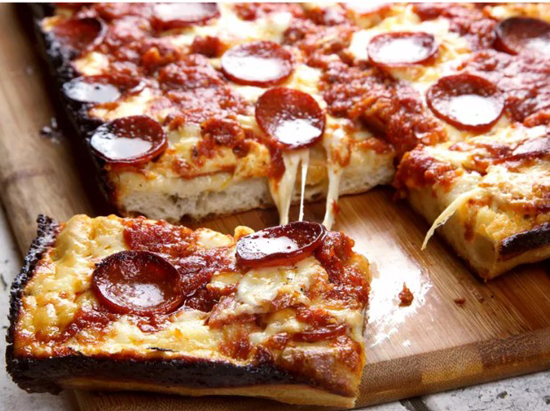
When did Detroit pizza become a thing? I mean, I know that rectangular pan pizzas have been served in the Motor City since at least 1946, when, according to PMQ Pizza Media, bar owner Gus Guerra and his wife, Anna, decided to throw a batch of her mother's Sicilian dough into a blue steel pan, originally used to carry auto parts, and bake it with cheese and sauce. The pizza emerged with a blackened, lacy, crispy cheese crust all the way around the edges, and a new pizza style was born. Buddy's, the restaurant opened by the Guerras, has been serving it ever since.
What Is Detroit-Style Pizza?
Let's start from the bottom and work our way up: The crust comes out crisp and golden on the bottom, with a lightly fried texture that it gets from sizzling in the rendered fat that drips down from the cheese. Next, we move on to the crumb, which is chewy, with a medium-fine bubble structure. Not so rustic as, say, a focaccia, but not quite as soft and fluffy as a New York–style Sicilian slice.
Above that is where things get a little topsy-turvy. Instead of using the "sauce, cheese, toppings" order of a typical pizza, Detroit pizzas are built in reverse. Creamy, tangy brick cheese from Wisconsin is cubed and applied directly to the top of the dough, where it bakes up gooey, buttery, and thick in the middle, crispy and dark brown around the edges. On top of the cheese is a sweet, thick tomato sauce, seasoned with plenty of garlic and spices and often applied in heavy parallel bands. If you order the pizza with pepperoni (the most common topping), depending on where you are, you might find it cupped and crisp on top of the sauce, or, occasionally, buried underneath the cheese, where its flavor seeps in and penetrates every bite. It's crispy, fatty, cheesy, tangy, and glorious, especially those coveted corner pieces that give you that extra crunch.
[Kenji experimented quite a bit with doughs. Detroit pizza uses a different dough than a New York style pizza does. It is thicker and chewier. Finally . . .] Swapping out that all-purpose flour for bread flour was the real key, producing a crumb structure that was relatively open and chewy, but still squarely on the Detroit pizza end of the scale as opposed to the focaccia end.
Detroit pizza is unusual in two ways when it comes to cheese. The first is the use of brick cheese, a high-fat aged cheese from Wisconsin with a uniquely tangy, salty, buttery flavor that's hard to replace with alternatives. The second is the edges. If you've ever been to Pequod's or Burt's Place in Chicago, or, better yet, had a pizza from Windy City Pie in Seattle, then you're familiar with the concept of a crispy, blackened cheese crust—the shelf of crisp, lacy cheese that surrounds the edge of the pizza. This is where the real magic of Detroit-style pizza lies, and, as I found out, getting it is not exactly straightforward.
Swapping out that brick cheese for a different cheese turned out to be surprisingly difficult. Not only does brick cheese have its own flavor, it's also extremely high in fat, which is important. As that butterfat drips down into the pan, it fries directly into the crust. Many people note that Detroit pizza has a buttery flavor despite containing no butter at all; that flavor comes from the brick cheese fat. I tried sliced and cubed low-moisture mozzarella and young, soft Jack. I even gave havarti a go. In the end, the closest substitute I could find was a 50/50 mix of low-moisture mozzarella (which provides some of that clean, buttery dairy flavor) and Jack (which has plenty of fat and also tanginess).
Unlike a typically sparse Neapolitan- or New York–style pizza sauce, Detroit-style pizza sauces are usually heavily seasoned with aromatics. My sauce was tasty, but it was still missing something. I'm generally a "fresh garlic all the way" type of guy, but I couldn't shake the feeling that granulated garlic powder might be that missing element. Turns out I was right. Adding a small dash of granulated garlic and granulated onion, along with a bit of sugar, was the key. Now, I know from experience how uncomfortable people can get about sugar in their tomato sauce, so I'll tell you right now: I don't care. If putting sugar in tomato sauce offends you, by all means, keep it sugar-free.
For the Dough:
300 g bread flour (10.5 ounces; about 2 generous cups)
5 g instant yeast (0.15 ounce; about 1 teaspoon), such as SAF Instant Yeast
9 g salt (0.3 ounce; about 1 1/2 teaspoons table salt or 1 tablespoon Diamond Crystal kosher salt)
220 g water (7.75 ounces; about 1 cup minus 1 1/2 teaspoons)
Extra-virgin olive oil, as needed
For the Sauce (you will use only half of this for the pizza):
2 tablespoons (30 ml) extra-virgin olive oil
3 medium cloves garlic, minced
2 teaspoons (about 5 g) dried oregano
Dash red pepper flakes
1 (28-ounce; 800 g) can high-quality crushed tomatoes
1 teaspoon (about 6 g) granulated garlic powder
1 teaspoon (about 6 g) granulated onion powder
1 tablespoon (about 15 g) sugar
Kosher salt, to taste
To Finish:
12 ounces (340 g) brick cheese, cut into 1/2-inch cubes
12 ounces (340 g) high-quality natural-casing pepperoni, such as Boar's Head or Vermont Smoke & Cure, cut into 1/8-inch slices (optional)
To Make the Dough in a Stand Mixer: Combine flour, yeast, and salt in the bowl of a stand mixer fitted with a dough hook attachment. Stir to combine, then add water. Mix on low speed until dough comes together into a rough ball, then shut off mixer and let rest for 10 minutes. Continue mixing at medium-low speed until dough forms a smooth, silky ball, about 10 minutes longer. (It should stick to the bottom of the bowl as it kneads rather than riding around the edges.) Remove dough hook, form dough into a tight ball, set in the bottom of the mixer bowl, cover tightly with plastic wrap, and set aside in a warm place until dough has roughly doubled in volume, about 2 hours.
To Make the Dough by Hand: Combine flour, yeast, and salt in a large bowl. Whisk to combine, then add water and stir with a wooden spoon until a rough ball of dough has formed. Set aside for 10 minutes. Turn dough out onto a countertop and knead until a smooth, silky ball has formed, about 10 minutes. Transfer dough to a bowl, form a tight ball, cover tightly with plastic wrap, and set aside in a warm place until dough has roughly doubled in volume, about 2 hours.
Pour a couple tablespoons olive oil in the bottom of a Detroit-style anodized aluminum pan or two 8- by 8-inch cake pans. (Split dough in half if using cake pans.) Transfer dough to pan(s) and turn to coat in oil. Press down on dough and spread it toward the edges. You won't be able to get it all the way to the edges; this is okay. Spread it as much as you can without tearing, then cover tightly in plastic and set aside for 30 minutes to allow dough to relax. Return to dough and stretch it out again. It should be able to reach the edges this time. If not, let it rest a little more and try again. To get the dough to stay in the corners, stretch it up beyond the corners so that it pulls back into place. Once dough is stretched, cover again and set aside while you make the sauce.
For best results, use a Detroit-style anodized aluminum pan. If you can't get your hands on that kind of pan, you can split the recipe into two square 8- by 8-inch cake pans.
For the Sauce: Adjust oven rack to lowest position and preheat oven to 550°F (290°C), or as close to it as your oven gets. Heat 2 tablespoons (30ml) olive oil in a medium saucepan over medium heat until shimmering. Add minced garlic, oregano, and pepper flakes and cook, stirring, until fragrant, about 30 seconds. Add tomatoes, garlic powder, onion powder, and sugar. Bring to a simmer and cook until reduced to about 3 cups, about 30 minutes. Season to taste with salt.
To Form the Pizza: Press down on dough with your fingertips to remove any large air bubbles. Lay half of pepperoni (if using) evenly over face of dough. Top with cheese, spreading it evenly all the way to the very edges of the pan, then add remaining pepperoni. Spoon sauce over surface in 3 even rows. (You will need only about half the sauce—save the rest for another pizza.)
Transfer to oven and bake until edges are black and bubbly and exposed cheese on top is starting to lightly brown, 12 to 15 minutes. (If your oven doesn't cook well from the bottom, consider placing the pizza directly on the oven floor.) Transfer to a trivet or folded kitchen towel on countertop.
Run a thin metal spatula all the way around the edges of the pan to loosen the pizza. Carefully lift it out and slide it onto a cutting board. Cut pizza and serve.
4 servings, Detroit-style 10- by 14-inch anodized aluminum pan or two 8- by 8-inch cake pans
