Thin & Crispy Pizza
from https://www.pizzamaking.com/
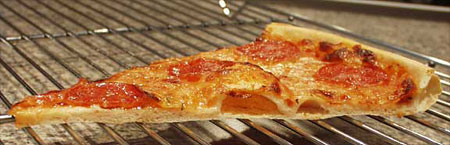 The thin-crust type of pizza is officially known as an "Original California-Style" pizza and is also found at such restaurants as Straw Hat and Round Table. To quote the folks at Straw Hat, "California crust is special, it's a layered, flaky crust. It's airy and crispy on the bottom, yet bubbling on top. It has a cracker-like crunch, and is never soggy or limp."
The whole concept of the thin crust is more than just the flour or dough recipe, it is the method of sheeting the dough into the pizza pan. Most restaurants employ the use of a special machine known as a dough sheeter (or roller) which rolls out the dough quickly and evenly. They typically run the dough through the sheeter about 5 or 6 times, dusting the dough with flour each time, to get it down to the paper-thin thickness. The function of the dusting flour is to actually incorporate more flour into the dough during the sheeting process. The dough is typically short a little flour in the mixing process so that it will sheet easier, so the dough reaches its final flour content during the dusting and sheeting process.
3½ cups all purpose flour (use all purpose for a more tender crust)
3/4 cup water,
90 °F
3 1/2 teaspoons vegetable oil
1 1/2 teaspoon sugar
1 teaspoon salt
1 1/2 tsp. active dry yeast
Stand mixer instructions: Pour 75% of the water and all of the oil into the mixer bowl. In a second bowl, mix the yeast with the remaining water and allow to proof for 5 minutes. In the mixer bowl, add the flour, salt, sugar, and the yeast mixture. Mix on slow speed for 10 minutes. Note: Because the dough is very dry, it will not form into a cohesive ball; rather it will be loose and scrappy with some raw flour left unincorporated.
Food processor instructions: Place all of the ingredients into the bowl of a food processor fitted with its steel cutting blade. Process for approximately 30 seconds until everything is thoroughly mixed and the dough resembles moist cornmeal. Empty contents onto a work surface and, using your hands, press the mixture into a dough ball.
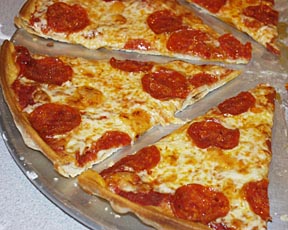
Rising: After proper mixing, the dough will be very stiff. Place dough into a sealed bucket and allow to rise for a minimum of 9 hours at room temperature. Dough can be held [in refrigerator?] and used for up to 18 hours after the initial 9 hour rise.
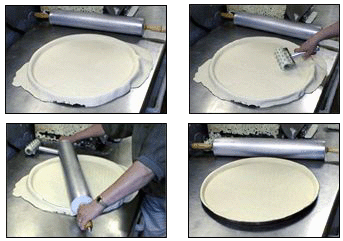
Sheeting: The dough must be sheeted into a cutter pan (see glossary below) prior to use. A rolling pin may be used in the absence of a dough sheeter. Please note that the dough will be very stiff and will be difficult to roll by hand. Sheet dough to approximately 1/16˝ thickness.
[Instructions from another recipe: Turn the dough out onto a large surface and dust with flour. Using a heavy rolling pin (or dough sheeter), roll the dough out very thin to form a 24-inch or larger circle. If you're using a cutter pizza pan (recommended), dust the pan lightly with flour, place the dough in the pan and dock (see glossary below). Use the rolling pin to trim off the excess dough drooping over the sides of the pan. If you wish to cook the pizza directly on a pizza stone (not using a pan), then place the dough on a dusted pizza-peel, dock, and fold the edge over 1-inch all the way around and pinch it up to form a raised lip or rim.]
Pizza Preparation: Place sheeted dough over a lightly oiled cutter pan, press into place, and dock. Use a rolling pin to trim off the excess dough draping over the side of the cutter pan. Apply sauce, shredded cheese, and toppings. [Go light on the toppings - the crust is thin and cannot hold a lot of heavy toppings.]
Baking Instructions: Bake in a preheated 475° F oven for approximately 10 minutes until crust is crisp and golden brown.
GLOSSARY
Sheeting: The act of rolling dough into a very thin and uniform sheet. Most commonly performed using a specialized machine known as a dough sheeter or dough roller. A rolling pin may also be used, but this technique can be slow and labor-intensive.
Docking: The act of poking numerous holes into a pizza skin immediately prior to topping which helps prevent large air bubbles from forming in the crust during baking. Usually performed using a specialized tool called a dough docker. Can also be performed using a fork.
Cutter Pan: A circular solid or perforated metal pan with sloping sides and a sharp exposed outer edge for permitting a rolled out or sheeted dough that has been draped over the sharp edge of the pan to be cut to fit the pan by rolling a rolling pin over the dough and pan.
